Josh Spector

Your Comedy Career Is A Startup Company (Podcast Ep. 59)

On the “pre-Oscars lunacy” episode of the podcast, Jordan Cooper and Josh Spector look at tech startups as an example of how you should approach your comedy career, experimenting with different online platforms to find ones that suit your strengths, developing the culture of your audience, being obsessed with continually learning, and how everything you do on and off stage is your “product.”

Plus, we take questions involving marketing a humor book, connecting with comedy bookers by providing value and repurposing your online content for multiple platforms.

[powerpress]

Have a question you’d like us to answer on the next episode? Submit it now through this form.

Participate with the community in our Connected Comedy Facebook group.

If you enjoy the podcast, please rate and review it on iTunes.

Links from this episode:

Ben Rosenfeld
Russian Optimism
The Morning Dump w/ Jordan Cooper
One Is Greater Than Zero
@CuriousBigDaddy on Twitter
Medium
@CrankyRicky on Twitter
Why Your Obsession With Getting Booked Is Actually Hurting Your Career
Jab, Jab, Jab, Right Hook – Gary Vaynerchuk
The #AskGaryVee Show
Gary Vaynerchuk on Twitter
How To Pitch Your Content To Other Websites

How To Pitch Your Content To Other Websites

I get asked all the time how best to approach other blogs and websites to get them to feature your newest video, blog post, or podcast episode.

There’s no one size fits all answer to that question, but there are definitely some strategies that can increase the chances other sites will share your stuff with their audiences. Here’s an overview of some things you’ll want to keep in mind and some tactics you can try…

You Have To Make Something Good

This should go without saying, but I’m going to say it anyway because it’s really the most important thing. If you don’t create something good in the first place, it doesn’t matter how many strategies you use because nobody is going to share something that’s not good with their audience.

Making something good is a prerequisite – it’s not optional.

Now, assuming you’ve created something good, let’s move on to how you can approach websites to get them to share your stuff…

Go After The Right Audience

The first thing you need to do is identify the right targets. Think about what your content is about and which audiences are most likely to enjoy it, then find sites that cater to those audiences.

For example, if your video is about being a parent, then find popular parenting blogs. Or if your podcast is about life in Chicago, then reach out to local blogs about Chicago.

If you do a funny show about life in Chicago, don’t bother pitching it to a national comedy blog because the majority of their audience isn’t going to care about what’s happening in Chicago.

The more the audience of the websites you target matches the topic of your content, the more likely they will be to share your stuff.

Understand What’s Actually Best For You

It’s easy to get confused about what your actual goal is when you approach a website to share your newest creation. Most people tend to focus on that single piece of content and getting it featured on other sites – but that’s short term thinking.

You’re always better served thinking about the long term. In this case, that means what you really want is to develop a relationship with other sites that can last beyond just the single posting of that single piece of content.

There’s lots of different ways to build relationships and I’ll go into some of them later in this article, but for now just recognize that what ultimately will benefit you most is a relationship with these sites and not just a one-off favor.

Become A Part Of Their Community

Rather than just Googling some sites and blind-emailing them to ask that they share your stuff, you’ll be better served to become a part of their communities first.

Comment on their posts, share their articles on social media, interact with them on Twitter or Facebook – all BEFORE you ever actually pitch them your own content.

Doing this will get them familiar with you and who you are so that when you eventually reach out to them, they will already recognize you as a fan and active member of their community. They’ll be predisposed to think better of you and more likely to help you out.

The other benefit of this is that you wind up learning more about the sites you hope to pitch, you’ll understand their community, what kind of content they share and how best to position what you’ve created to fit their interests.

Offer To Help THEM Instead Of Asking Them To Help YOU

This may seem counterintuitive, but it works – and it’s also helpful for people who are uncomfortable promoting themselves.

Instead of emailing the people who run a website and asking them to share your new content, offer to create some content for them for free. You can let them know you’re a fan of their site and that you’d be willing to write some guest posts or make some videos for them if they’re interested.

Every website struggles to churn out content on a constant basis and many of them will be open to having somebody else contribute content for them (again, as long as it’s good).

And remember, what you’re really after is exposure to their audience – it shouldn’t matter whether the video you make lives on your YouTube channel or theirs, or whether the post you write lives on your website or theirs. As long as you get credit for it and a link where people can learn more about who you are, it’s valuable.

The other thing this does is start to form a relationship for you with the site which goes back to the initial goal of thinking bigger than just exposure for a single piece of content you created.

Offer To Give THEM Attention Instead Of Asking For Attention

Here’s another trick that almost always works. Instead of asking them to write about you and share your content, ask the people that run the website if you can interview them and tell your audience about them and their site.

No matter how small your own audience may be, just about anybody will be flattered that you want to interview them and will likely say yes.

Remember – they want attention for their creations every bit as much as you want attention for yours.

When they agree to be interviewed, this does a couple things. It starts a relationship for you with them that can potentially make them more likely to feature your content on their site down the road. And when you post the interview with them on your website or YouTube channel, they will most likely share a link to it with their audience.

So basically, you’ve managed to get them to drive their audience into your world without even having to ask them to.

The other great thing about this strategy is that you can easily scale it. For example, if you want a bunch of punk music blogs to tell their audiences about you then you could set up a series of Punk Music Blogger interviews and reach out to all those blogs to interview them.

It gives you an easy excuse to reach out and build relationships with all of them, with each then likely linking to your interview with them.

Ask Like A Real Person

Whether you choose to try any of the above strategies or just want to simply reach out and ask a site to share a single thing you’ve created, make sure that you ask like a regular person and not try to be overly formal.

Just email the person that runs the site, tell them you’re a fan of their site (which you should be since you hopefully have been reading it for a while before you reach out), explain who you are, and send them the content you think they (and, more importantly, their audience) will like.

Don’t try to make yourself sound like some kind of comedy superstar, don’t pretend to be a publicist, don’t act like your video is going viral when it isn’t, just be a regular person.

Or at least as close to a regular person as you’re capable of being.

And if they actually post it? Don’t forget to say thanks and share the link on all your social channels.

Good luck!

READ THIS NEXT: 5 Free Ways To Get More People To See Your Facebook Posts

5 Things You Can Learn From Vine Star King Bach

With more than 10 million followers, King Bach has become one of the most popular comedians on Vine.

In a recent appearance on The Champs podcast, he talked about how he got started on Vine, what he did before Vine that helped prepare him for success, and even broke down how he makes money from 6-second videos.

You can listen to the full episode here, or read up on some of the highlights below.

1. Overnight Success Is A Long Time In The Making

There’s a misconception that when stars emerge on a new platform like Vine that those people became instant sensations. But usually, those people have actually been developing their skills long before those platforms even formed.

At around the 7-minute mark, King Bach reveals that was the case for him. His original plan was “to be the biggest movie star ever created,” so he had gone to film school, experimented with YouTube videos, and put in a lot of time learning how to act and perform comedy.

One specific experience that turned out to be perfect training for his Vine work in retrospect was a college sketch group he was a part of called “30 in 60.” The concept was that they performed 30 sketches in 60 minutes, which basically taught him how to create quick jokes and premises.

2. You Have To Create Your Own Opportunities

At around the 29-minute mark, King Bach explains what led him to start putting content online in the first place – he saw YouTube as a place where he could get seen.

“I did it to show directors, producers, and casting directors that I could act because I couldn’t get any auditions,” he says.

3. Don’t Quit, But Be Willing To Adapt

At around the 49-minute mark, King Bach talks about how he made the transition from YouTube to Vine. He only joined Vine in May of last year, but had been posting videos to YouTube since 2008.

The transition was prompted by a realization – he was getting about 10,000 views max on his YouTube videos and spending as much as $3,000 per video he produced.

But on Vine, he realized he could just shoot the videos with his phone bringing his costs down and increasing the volume he was able to produce.

4. You Can Make A Living From Vine…

At around the 41-minute mark, he breaks down some of the economics of how he’s monetizing his Vine account. He says he’s able to make a good living off Vine primarily by incorporating product placement into his videos.

But he points out that the key is to not make it feel like an ad. “I don’t make it look like an ad – I just put a hashtag on it,” he says.

Since there’s no traditional advertising on Vine, King Bach doesn’t get paid anything for just getting views on his videos, though he is able to collect advertising money from when they get illegally uploaded to YouTube on other people’s channels where ads do run against them.

5. …But It Takes A Big Audience To Do So

At around the 46-minute mark, King Bach shares some of the economics of his Vine videos and reveals that he’s making a lot more than just “a living” from them. He says he’s getting paid between $30,000-$60,000 for each 6-second video that includes a brand or product placement in it.

Those are big numbers, but keep in mind he’s got more than 10 million followers at this point. He says that agencies started contacting him with opportunities once he had 3 million followers, but at this point he mostly deals directly with the brands themselves when it comes to product placement.

READ THIS NEXT: How To Decide Where To Post Your Comedy Videos

Little Things Make Big Differences (Podcast Ep. 58)

On the “we’re not dead” episode of the podcast, Jordan Cooper and Josh Spector talk about the importance of a mobile-optimized website, how expected traffic sources influence the way you should design your website, creating ways to measure performance and results so you can improve what you are doing, and understanding the audience you should target for a specific piece of content (it’s not “comedy fans”).

In addition, Jordan shares what he’s learned the past year doing three different weekly podcasts, developing content as a proof of concept for something bigger, and we answer listener-submitted questions on reaching college markets without NACA, press releases & getting coverage for yourself and the prospects of “making it” just doing live stand-up performances.

[powerpress]

Have a question you’d like us to answer on the next episode? Submit it now through this form.

Participate with the community in our Connected Comedy Facebook group.

If you enjoy the podcast, please rate and review it on iTunes.

Links from this episode:

Google Analytics – Web Analytics & Reporting

Blenderhead Podcast

Tech Douchebags – 5by5

Internet Outrage Machine – 5by5

Transmission – Goodstuff FM

Tony Deyo – YouTube

How Do You Bend An iPhone?

Trust Me, I’m Lying: Confessions of a Media Manipulator

Comedian asks: ‘Do you want to laugh at the crippled girl?’

What I Learned From The Book Contagious: Why Things Catch On

Help A Reporter Out

PewDiePie – YouTube

The 20 Most Popular Connected Comedy Articles Of 2014

The 20 Most Popular Connected Comedy Articles Of 2014

2014 is officially history, but it’s never too late to look back and learn from the articles I posted over the course of the year. Thanks to all of you for reading, sharing, contributing, and being a part of the incredible Connected Comedy community that has developed over the past few years – I appreciate it more than you know.

Below is a breakdown of the 20 most-read posts on the site last year with some brief excerpts of each.

And if that’s not enough to keep you busy, go ahead and check out what were my most popular posts in 2012 and 2011.

20. Case Study: How I Got Facebook Fans And Website Traffic For A Comedian

In determining who to target, you always want to go as specific as possible – the more specific you get, the better the ad will perform. Also, you want to think about what the content is about as opposed to what you (or your website) are about.

19. 5 Things You Can Learn From B.J. Novak’s Appearance On The Nerdist Podcast

“That’s what makes the difference,” he said. “One guy after another kills on stage, but with most of them you don’t feel like you need to know who they are.”

18. 5 Things You Can Learn From Canada’s Biggest Comedy Club Owner

“Don’t hang out with other comics,” he says. “Go to the theater, art galleries, music. [An original voice] doesn’t come from watching comics and imitating them.”

17. 5 Things You Can Learn From Jim Norton

“George Carlin had anger, but look how silly a lot of his delivery was. He let his words talk for him and let the audience come with him…or not. He led them with logic instead of doing the emotional work for them.”

16. 7 Simple Ways To Get More Out Of Twitter

It’s a good idea to post important tweets multiple times during the day/week to ensure that more people see it. Stats have proven you’ll get just as many clicks/interactions the second or third time as you do the first and sometimes more.

15. How To Use A “One-Action” Strategy To Activate Your Audience

What you’ve likely lost sight of in the midst of your hustle is that multitasking is a myth. In reality, people don’t take multiple actions at once, they take one single action at a time.

14. 7 Things You Should Know About The Houston Comedy Scene

The crowds range from extremely diverse to extremely homogenous depending on what side of town you’re on. Houston’s strongest comics tailor their material, with minor tweaks, to work in front of whatever audience they’re performing for that night.

13. 7 Things You Can Learn From Dave Foley Of Kids In The Hall

“The audience has to understand the logic of the joke and if you can’t convey that logic in a concise way, it’s not going to work. You must understand that the people hearing the joke are not in your head – they don’t know your back story to your joke. Their entire universe exists from what you write down and if you don’t have the information in the joke, no one is going to get it.”

12. 5 Things You Can Learn About Comedy Promotion From Steve Hofstetter

“If you do something you wouldn’t have done, because of the money, you’re a sellout. If you take money for doing what you love already, you’re just selling. You’re not selling out,” he says.

11. 5 Things You Can Learn From The Colbert Report’s Head Writer

He explains that a comedy career isn’t like becoming a doctor where you study pre-med, go to medical school and follow a clear path. Because there is no clear path to it, he suggests that you have to be willing to work hard and try everything you can to put yourself into a position where you can get opportunities.

10. The Best Audience For An Unknown Comedian To Connect With

It’s one thing to be funny, it’s another to be interesting. Funny is the minimum, but the way to really connect with people on a more long-term level is for them to become interested in you. There’s no one way to do that, but if you think about it, most comedians that build large, passionate, fanbases have done so with more than just their ability to make people laugh.

9. 5 Things You Can Learn From Adam Carolla On The Solopreneur Hour Podcast

Carolla explains that early on in his career he realized he was not going to be the kind of person who was going to just nail an audition and land a gig. He realized nobody trusted him or thought he was anything special. Taking that into account, he decided early on that if he was going to succeed, he was going to have to create his own vehicle.

8. 7 Things You Can Learn From Manager/Producer Barry Katz

“There’s no way you can’t make money in this business if you get up every morning at six and work till two on your craft and do everything in your power to,” he says. “The only way you can’t make it is if you’re self destructive, doing drugs; if you’re lazy, if you have a sense of entitlement, or if you’re mean or disingenuous.”

7. How 5 Successful Comedians Used Their Websites Before They Got Famous

With a little help from the Internet Archive, I thought I’d go back in time and show you some of the things that today’s biggest comics were doing years ago – when both their fanbases and the Internet audience as a whole was a fraction of what it is today. It’s a good reminder that success online doesn’t happen overnight and that most comics who have made it were putting in work years before you may have realized it.

6. 7 Things You Should Know About The New York Comedy Scene

New York is a very safe place to fail. You can do all manner of crazy stuff here. If it works, everyone thinks you’re wonderful. If it doesn’t, no one cares and it’ll be forgotten about next week. So swing for the fences.

5. 10 Lessons From A Comedian’s First 500 Days In Los Angeles

Sure, open mics are great, especially when you’re starting out, but I think it’s important to make sure you’re getting what you want out of these nightly segments. Think about what you can do with that four-hour stretch rather than just conforming to this idea that “more open mics = better comedian.”

4. 5 Things You Can Learn From Gabriel Iglesias

Early on he also made a conscious decision to maintain a consistent look – in his case it involved shorts and a Hawaiian shirt. He explains that it’s tough enough for people to remember specific comics in general, but comics who constantly change their look only make it harder on themselves.

3. 10 Things You Should Know About The San Francisco Comedy Scene

The audition process starts with the Sunday Showcase at the Punch Line. You purchase a punch card, show up for a year, and then get your chance to do five minutes. If that goes well, you get back up in three to six months, eventually graduating to off-night Cobb’s showcases and an audition if all goes according to plan. If you pass your audition, you’re added to the rotation of openers, which currently numbers around 70.

2. 5 Things You Can Learn From Comedy Central’s Head Of Talent

Larsen explains that advertising sales are ultimately what runs a TV network and that “controversy is not a good thing to sell advertising.” This means if you want to get on TV, being unnecessarily blue or racy will hurt your chances. He also discusses the importance of continuing to create new things even after you get a break or some exposure. He hates having an opportunity spring up for a person, only to have them not prepared to go with new material from the last time they got their shot.

1. Louis CK and Doug Stanhope Discuss Being A Healthy Comedian On A 2005 Message Board

I don’t mean looks, I don’t
 mean weight.  I maintain a pretty good belly.   I just mean getting
 yourself ready, steeling yourself, improving your abilities and 
strengths as a person. Given the odds of making it as a comedian, I am amazed at how little 
effort so many comedians make, while complaining bitterly about their 
lack of breaks.  I mean, you should be thinking like an olympic athlete 
but you think like dorito-eating high school brats, doing nothing and
 expecting everything.

Thanks again for making this a great year for Connected Comedy – can’t wait to see what comes in 2015!

How To Share And Tag Your Way To More Influential Twitter Followers

Everybody always wants more Twitter followers, but few people actually implement one of the simplest strategies to attract them.

I’ve gained a few new particularly influential followers of my personal Twitter account in the past couple weeks and thought I’d share how that happened. It’s a simple tactic that can be done by anybody and while it doesn’t work 100% of the time, it works often enough to make an impact on your Twitter success.

It’s a ridiculously simple two step process:

Step 1: Every time you come across something interesting, tweet a link to it or reference it in a tweet and recommend it to your followers.

Step 2: Look to see if the person who created it has a Twitter account, and reference their account name in the tweet you post, giving them credit for what they created.

That’s it. I know it seems obvious, but it’s amazing how few people actually do this and it really works.

What winds up happening when you do this is that the person you tagged in the tweet inevitably gets a notification when you’ve mentioned their name and it leads them to check out your tweet and your account.

Because you’ve sent some attention their way, they will likely be appreciative and usually will either favorite your tweet (good for you), reply to your tweet (better for you), retweet it (even better for you), or follow you (the best for you in the long term).

This can be a powerful tool not only because it can attract attention from more people to your tweets, but also because it allows you to target specific influential people who you might want to know that you exist.

For example, if there’s a booker, or journalist, or YouTube star that you want to be aware of you then look for opportunities to share things they’ve created and tag them in the tweets.

Here’s a few examples of tweets I’ve recently posted where I did this and what came of them.

Example 1: Drew Curtis and Fark

After listening to a recent episode of the James Altucher podcast in which he interviewed Fark founder Drew Curtis, I posted the following tweet.

Sure enough, Drew Curtis saw the tweet and retweeted it to his 12,000 followers. On top of that, the Fark account (with 25,000 followers!) also retweeted and favorited the tweet. Fark also followed me, which was great considering they only follow about 700 people at this point and hypothetically have the opportunity to share future things I post with a lot of people.

This reminds me of one more suggestion related to this. As a general rule, you’re better off tagging the individual author of an article as opposed to the publication because that person is more likely to see it than the overall publication.

For example, if you share a Buzzfeed article you’ll want to find the Twitter account of the author of that article instead of (or in addition to) just tagging @Buzzfeed.

Example 2: Gary Vaynerchuk

After reading an interesting blog post from Gary Vaynerchuk, I decided to share a link to it and reference Gary in the tweet. Here’s what I posted:

Sure enough, Gary wound up seeing that I had mentioned him, replied to my tweet and followed me. He’s following about 7,000 people, but I’m still honored to be in the mix and be followed by a guy with over a million followers and one of the leading voices in the world when it comes to digital marketing.

Example 3: Four Bands

I wrote a simple post on my blog highlighting a few songs from newer bands that I had recently discovered and decided to tag the bands when I shared a link to the post on Twitter. Here’s the tweet:

Sure enough, three of the bands favorited the tweet, one retweeted it, and one of them followed me.

The Point Is…

While these three examples are certainly random and they’re not the kind of thing that is suddenly going to catapult your career, the point is that there are really easy opportunities to get people’s attention and start building connections that can directly add value to whatever you’re trying to do.

The next time you come across something interesting in your travels, take a moment to share it on Twitter and take another moment to tag the person who created it in your tweet. Do that consistently and you’ll be surprised at what can happen.

And if you want to try it out, why not go ahead and tweet this article and tag me?

Case Study: How I Got Facebook Fans And Website Traffic For A Comedian

A few weeks ago I put out an offer to members of the Connected Comedians Facebook group – I offered to run some Facebook ads for a comedian to promote something they were working on for free.

All the comedian would have to do is cover the costs of a Facebook ad – as much or as little as they wanted to spend – and I’d lend my expertise for free as long as they were ok with me sharing how I did it and the results with other Connected Comedy readers.

I was happy to see there was lots of interest in my offer, and ultimately I chose to work with Chicago comedian Kyle Scanlan who wanted to promote his humor site The Whiskey Journal. (For those of you I didn’t choose, I’m likely to do this again so you’ll have another chance.)

Kyle had $50 to spend on the Facebook ads and didn’t have a specific goal beyond getting more attention for the site, so I decided to split the budget amongst two goals.

I’d spend half of it on an ad designed to get more fans for his site’s Facebook page, and the other half of it to drive traffic to a specific article on the site.

Here’s a breakdown of how I approached it and what happened (Spoiler Alert: It was VERY successful).

Please note that below I focus on the strategy behind running Facebook ads and not the nuts and bolts of how to technically set them up and run them – you can learn about that here.

Ad #1: How To Get More Facebook Fans

The first ad I set up was designed to get new fans for the Whiskey Journal Facebook page.

It can be challenging to get fans for a Facebook page – especially when it’s for a broad site like the Whiskey Journal, where the topics covered are really all over the place.

It was additionally challenging in this case because the name of the site doesn’t really convey what it is, and in fact can be misleading. If somebody sees a site called The Whiskey Journal in their feed, they don’t immediately think it’s a comedy site – they’re more likely to think it has something to do with liquor.

Regardless, we weren’t about to change the site’s name so I turned my attention to how best to play the hand I was dealt.

In creating a Facebook ad strategy, there’s really two key components to consider – who you’re going to target and what you’re going to target them with.

Step 1: Choosing Who To Target

I noticed that the page already had a couple thousand fans which was a great start and something that could be leveraged in the Facebook ad targeting. Also, even though the site’s content is pretty broad, there was still an underlying niche in that its tone was similar to some really popular news parody sites like The Onion.

I also assumed based on the content and its writers, that men might be more likely to enjoy the site than women so I figured I could focus the ad that way as well.

One other thing I always do when I run ads is have them run only in people’s news feed – by default Facebook runs ads in the news feed AND on the right sidebar of pages. But I personally believe that nobody pays attention to the sidebar and those ads are a waste of money, so I uncheck that box to ensure that my ads only run in the news feed itself.

So based on these thoughts, here’s the targeting I came up with for the ad:

Screen Shot 2014-12-13 at 2.11.14 PMThis means that the only people who would ever see my ad would be people who I believe are most likely to actually like the page – they would be friends of people who already like the page, they would be men, they would be people who already like or talk about The Onion, and I’d only pay for ads that appeared in their news feed, where’s they’re most likely to notice them.

Step 2: Choosing The Ad Creative

With my targeting in mind, I then thought through what the ad should look like and say.

While you have somewhat limited options, there’s actually a lot you can control including the caption and image that runs with the Page name (which you can’t change when promoting a page).

Keeping my targeting in mind, I wanted to create something with an image that would grab people’s attention (they have to notice your post in order to even have a chance of getting them to like it) and convey something funny, combined with a caption that helped amplify what I thought were the key selling points of my targeting.

Here’s what I came up with:
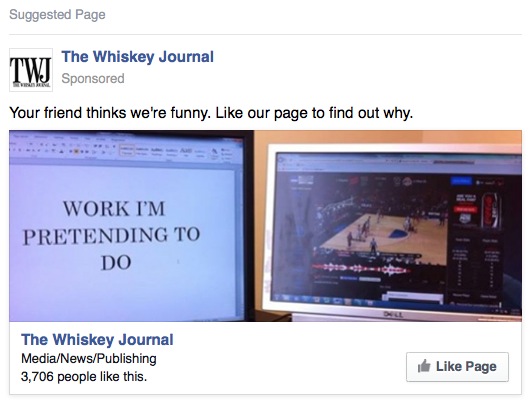
Screen Shot 2014-12-13 at 2.10.47 PMYou’ll notice that the image I chose (one which I found on a post on the site) is a joke in itself. My hope was that people would notice it, get a laugh, and that would encourage them to at least check the page out. And maybe some people might even hit the “Like Page” button thinking they were just liking the image – an honest mistake that could also get us some extra new fans.

I always try to keep captions as simple as possible – less is more.

In this case, I knew that most people seeing this ad will never have heard of The Whiskey Journal before, but I knew that because of my targeting they will be people whose friends already like the page. So, I tried to use that to my advantage – providing some social proof (your friend likes it, so it must be decent) as well as inspiring curiosity (don’t you want to know why your friend likes this thing you’ve never heard of?).

The resulting caption line I came up with – “Your friend thinks we’re funny. Like our page to find out why.” – accomplishes both of those things in as simple a way as possible.

The Results

So, how did it work? It wasn’t the most amazing performance I’ve ever had with an ad, but overall I was pretty happy with the results considering the inherent challenges in the title of the page and promoting a page for a website few people were familiar with.

Here’s the breakdown of how it performed:

$24.89 spent

2,442 people reached (this is the number of people who saw it in their news feed)

54 clicks (that represents a 1.7% clickthru rate)

42 Page Likes (this means it generated 42 new fans for the page)

59 cents cost per new fan

So basically, for $25, I got Kyle 42 new Facebook fans. Ultimately, it’s up to you/him to determine whether or not that was worth the spend, but personally I think that’s a solid, if not spectacular, performance.

Speaking of spectacular…let’s move on to the second ad I ran for Kyle.

Ad #2: How To Get More Website Traffic

The second ad I ran was designed to get people to visit the Whiskey Journal website who had never seen it before. Since I only had a $25 budget to work with, I decided to focus my efforts on a single ad leading to a single piece of content on the site.

Kyle didn’t have any specific post he wanted me to promote, so it was up to me to choose whatever I thought would work best. I surfed around the site looking for a post that I thought was not only funny, but would also appeal to a very specific (and targetable) audience.

I came across this article about Derrick Rose that I thought would be a great fit because it not only was funny and likely to appeal to a very specific (and easily targetable) audience, but it even was somewhat topical and controversial. I could see how it might be the kind of thing that people who are frustrated with Rose would want to share and people who are Rose defenders would want to comment on in disagreement.

Remember, there’s value to content that causes a reaction – even if that reaction isn’t necessarily agreement.

Step 1: Choosing Who To Target

After choosing the content I wanted to promote with the ad, I started to think through the audience I wanted to target with it. Since I chose a piece of content that led itself to a somewhat obvious audience, this was easier than determining the targeting for the more generic ad I previously ran for Facebook fans.

As a side note, it should almost always be easier for you to come up with specific targeting for a specific piece of content than it is for an entire website because each piece of content is usually about one specific thing as opposed to a website which may be more all over the map.

In determining who to target, you always want to go as specific as possible – the more specific you get, the better the ad will perform. Also, you want to think about what the content is about as opposed to what you (or your website) are about.

For example, even though Whiskey Journal is a comedy site, this article is about a sports figure – so instead of targeting comedy fans, I’d do better to target sports fans.

This may seem obvious when you think about it, but it’s a huge mistake that most comedians make when running Facebook ads – they think because they’re doing funny stuff that the only people interested in it will be people who are into comedy. You’ll have more success if you focus on the topic of the content, as opposed to comedy in general.

Another place where a lot of people would go wrong with targeting is they might just target people who like sports and be done with it. But again, you want to go as niche as possible and in this case Derrick Rose is a big enough star that I was able to target people who are specifically fans of his.

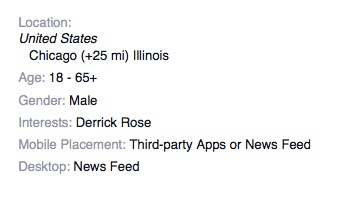
I even took it a step further by limiting it to men, and limiting it to people who live in Chicago – figuring that those would be hardcore Bulls fans with strong opinions on Derrick Rose.

Again, my goal was to drill down as specifically as possible to increase the chances that the people who saw my ad would be interested in it.

Here’s the targeting I settled on:
Screen Shot 2014-12-13 at 2.10.15 PM

Step 2: Choosing The Ad Creative

The next step was to figure out what I wanted the ad to look like – again keeping in mind who I was targeting and trying to make it as compelling as possible to that audience to drive clicks.

Typically, people just paste in the link to their article and run the ad with whatever image, headline, and description happens to get auto-pulled from the site. That’s a huge mistake and a missed opportunity.

Each of those elements can (and should) be edited to match the people you’re targeting and the goals.

For example, here’s how the link to this article would show up on Facebook by default:
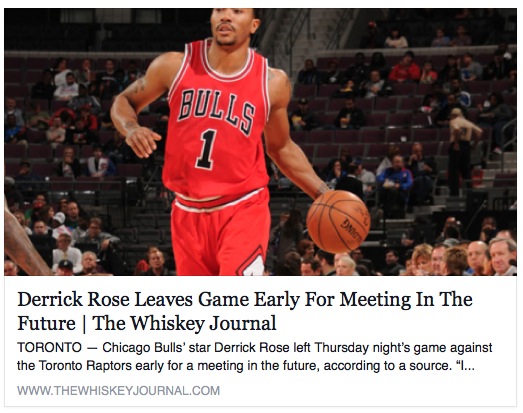
Screen Shot 2014-12-14 at 11.21.42 AM

This was ok, but I thought I could do better. Here’s what I created instead:
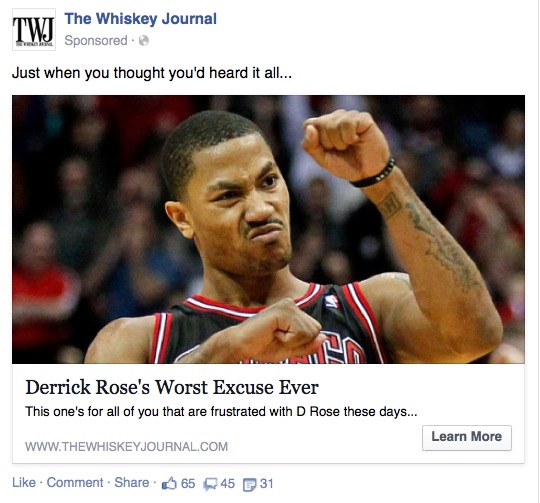
Screen Shot 2014-12-13 at 2.09.37 PM

I changed the headline to something simpler that teased the article and made people curious to see what Rose had said.

It’s a little clickbait-y, but I’m trying to get clicks so that’s not a bad thing. Also, I wrote a short, simple headline that I thought would appeal to people who are frustrated with Rose (they were more likely to enjoy an article parodying him than people who are his fans).

The original headline also kind of functioned as a joke on its own, where my revised headline played more like the setup, with the joke being delivered on the page itself.

I also swapped out the photo with what I thought was a more compelling image I found on Google images. In general, close-up shots of people’s faces perform better than full body shots and I thought the face Rose is making in this image, when combined with the headline, was more attention grabbing than the more generic image of Rose on the court.

These are minor details, but they can make a difference.

Finally, I changed the description and caption to speak to the reader in a conversational tone as opposed to just auto-pulling the first few words of the article. As you can see, that’s a whole different tone and in my opinion makes it much more compelling.

Also, running it as an ad allowed me to add that “Learn More” button which gives an additional call to action to drive clicks. [FYI, I chose the Learn More button from a few pre-set options Facebook provides, it’s not the best language but it was the closest one that fit in this case.]

The Results

This ad wound up performing as good as any ad I’ve ever created. In fact, I’m not sure it’s even possible to have an ad do any better.

Here’s the breakdown of how it performed:

$26 spent

40,043 people reached

4,379 clicks to the website

13.5% clickthru rate (this is insanely high by the way)

1 cent cost per click

That’s right, this ad drove a targeted audience (Derrick Rose fans) to the Whiskey Journal’s Derrick Rose article at a cost of just a penny per click!

The post also generated 65 Likes and 31 shares from the people who saw the ad.

Now, I should mention that not everybody loved the post and some people found it misleading because they clicked expecting it to be a legitimate news story and not an Onion-style parody.

That led to some negative comments on the post pointing out that it was fake, and some other negative comments from people who didn’t get the joke and were mad at the press for ripping Derrick Rose (which is funny in a whole other way).

You can see all the comments on the post here.

But, there were lots of people who did get the joke and found it hilarious – they commented about that, they shared the post, and in some cases left comments calling other commenters dumb for not getting the joke.

Remember – it’s ok if not everybody likes what you do. In fact, they probably shouldn’t.

The “controversy’ of the post actually helped the post do well – remember, even a negative comment counts as engagement in Facebook’s eyes and therefore increases the chances it will show the post to more people.

The goal was to get noticed and to attract some new readers to The Whiskey Journal and this ad did just that.

If 50% of the people that clicked didn’t like what they saw, that doesn’t matter – what matters is the 50% of the people that did like it.

Any Questions?

Ultimately, every ad campaign is different because every person’s goals are different and so is the content they’re trying to promote. But hopefully, this example has helped you see how I think through what to do when I run Facebook ads and you can apply some of that thinking to your own efforts.

I should also add that this was just a small test with a small budget – in general, I always recommend testing different combinations of ads and the more you test, the more you can learn what works best.

These ads worked really well, but could they have been better with different images? With different headlines? With different targeting? Maybe.

That’s why Facebook ads are an ongoing challenge – no matter how great you do, there’s always that chance you could do better.

If you’ve got any questions about any of this or want some advice about promoting your own stuff with Facebook ads, post a comment below or tweet me.


How To Use A “One Action” Strategy To Activate Your Audience

Are you asking fans and potential fans to multitask? Probably.

Is that hampering your ability to grow and leverage a fanbase? Definitely.

If you’re trying to build an audience for something these days the chances are that you’re making a lot of requests (or “offers” to use a gentler term) to your existing or potential fans. You ask them to watch your videos, share your social media posts, join your email list, buy tickets to your show, listen to your podcast, and god knows how many other things that will help further your career.

But what you’ve likely lost sight of in the midst of your hustle is that multitasking is a myth. In reality, people don’t take multiple actions at once, they take one single action at a time.

And that’s why I think you’ll find a lot more success – short term and long term – if you focus on a single action that you want people to take in every situation where they encounter you and your work.

What Is A “One Action” Strategy?

My definition of a One Action Strategy is that in any scenario in which people encounter your content, there is a single, specific action that you want them to take.

You may make multiple actions available for them to take (though it’s possible you’ll see better results if you limit their options), but you hone in on the single action you most want them to take and devise a strategy to increase the likelihood that they’ll do so.

You can can have different actions for different scenarios – for example, the “one action” you might want people to take after watching your videos is to subscribe to your YouTube channel, but the action you might want people to take when they see you perform live might be to join your email lists – but focusing on a single “ask” for each situation and developing a strategy designed specifically to match the single action you want people to take will drastically increase your success rate.

That’s because it simplifies the process for people, focuses your own promotional efforts, and matches the way people act – they can only do one thing at a time so why ask them to do more?

Why It Works

The biggest reason why the One Action Strategy works is because it simplifies things for both the audience and yourself.

Your audience won’t get lost in a multitude of asks and you’ll essentially make it easier for them to support you. Also, they won’t feel assaulted with asks (Share my video! Retweet it! Subscribe! Watch another!), which will make them more likely to actually do the one thing you ask them to do.

Also, the mere process of forcing yourself to choose only a single action to ask people to take will lead you to really think through what actions will be most valuable to you. This essentially forces you to act more strategically and protects you from yourself – you’re no longer just throwing stuff at the wall and hoping something sticks. It’s a way to force yourself into setting a clear goal and messaging that goal.

That leads to the other reason why this strategy works – it gives you a clear and simple way to measure success. Once you focus on a single action that you want people to take it becomes very easy to measure the success of both your content and your calls to action.

And as I’ve said before, you can’t improve anything you can’t measure.

How To Choose The Right Action For The Right Situation

Ready to give this One Action Strategy a chance? There’s three things you’ll need to think through in order to figure out what actions you want to ask people to take.

First, you have to know your goals. There’s lots of different actions people can take after seeing your content and all of them provide different kinds of value. So the first thing you want to take is think through your personal goals and then let those guide the actions you want people to take.

For example, if you posted a video of yourself performing standup on YouTube there’s a few different ways you might want to go. If your goal was to get more people to come to your shows, then the action you might want people who watch the video to take could be to email you and get on your guest list. But if your goal is to build a bigger following for your YouTube channel because you plan to post a lot more videos, then the action you might want to encourage could be subscribing to your channel or sharing the video.

There’s no right or wrong action to focus on, it all depends on your goals. You just want to make sure that the action you choose to emphasize will actually benefit the goals you’re pursuing.

The second step to figure out what One Action to emphasize is to understand the value of the action you want people to take.

Not all actions provide the same level of value. For example, somebody buying tickets to your show might be more valuable than them following you on Twitter. But them following you on Twitter might be more valuable than them watching a single video.

The specific values depend on your goals, but you need to recognize that not all actions have equal value and (generally speaking) the more valuable the action is, the tougher it is to get people to take it. So part of what you’ll want to think through when determining what actions you’re going to try to drive is to weigh the relative value of each.

Would you rather sell 10 albums or get 100 people to sign up to your email list? Would you rather somebody subscribe to your podcast or your YouTube channel? Would you rather they tell their friends they saw you perform on Twitter or would you rather they come to your next show?

These relative values will be different based on your individual situation, but it’s worth thinking about them as you decide what actions to emphasize.

The third thing to consider when planning your One Action Strategy is to keep in mind how the medium works where your content lives and to recognize what assets are available to you.

Different mediums (both online and offline) have their own unique strengths and weaknesses that you’ll want to take into account when figuring out what actions you’re going to ask for from your audience.

For example, it might be easier to get people to join your email list after reading something on your blog than it is after they read something on your Facebook page because you can put the signup form right at the bottom of the post. On the flip side, it might be easier for people engaging with your posts on Facebook to tag their friends in the comments than it is for them to share a blog post on your website with them.

YouTube’s annotations make it very easy to get people to subscribe to your channel or drive them to another video you’ve created so that might make you decide to focus your action around those things as opposed to trying to drive Twitter followers from your YouTube videos.

This is not to say that you can only do things that occur naturally in the medium you’re using, but rather that you should be aware of what is “easier” to do on various platforms when plotting your strategy.

And Now, The One Action I Want You To Take…

Since this is a post all about asking your audience to take a single action I figured I should follow my own advice and ask you to do a single thing if you found it helpful. So here’s the action I want you to take – give the One Action Strategy a try with at least one thing that you do regularly (social media posts, videos, live performances, whatever) over the course of the next month and email me to let me know how it works for you.

If you don’t see improved results, I’ll be happy to give you some more tips geared toward your specific goals.

15 Things Comedians Should Be Thankful For

In honor of Thanksgiving, let’s take a break from the negativity and struggle that permeates so much of the conversation about the comedy business and remember that there’s actually a lot of things for comedians to be thankful for these days.

Whether you’re an established comic, or somebody just starting out, here’s 15 things I think are worth taking a moment to appreciate in the next few days.

1. Your Fans

Whether you’ve got thousands of fans or just your Mom hanging on your every word, you should truly appreciate each and every one of the people who care enough to pay attention to what you create. We’re living in a world where there’s never been more competition for a person’s attention, and it’s honestly a miracle when anybody is willing to consistently give you some of theirs.

2. Free Social Media Tools

For all the bitching that people do about social media platforms it’s easy to forget how many incredible tools have been provided to comedians at no cost. YouTube, Facebook, Twitter, Instagram, and virtually every other social platform spends millions of dollars to provide you with an opportunity to reach the world and doesn’t charge you a penny to do it.

3. The Opportunity To Learn

Things like YouTube, Netflix and Google have ushered in an era where it’s never been easier to watch comedy, study comedy, and learn from a library of content that’s easier and more inexpensive to access than at any point in history. For virtually no cost, you can access just about any comedic performance that’s ever happened or read articles and learn from the greatest comedic performers of all time. There’s never been a better time to learn from the masters than right now.

4. The Ability To Communicate With Established Comics

Now that just about every working comedian is using social media in one form or another, it’s created opportunities for you to reach out to them and connect with them to build relationships, ask them questions, or just simply compliment their work. Will Louis CK respond to every tweet you send to him? Of course not, but there are opportunities out there to get to successful comics in ways that there never were before.

5. The Opportunity To Make A Living By Making People Laugh

The mere fact that it’s possible to have a comedy career is something to be thankful for if you think about it. It may not be easy to make a living by making people laugh, but it is possible and there are lots of people out there doing it. Even if you’re not one of those people yet, you should appreciate knowing that it can be done – after all, there’s a lot worse ways to make a living.

6. The Chance To Start Over

Online tools allow comedians an opportunity that they rarely think about – the chance to start over. If things aren’t working out for you, you can always delete what you’ve done – take down your videos, take down your social accounts, take down your website, and “re-create” yourself from scratch. If what you’re doing hasn’t been working and you want to start over, you can. Second (or third) chances are worth appreciating.

7. The Comedy Community

Whether you live in a small town, a big city, or are just part of the online comedy community, it’s pretty amazing the way comedians can bond together to support and help each other. Just like any community, comedians have their fair share of jealousy and burned bridges, but overall I’ve found the comedy community to be way more helpful and supportive of its peers than just about any other profession.

8. The End Of The Gatekeeper Era

Do comedy gatekeepers still exist and are they a huge part of the comedy business? Yes. But, it’s also now possible to build a successful career without going through the gatekeepers and that’s a HUGE shift in the industry. There’s more ways than ever to build a successful comedy career these days, and you no longer have to wait for somebody to “discover” you in order to make it happen.

9. The People That Give You Opportunities

No matter where you’re at with your career, you’re likely surrounded by people who give you opportunities. Whether it’s stage time at an open mic, help producing a video, or a guy who shows you how to register your website domain, there are lots of people out there who help create opportunities for you. You should be grateful for everything they do for you – even the things that seem small. Because those small things, and the people that do them, can often lead to much bigger things.

10. The Opportunity To Get Better

Comedy is an art form where the more you do it, the better you will get. There’s no guarantee that you’ll ever get good enough to make it, but it’s a sure thing that your 100th time on stage will be better than your first. Not all things are like that and it’s important to recognize that just having the ability to ensure that the work you put in will result in improvement is a great thing.

11. Every View, Listen, Like, Comment, and Share

Every single time somebody takes the time to engage with something you have created is an incredible experience and one that should be valued. It’s easy to take for granted things like retweets or video views, but those are important actions from people who can really help you grow your career.

12. Your Day Job

Too many comics are too eager to leave their day job too soon. They think that the sooner they can do that, the sooner they will be considered a “real” comedian and that it will free up their time to work more on their comedy.

But often times comedians overlook the value of their day job and the value of what it provides. The financial benefits of a day job, the structure, and the life experiences it can create often times can do more to help your comedy career than hurt it. If you’ve got a decent day job, you might want to take a moment to appreciate it instead of trying to figure out how to leave it before that’s necessary.

13. The Host Of Your Show

If you’re performing on a standup show, the show’s host/MC matters – a lot. Recognize the importance of the comic filling that role and appreciate the role that they have to play in your performance on that stage.

14. Comedy Clubs

Comedy clubs are far from perfect, but they do provide some incredible opportunities for comedians. It’s a brutal business and most clubs are taking on a lot of financial risk to provide you with opportunities – you should be thankful that there are people out there willing to do that. And while there are a lot of club owners that aren’t exactly the best people in the world, there are still lots of them who treat comics well, are passionate about the art form, and do their best to create what everybody wants – a great show.

15. People Who Hate Comedy Clubs

While I think you should appreciate comedy clubs, I also think you should appreciate all the indie promoters and comedy fans who have turned their backs on the clubs. Their efforts have led to a rise in new comedy venues, alternative rooms filled with hardcore comedy fans, and a whole wave of new opportunities for comedians. Plus, the success of these alternative venues has forced comedy clubs to step up their game and improve their own situations to compete.

Now It’s Your Turn…

What do you think comedians should be thankful for? Tell me on Twitter.

READ THIS NEXT: 25 Things Most Comedians Do

5 Things You Can Learn From Saturday Night Live’s Youngest Writer

Author and comedy writer Simon Rich, the youngest writer ever hired on Saturday Night Live, recently appeared on the James Altucher podcast for an interesting look at his approach to writing comedy.

In the conversation he shares his thoughts on writing vs. standup comedy, how he comes up with stories, and why he believes emotion is everything.

You can listen to the full episode here, or read up on some of the highlights below.

1. You Have To Be A Superfan First

At around the 9-minute mark, Rich discusses how he got his start in comedy writing and how he believes most people do – by being a superfan first. He points out that for most people who “make things” for a living, it starts with them being obsessive fans.

Rich grew up watching tons of comedy on TV, particularly noting how he would obsessively watch sketch shows like Mr. Show and the Upright Citizens Brigade TV series.

“I was always trying to copy my heroes,” he says.

But his biggest influence was The Simpsons, noting at the 46-minute mark of the podcast that, “Everything I believe about comedy I learned from The Simpsons. In my mind, it’s the most perfect work of art.”

2. You’re Probably Either A Standup Or A Writer – Very Few People Are Both

At around the 17-minute mark, Rich weighs in on the differences between performing standup and writing comedy, and explains why he believes people are rarely good at both.

Calling standup an “extremely hard skill,” he points out that you can be a good standup and not a good writer and vice versa – there isn’t necessarily any overlap in the two comedy art forms.

For himself, he realized early on that he was drawn more to writing than performing so he chose to focus on writing.

“Usually, standups love performing – they can’t wait to get on stage,” he says. “It’s a very different thing than what I do.”

3. Everybody Tells The Same Stories

At around the 23-minute mark, Rich goes into a very interesting explanation of how he actually approaches writing.

“A lot of what I do is taking an old story I love and making it my own with a twist,” he says.

He goes on to explain that some people believe there are really only a couple plots that exist in the world and that every story is a variation on them. He believes there’s more like a dozen plots out there for people to reinvent, but agrees that everybody is pretty much telling the same stories in different ways.

Rich approaches his writing by looking for the emotional core of a story and finding ways to amplify that emotion, which is where the comedy is found.

“I start with a visceral emotion I have felt [in real life],” he says. “If it feels universal, I’ll write about it. I try to write about emotions not in the way they actually occurred, but in the way they felt. It feels much more high stakes than it is.”

For example, a broken heart in a relationship might not actually be the end of the world, but it feels like the end of the world. So he writes about it being the end of the world.

Later in the podcast, Rich adds that once you hone in on the stories you want to tell you can continue to tell them in different ways forever. “Some people write the same story for their whole lives,” he says.

4. Comedy Is Vulnerability

At about the 30-minute mark, Rich talks about how important he believes emotion is to comedy writing – and especially vulnerability.

“At the core of every comedy premise there needs to be some vulnerability, somebody has to be weak,” he says.

He goes on to talk about how challenging it is to incorporate an emotional connection into sketch comedy writing, which is one of the reasons he’s currently adapting one of his books into a sitcom instead of a sketch show.

He points out that audiences have a tendency to write off sketch shows and not allow themselves to become emotionally invested in them because you’re constantly reminded that what you’re watching is fake as a result of the characters constantly changing.

He contrasted that with a sitcom, where viewers get to know the same characters and develop an emotional connection to them relatively easily.

“Every new SNL cast member is hated at first because the audience doesn’t recognize them,” he says. “With a sitcom, by episode two or three you know the character. They always look the same.”

5. It’s Never Too Late

At about the 54-minute mark, Rich offers some words of encouragement to other would-be comedy writers who may be unsure of whether they’re making any progress or if they’ve waited too long to chase their dream.

“It’s never too late,” he says. “But if you don’t love sitting down and writing then you definitely shouldn’t do this because that’s what it is. But if you think you might like it, then you should sit down, write, and find out.”

READ THIS NEXT: 5 Things You Can Learn From The Colbert Report’s Head Writer