Josh Spector

My Email List Building Challenge: Week 3 Progress

I’m three weeks into my self-inflicted challenge to grow my email list by 25% this month and I’ve got another update for you this week about my progress, what’s working, and what I’ve learned.

If you’ve just stumbled across this article, I highly recommend you get up to speed by reading my initial challenge to myself, what I learned during my first week and during the second week.

Now on to this week’s update which is a pretty monumental one for me…

THE GOAL

As a quick reminder, my goal was to generate 285 new subscribers this month, which would represent a 25% increase in the number of Free Tips Newsletter subscribers I got last month. In order to reach that goal, I need to average approximately 9.5 subscribers per day.

THIS WEEK’S RESULTS: MISSION ACCOMPLISHED!

This past week the number of subscribers I added went up for the third consecutive week and I set a new personal best with 136 new subscribers! But even more importantly, this pushed me past my overall goal with another full week remaining.

This month, I’ve already accumulated 322 new subscribers which represents a 41% increase already compared to last month. Even though I thought I had a shot to hit my 25% increase goal in this challenge, I thought it would be tough and I certainly didn’t think there was any way I’d get this much of an uptick, let alone do it in only three weeks.

HOW I DID IT: EXPLOIT WHAT’S WORKING

While swapping out my email signup forms (as I detailed in Week 1) and running Facebook ads (as I detailed last week) continued to work well, there’s no doubt in my mind that the key ingredient to my success in this challenge has been the release (and more importantly, the promotion) of exclusive content to my mailing list subscribers.

Last week I explained how I used the lure of an upcoming article on 10 Huge Opportunities I See For Comedians to attract new subscribers and I expanded on that plan this week. When you find something that works, you can usually find other seamless ways to capitalize on it and extend the value you get from it. In this case, I thought I had an opportunity to do just that and it turned out I was right.

Teasing my upcoming Huge Opportunities article was a great way to attract new subscribers, but I knew I could only do that for a couple days before I had to actually send out the email – I couldn’t just tease it forever and not deliver. That meant I had to identify some ways to capitalize on the actual publishing of the article to my subscribers.

The first part of that was to make sure that I wrote a kickass article that people would feel was well worth the value of giving me their email address in the first place – otherwise, they’d just unsubscribe once they got it. Second, I wanted to incorporate a way for people who got the article and enjoyed it to spread the word for me and bring in additional subscribers.

So, I used Click To Tweet (which is quickly becoming a favorite tool of mine) to create an easy way for people who got the email to tweet about its existence to their friends, including a link to the original article page where other people could sign up to mailing list to get the article emailed to them.

At the bottom of the article, here’s what subscribers saw:

If you found this email helpful, please click here to tell your Twitter followers about it.”

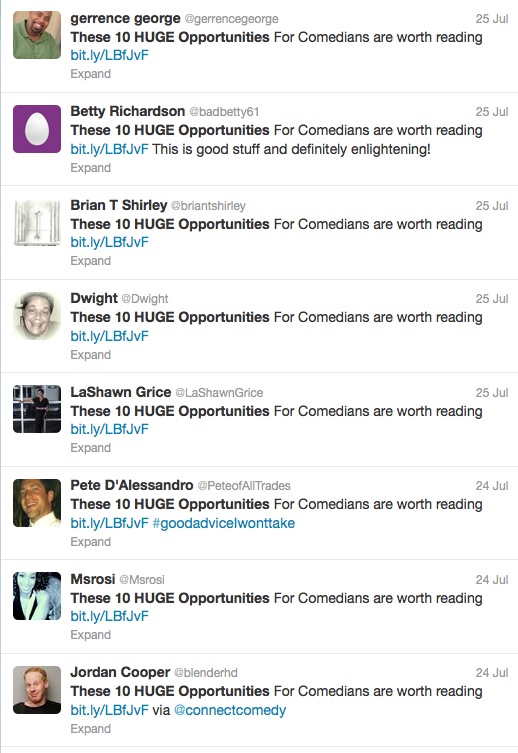
And sure enough, several people took me up on the offer – see?

The end result is that the page I created to tease that article wound up getting me 30 new subscribers even AFTER the article was initially released and without any additional promotion by me after that fact.

HOW I DID IT: INSIDE THE NUMBERS

I’ll spare you a full breakdown, but here’s a couple other numbers I thought were worth mentioning as relates to other stuff I’ve been doing to grow subscribers. The sidebar form that I redesigned back in the first week of this challenge has proved to be a dramatic improvement. It’s converting 1.2% of visitors into subscribers, which is double what the old form was doing.

Traffic to my site actually dipped 27% this week compared to last week, but the number of subscribers still increased – this shows that while more traffic definitely can lead to more subscribers, not all traffic is created equal and it’s not just as simple as getting more traffic.

That Huge Opportunities article signup page is converting a whopping 17% of the people that visit it into email subscribers. It’s still amazing me how effective a tool that has been.

WHAT’S NEXT

Even though the pressure is off and there won’t be any kind of tension-filled final week to my challenge, that doesn’t mean I’m giving up on the opportunity to take another week and try to learn some more lessons. I’ll be back again next week with a final wrapup post including some new lessons about how I (hopefully) get a bunch of new subscribers this week.

Connected Comedy Podcast Episode 9: Maybe That’s Why I Don’t Get Booked Much

Please subscribe and rate this podcast on iTunes!

On the “throwing bookers to the wolves” episode of the podcast, Jordan Cooper, Josh Spector, Chelcie Rice and Josh Homer welcome festival and club booker Matt Komen, currently of Stand-Up Live in Phoenix, on to the show to take the heat of all comedian’s frustrations with the industry.

We discuss what a club manager looks for when booking a new comic, why you don’t have to be in New York or Los Angeles to get discovered, how getting the attention of headliners may be more helpful than soliciting clubs and the importance of having a 360 degree approach towards your comedy career.

In addition, we have a lengthly debate on whether the comedy club business model is dead, plus go through a cavalcade of topics including festival submissions, press kits, getting representation, why first impressions count a great deal and ultimately, that no matter your goals, no one can “want it” more than you.

[powerpress]

Links from this episode:
The Laugh Factory YouTube channel
Why Laugh Factory Live Will Be A Colossal Failure [Jordan Cooper]
How To Fail In Comedy While Really Trying – Feature Work [J-L Cauvin]
Don McMillan – Technically Funny
Comedians At Law
Mail Order Comedy
Anjelah Johnson – Nail Salon (YouTube video)
My Email List Building Challenge: Week 2 Progress [Connected Comedy]

Participate with the CC community in our Connected Comedy Facebook Group or post your questions, suggestions or topics to cover in the future on our Facebook Page. We always welcome your comments!

My Email List Building Challenge: Week 2 Progress

I’ve just reached the halfway point in my self-inflicted challenge to increase my email list subscribers by 25% in a month and I’ve got another update for you about my progress, what’s working, and what’s not.

But first, if you haven’t been following along so far you should get up to speed by reading my initial post about the challenge and then last week’s article about my first week’s results.

Now on to this week’s update…

THE GOAL

As a quick reminder, my goal was to generate 285 new subscribers this month, which would represent a 25% increase in the number of Free Tips Newsletter subscribers I got last month. In order to reach that goal, I need to average approximately 9.5 subscribers per day.

THIS WEEK’S RESULTS – A BIG BREAKTHROUGH!

In the last 7 days I’ve gotten 116 new subscribers! This is a 69% increase compared to what I got in the first week of this challenge and it puts my total number of new subscribers this month already up to 185 subscribers in just 14 days.

That means I’m averaging 13 subscribers a day and am on pace to shatter my goal of a 25% increase this month. I’m not sure I can maintain my current pace, but if I do then I’m on track to get more than 400 email subscribers this month which would be pretty amazing. And most importantly, this week I made a real breakthrough with a new tactic that proved incredibly effective to attract new email subscribers.

HOW I DID IT: EXCLUSIVE MAILING LIST CONTENT

I tried several things this week including continuing to tweak my sign up forms and re-sharing old “greatest hits” content from my site on social media (both of which I detailed in last week’s update). Those have continued to be helpful, but there was something that I tried for the first time on Saturday that really jumpstarted my email signups this week and that’s what I’d like to discuss in more detail here.

My Free Tips Newsletter features a lot of exclusive content that isn’t available on this website, but I’ve always just promoted it in more general terms. I assumed that talking about the overall things that the newsletter had to offer (tips to grow your fanbase, book more gigs, etc.) would be a compelling enough offer for people interested in that sort of thing to sign up.

But recently, I started wondering if the response would be different if I offered a single piece of specific content as a lure to get people to sign up for the newsletter, so that’s exactly what I decided to try.

I decided that in order to make it as compelling as possible to my audience, I wanted to come up with an idea for an article that would sound very valuable and have the broadest possible appeal. I could offer an article just about Facebook, or Youtube, or websites, but lots of comics aren’t interested in those things. I wanted something that EVERY comic would hopefully be interested in and, of course, a topic that I had an opinion about and valuable information to share.

After giving it some thought, here’s what I came up with: an article about 10 Huge Opportunities I See For Comedians.

My hope was that any comic who was a reader of Connected Comedy would be intrigued enough at that title to warrant signing up for me email list in order to be able to see what those opportunities were. And since the only way they could get that information was to be a subscriber of my email list, that many of them would go ahead and sign up.

It hasn’t even been 24 hours since I posted the news that I would be releasing that article to subscribers only later this week and the results have been pretty great.

Of the 232 people who have visited that page, 33 of them have subscribed to my email list. That’s a 14% conversion rate and a clear sign that offering a specific piece of exclusive content is a great way to turn regular readers of your content into subscribers. Plus, this is clearly a tactic that would be easy for me to repeat if I wanted to – I wouldn’t do it all the time but occasionally creating content just for my subscribers and notifying non-subscribers about its upcoming release is an easy way to drive new subscriptions.

HOW I DID IT: FACEBOOK ADS

The other thing I did this week that helped spike subscriptions was to spend a little money on targeted Facebook ads. This is something I’ve done on and off since I launched Connected Comedy and it was really to credit for the early growth of the site.

This week I decided to just run some “Sponsored Story” ads with some specific targeting. Here’s a look at what the ad I ran looked like and who it targeted:

In case you’re not familiar with how Facebook’s sponsored story ads work, anybody who fit my demographic targeting would see that ad run with a heads up that their friend already liked Connected Comedy. Since I know most comedians are friends with other comedians, this ad tends to work pretty well in terms of reaching my target audience.

And while the prices for these kind of ads can vary greatly, in this case it was pretty cost effective. I decided to spend $10 per day on the ad for a total spend of $70 this week. But here’s what I got for that investment: 390 people clicked the ad and 268 of those people actually then “Liked” my Facebook page.

I’m not able to tell exactly how many of them wound up joining my email list, but I’m sure several of them did. And even if they didn’t, I got them as Facebook fans and they’ll have plenty of other chances to eventually join my email list.

I’m a huge proponent of Facebook ads (if used in a smart way) and I’m very happy with what I got for my $70 investment in them this week.

WHAT’S NEXT

I’m way ahead of my 25% increase pace at this point so I’m definitely going to keep doing what’s been working, but I’m sure I’ll also come up with a couple new things to try next week to see what else I can find that might continue to build on this momentum. And I’ll be curious to see how many more subscribers I get from the exclusive newsletter post tease, since I won’t be sending that to my mailing list for a couple days still.

10 Huge Opportunities I See For Comedians

One of the great things about the current state of the comedy industry is that there are new opportunities emerging every day for comedians to grow their fanbase and further their career.

So, I’ve written an article in which I spell out 10 Huge Opportunities I See For Comedians and I’ll be sending it exclusively to my Free Tips Newsletter subscribers later this week.

If you’d like to get it, just sign up below. And as an added bonus, you’ll also start receiving my Free Tips Newsletter which is packed with more advice for comics who care about their career.

NOTE: If you’re already a subscriber to my Free Tips Newsletter, you don’t have to do anything to get the 10 Huge Opportunities article – you’ll get it anyway. Thanks!

An Interview With Connected Comedian Ryan Budds

This is the first in a new series of Connected Comedian interviews I’m doing with comics from around the country who are members of the Connected Comedy community. They’re designed to help other comedians learn from what’s working for them (or not), and to help you get a sense of how your peers are handling some of the same challenges you may face with your career.

If you’d like to be featured in a future interview, shoot me an email and let me know.

Today’s interview is with Chicago comedian Ryan Budds.

Tell me a little bit about your background in comedy and where you’re at with your career right now?

I got hooked on the idea of standup comedy around 13-14 when my brothers sat me down to watch Eddie Murphy’s Delirious for the first time. I cried laughing, I think for the first time in my life I was completely envious of somebody’s ability to make others do that with jokes.

Six years later, I started doing comedy in 2006 at an open mic in my dorm’s basement in college. I won a radio contest to open for Dennis Miller about 9 months in and got a good tape out of it that later got me work with different agencies like Funny Business. I’ve featured for them ever since, pretty frequently, while trying to work a day job after college.

I quit that job in January of this year to do comedy full time and have been loving my quality of life since then. I work pretty consistently on the road and locally in Chicago at clubs, bars, and random gigs.

How many “fans” do you think you have at this point in your career? I don’t just mean how many people you have following you on social media, but how many do you think are actually paying attention and really care about what you have to say and what you’re doing? How many do you have a connection to that you think will support you in some way? (It’s ok if this is a small number)

I’d say there’s at least 100 people who really care about what I’m doing who aren’t close friends and family. The people that constantly post on content I put online seem to be mostly the same people, and they seem to join in after seeing me live or meeting me somewhere I recently performed.

I don’t know that these people would necessarily buy any/all merch that I released, but these are the people I think would definitely pay to see me at a show in their area. I randomly get emails and messages from people who enjoyed my set somewhere or liked the free album download I gave them for signing up for my email list. I’d like to see this number grow obviously, so I’m trying to think of ways to make that happen.

As far as your career goes, what are you doing right now that you think is working well?

I’m cultivating different opportunities and turning them into comedy-related ventures. I’ve been hosting these trivia nights at bars for a friend who runs a company called YesIAmShow.Biz that produces these nights in the city, and I’ve brought that idea into the south burbs to fill the nights where I’m not booked for paid shows (Sun-Thurs). We call it Standup Trivia, as it’s a trivia night hosted by a comic, and we try and make it more fun and engaging than other trivia nights.

Setting up these locations and hosting them three times a week has really helped me in terms of income, “stage” time, and networking. I try new bits out at these nights frequently and casually, in the same way you might do to a friend you’re running a new joke by. Along with that, I’m pretty solidly booked at clubs, one-nighters, and a few colleges this fall. I’m moving to LA with my wife in October, so the next three months are really busy, but in the best way possible.

What are you having problems with? What’s the most challenging thing for you at the moment?

The most challenging thing for me right now is trying to figure out how to make the biggest impact on people. I’ve gotten to a point where I’ve been relying on the same set for a good 6 months and it needs to be drastically changed. I try and do it once a year, to throw out old ideas and focus on just new material, but I honestly get lazy with it sometimes and it really bothers me.

I’m trying to focus on a daily writing regiment where I do an hour, 2 hours, everyday no matter what. But that can fall by the wayside pretty quick. Another challenge comes with this move to LA. I’ve been doing this in the Midwest for over 6 years, so I feel like it’s a good transition time, but you sometimes hear about being seen by industry too early out West. I’d like to think I’m prepared for anything, but you never know, and that can be a scary feeling.

I’m trying to make sure I have a ton of material in terms of jokes, spec scripts, and video content to showcase myself in a good light when I get out there. I constantly hear the phrase “what else you got” coming from friends of mine who already live out there, usually from the mouths of agents or managers, so I want to make sure I’ve got a lot of bases covered with what I have to offer people.

My wife grew up near LA, so we’ve got a huge family support system out there, which helps. My goal is to be able to have a decent enough income so that I don’t have to get a day job that’s not related to entertainment in some way. I’ll do extra work, I’ll audition for commercials, whatever it takes; I just don’t want to be working at some community college like I did for the last 3 years of my life. Going from a ton of good relationships for booked work with bookers in the Midwest to almost zero on the West coast will be hard, and almost like starting over in a way. As long as I can get on stage frequently and get some paid gigs here and there, I’ll figure out a way to survive out there.

It looks like you’ve been posting pretty regularly on your website for the past few weeks – what’s your strategy behind that? How do you decide what to post? What kind of feedback are you getting from it?

For a long time, I had a static website that only showed what new shows I had coming up. No twitter updates, no Facebook anything, just totally the same information on a page that looked really nice but ultimately did nothing. You actually gave me some great website tips about a year ago on how to improve my website, and I took this into consideration, but didn’t make a move on the issues until I started hearing them again and again on the Connected Comedy podcast.

I knew I had to fix these elements of promoting myself, so a friend designed me a brand new site that utilized WordPress and really let me control a lot of the things I wanted to be able to update. I launched the site about three weeks ago and my goal is to update it with some piece of content daily, whether that be a blog, picture, video, etc. For example, I’m doing a thing called Grinstagram every so often that is just a funny/goofy picture I took on Instagram with some story behind it.

I want to give people a reason to check out my site as a whole, rather than just one part of it like my shows calendar. I’m getting really good feedback from it just from the amount of likes and comments I’m getting on posts that I share on Facebook. My hits are pretty strong at about 700 since I launched, which is about 600 more per month than I was getting with that old site. I’ve been using Google Analytics to see what posts are getting more traffic than others, which is neat and beneficial in terms of creating more content.

Just from my free CD download and a spec script I posted of the show Adventure Time! I got some awesome feedback from people who normally wouldn’t have probably seen what I was up to. You can check out an article I wrote on that feedback here. I’ve got the month’s calendar lined up with what I’m going to post each day, that scheduling is how I work best and get things done. And with that schedule in mind, I leave the house every day doing different things going, “Could that be a piece of content for my site?” Having that mind set keeps me thinking like a comedian way more often than not, which is really neat.

I know you’ve got the Between Gigs webseries you’ve been working on. Can you talk a little about how that came about, what you’ve learned from doing it so far, and what the process is like? How do you produce it, how much does it cost, how much time does it take, etc.? 

Between Gigs was an idea that my friend Dale Zawada and I had that would give us something to do during the day when we’re not doing shows. We wanted to make a microseries, something short and quick we could put out every so often, and that quickly transformed into a weekly 2-5 min web series idea. We knew we wanted it to be random and that we’d touch on different aspects of being comedians in many of the episodes like getting booked, bad shows, setlists, stage names, etc.

And we also realized pretty quickly that it helps to have comedian friends as side characters in the episodes, sometimes playing themselves, but mostly playing weirdos and creeps we interact with for a variety of reasons. After a few months, lots of comics were asking us to be part of the show, which worked out great for everybody in terms of promotion and getting things shot quickly.

We have a brainstorm session every few months for episode ideas where we come up with 20-something shows and then each write up about half of them. We produce the show for pretty much zero dollars. We record most of it in my apartment or around my neighborhood with an HD camera my wife and I got for our honeymoon last Sept. It looks decent and the mic is an external attachment I bought for around $100 that picks up nice sound.

All the props we use are things lying around for the most part. We film the episodes usually two at a time and each one takes 1-2 hours depending on what’s involved. Sometimes we have a camera guy (Bryan Christopher, a very funny Chicago comic who plays a future version of me in an upcoming episode) but mostly it’s us and a tripod.

The biggest thing I think works for the show is consistency. We’ve put out a new episode every Monday afternoon for the past 7 months, and are planning on filming the rest of the year’s episodes before I move to LA so we can finish with 52 solid episodes of this thing. We’re always ahead of schedule by filming multiple episodes in one week, so we have this bank of shows we can put out for future weeks, which takes some pressure off of having to work every week on it. We get usually around a few hundred hits per episode, and sometimes closer to the 1,000 mark on certain shows.

How did you get Todd Glass to appear in your latest video?

Last year around this time, I was working on a podcast called Joking Off with a comedian friend of mine, Kevin Kellam. We recorded about 30 episodes and had a good time with it, but he moved into the city so it became harder and harder to record so we just stopped.

But around episode 20 or so, I saw one of my favorite comedians, Todd Glass, was going to be in Chicago opening for Sarah Silverman. So, I emailed him asking him to do a really short segment on the podcast and that we’d come to him and it would just take like 15 minutes when he was in town. He never emailed me back. I forgot about it, that was in April 2011.

Literally one year later in April 2012, Todd emails me back saying, “Ryan, I just found a bunch of old emails I never responded to. I’d love to do your podcast.”

I was shocked he took the time to respond to an email that old from some random comic in Chicago, but I was thrilled to hear back from him. I replied saying that I didn’t do the podcast anymore but that I’d love to have him on an episode of this web series I was working on. We came up with an idea for how to get him on it without being the same area (we used voicemails he left us as the basis for the episode) and the rest was history.

We were featured on the front pages of Laughspin and Rooftop Comedy, which was really cool, and people seem to really enjoy the episode. We’re obviously going to try and use this episode as a springboard to get future established comic guests on the show. I’m talking to Jimmy Dore right now, who is interested in doing one. It’s very cool to have this platform to reach out to people like that.

Since you’ve decided to make the move to LA in October, how did you come to that decision? Why did you choose LA as opposed to NY? What are you expecting or hoping will happen once you get to LA? Do you have any specific concerns regarding the LA move as relates to comedy?

Like I mentioned earlier, my wife grew up in the LA area and we’ve got a ton of family out there. Lots of support if something went horribly wrong. That’s a huge plus.

From what I hear for everything I want to do, LA is the place to be. I’ve always heard that NY is the place to go to learn how to be a great comic and LA is the place where you put being a great comic to use. I’m not a great comic yet, I know that, but there are a lot of things I want to do other than just standup comedy. I really want to write for television. I want to write for anything, to tell you the truth.

I love sitting around with comics and coming up with bits and creating storylines and things. A writer’s room is like the ultimate office for me. If I could make a career coming up with ridiculous things that make people laugh with a group of other like-minded people, I’d be set. Doing standup is something I never want to stop doing, but branching out into other areas like screenwriting is definitely something I want to dabble in.

I hope that once I get to LA I can establish myself as a decent comic from the Midwest who knows what he’s doing on and off stage. That would be ideal. And if that leads to gigs in any field that harbors comedic talent, I’ll be extremely satisfied.

You’re 6 years into your comedy career – what do you wish somebody would have told you 3 years ago?

I wish someone would have urged me to never be stagnate, to never get used to things on stage. I had (and still have sometimes) this intuition that if an audience is laughing hard at something, there’s no need to change it. No need to switch up a feature set that works 99% of the time, right?

That’s definitely not the case, and relying on a set like that makes you lazy. I also wish I would’ve have told myself I could do this full time 3 years ago. I had this great job after college that paid great and kept me secure, but I think that struggle of having no set income would have forced me to work harder at being a better comic.

During those first 5.5 years, comedy was a secondary job, the FUN job, but it was secondary because it paid about a third of my day job. I’m really glad I got to the point where I realized I didn’t need those set hours at a desk every day to support myself, but part of me really wishes I would have just dived into comedy head first after college.

How would you describe the Chicago comedy scene right now? What advice would you have for a comedian who may be considering moving there?

The Chicago comedy scene is diverse. There’s old comics, young comics, comics of all races and backgrounds, and tons of people doing it for fun, full time, or somewhere in between. I live in the south suburbs, so I’m not a guy that’s at like 15 city mics a week because it wouldn’t make sense for me to do that kind of driving to wait on a list of sometimes 60 comics at any given venue.

The great thing about living near a city like Chicago is the ability to perform in literally hundreds of different types of places. You can hit up a swanky club for a showcase set in the heart of downtown or you can eat shit at a dive bar out in some suburb that feels like the South. You can be seen by everybody or nobody all on the same night. All black crowds, all female crowds, gay crowds, none of that’s uncommon.

There’s a ton of opportunity to learn in the city and surrounding area. I would recommend Chicago as a great place to start doing comedy and to learn how to get comfortable on stage in front of as many audiences as ever. Don’t stick with just doing shows in the city, get out into the sticks and see what it’s like to really perform for people that aren’t like you at all. On the flip side, I’m not really a city guy, but I totally see the benefit of being part of the metropolis of comedy that Chicago has to offer and I take advantage of it as much as I can.

For other Connected Comedians who may read this, is there anything in particular you’d be willing to do to help them? And is there anything in particular that you need help with in case any generous readers out there want to help you?

I’d like to help any comic do anything they need help with. I don’t think I’ve ever turned down somebody asking for advice on how to get started, where to perform, how to write jokes, any of that. I try to be nice to everybody I meet, even if they’re a dick but I feel like they have something to offer in some way.

My first impressions of people can totally be turned around after a few jokes and a beer. I’d be happy to promote anybody that wants to do what I’m doing. There’s no class system in comedy, we’re all trying to make it at a thing that’s just fun and rewarding. Sure it sucks sometimes, but like any job, you’ve got to put up with some bullshit every once in a while. Just do your best to not be the bullshitter, and everything will be fine.

I’d like help in promoting my web series, Between Gigs, if anybody wants to repost episode they dig. That would be great. I’d also love to have as many contacts in LA as possible before I move out there, so if you’re from that area and like anything I do, please hit me up so I can hit you up when I’m out there.

Is there a particular article or feature of Connected Comedy that you’ve found the most helpful so far?

I really enjoy the podcast. I’ve said so in a few comments and reviews, but it really helps put the business side of comedy into a perspective that every comedian who’s serious about succeeding needs to hear. The 5 free tips you gave me last year got me motivated to redo my site, so that was really helpful. I’m a big fan of message boards and commenting on topics that lead to big discussions, so the Facebook group is really helpful.

If you could ask me one question, what would it be?

I’d ask what your big goals are with working so hard on a website like Connected Comedy. Helping comics seems to be your thing, but are you ultimately looking at turning your expertise in marketing into a money making business through comedy?

MY ANSWER: When I launched Connected Comedy a couple years ago I started it because I felt like I had a certain knowledge and expertise that many comics needed and that there really wasn’t any central place for them to get it. It was partially an experiment to see if I could use many of the tactics I promote to build my own audience, and then ultimately convert that audience into a business with people hiring me on a consulting basis to help them grow their fanbase and career.

That’s exactly what happened and I’m really proud of how Connected Comedy has evolved and grown – it’s also how I know that the stuff I’m recommending actually works. A few months ago I was actually offered a job running Digital Media and Marketing for The Academy of Motion Pictures (and the Oscars), which was too great an opportunity to pass up so that is now my full time job.

However, I value the Connected Comedy community too much to abandon it, so I continue to share what I know here and have been thrilled with the way many of my readers have helped keep it alive by doing things like moderating the Facebook Group and helping produce the podcast. I still do a little consulting occasionally when I have time (you can email me if you’re interested), but basically I’m just doing this because I love the community and it’s a great way for me to continue to learn.

If you could ask other Connected Comedians one question, what would it be?

At what point would you feel like you’ve “made” it? What the big end goal for you as a comedian? Is it like an HBO special and fame or is it just being comfortable making some kind of living making people laugh?


Connected Comedy Podcast Episode 8: The Stupid Lazy Comedian’s Guide To Email Marketing

Please subscribe and rate this podcast on iTunes!

On the “all things e-mail marketing” episode of the podcast, Jordan Cooper, Josh Spector and Chelcie Rice welcome DJ Waldow, the co-author of the Rebel’s Guide To E-Mail Marketing, on to the show to discuss why a comedian’s e-mail list is the best connection to their fan base, how content and e-mail marketing go hand-in-hand, why your e-mail list should be about delivering value to your audience, the power of curation and why being human, honest and engaging is key.

In the midst of the show, Josh shares results from the first week of his e-mail subscriber drive, we hold an e-mail intervention for Chelcie, and Jordan scolds DJ for even asking whether or not he could curse on the podcast. If you’ve been putting off starting that e-mail list, or are looking for creative ideas on how to use your existing e-mail list, this episode is definitely for you.

[powerpress]

Links from this episode:

My E-Mail List Building Challenge – Week 1 Progress [Connected Comedy]
Ryan Budds – “Featurable” live album download
Jason Falls’ Twitter strategy t-shirt
Perfect is the enemy of good [Wikipedia]
MailChimp
Aweber
Constant Contact
Feedburner

Participate with the CC community in our Connected Comedy Facebook Group or post your questions, suggestions or topics to cover in the future on our Facebook Page. We always welcome your comments!

My Email List Building Challenge: Week 1 Progress

It’s been a week since I declared I was going to increase my email list subscribers by 25% this month and explained exactly how I hoped to do it. So, I wanted to give you a quick update on what I’ve tried so far and what I’ve learned.

Again, I hope that you’re experimenting on your own to grow your email list and that some of what I share here can help you with your own list.

THE GOAL

Just a quick reminder: my overall goal was to get 285 people to sign up for my Free Tips Newsletter email list over the course of 30 days, which would mark a 25% increase in the number of subscribers I had gotten the previous month.

That means that in order to be on pace to reach that goal, I need to get an average of about 9.5 new subscribers each day.

THIS WEEK’S RESULTS – SO FAR, SO GOOD

In the first 7 days of my experiment I’ve added 69 new subscribers! This means that I averaged 9.85 subscribers per day which puts me slightly ahead of my goal pace for the month.

I’m thrilled that I’m off to a great start, but it certainly wasn’t easy – I tried a bunch of different things to increase my subscriptions this week and while some of them were effective, several were not.

HOW I DID IT: SUBSCRIPTION FORM CHANGES

The first thing I did this week was experiment with changing some of the web forms that I use to get people to subscribe to my list. My changes turned out to be a real mixed bag with some working better than the old forms and others actually performing worse.

The first thing I changed was my pop-up email form. I increased the frequency that it is shown to readers – they used to only see it once every 30 days and I changed that to once every 15 days. That’s still pretty infrequently so I don’t think it will be too annoying, but it increases the number of times people will see it so maybe that will lead to more signups.

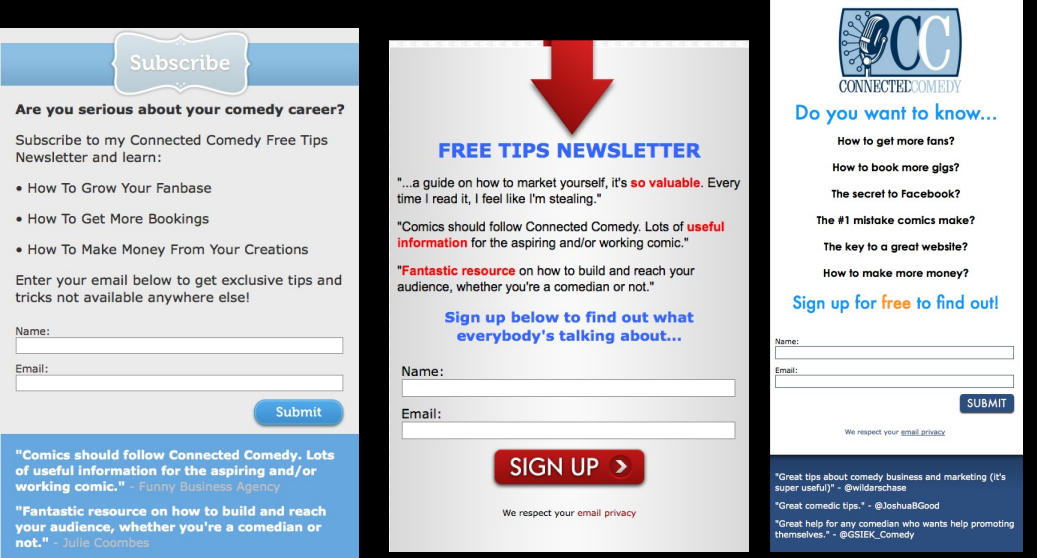
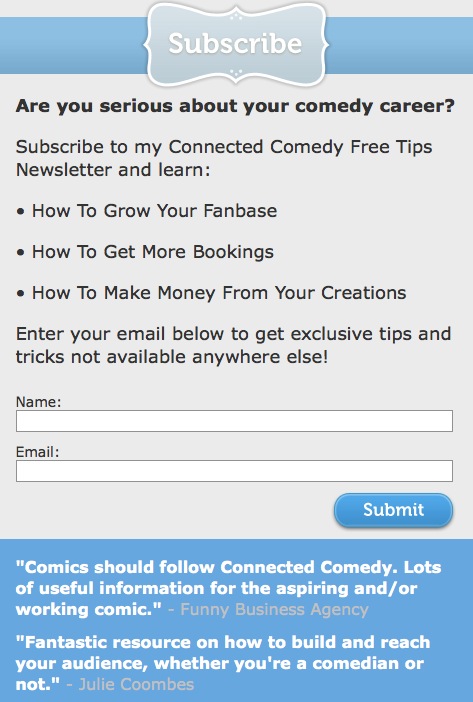
More notably, I changed the form itself – twice. Here’s a look at my original form (on the left) followed by the next two versions I tried.

Click to enlarge

When the original version of my pop-up form was running,  3.3% of the people who saw it wound up joining my email list.

Version 2 of the form was designed to see what would happen with a different design and one which played up quotes from people about the newsletter as opposed to detailing the service it provides. Unfortunately, that didn’t work out very well as my conversion rate plummeted to 1.3%.

Realizing that wasn’t working, I changed on the fly and designed version 3, which included a Connected Comedy logo and an emphasis on the questions that I answer through my Free Tips Newsletter. This one has only been running for a couple days, but the results are definitely more encouraging as 2.9% of the people that have seen it have joined my list.

Unfortunately, that’s still below the original version of the form, but I’m going to give it a few more days for a larger sample before making any additional changes or switching back to the old form.

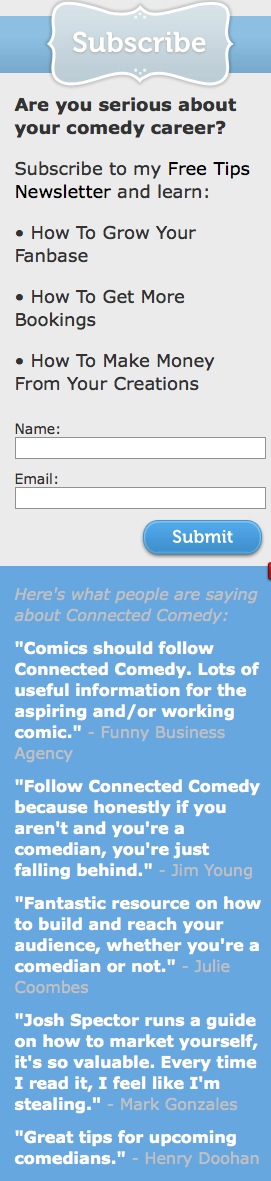
I had better results when I made changes to the Sidebar Form on my site. Here’s what the old form looked like:

Click to enlarge

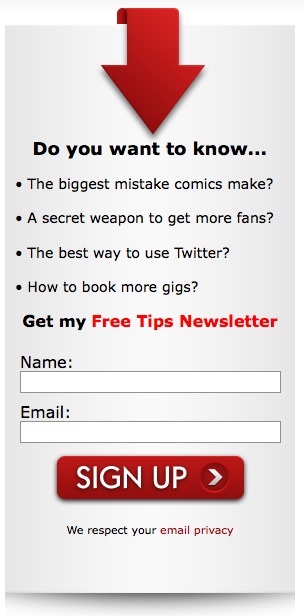
That old form converted just 0.6% of the people who saw it into subscribers. I switched it up to a new design that would be shorter, and more importantly featured a big red arrow hoping that it would catch more people’s attention as opposed to blending into my site’s color scheme like the old one did. Here’s what it looks like:

Click to enlarge

There wasn’t a huge difference in results, but this new form did prove more effective as the conversion rate grew to 0.8%. I may still experiment some more with it, but it’s nice to see at least I took a step in the right direction.

HOW I DID IT: MORE TRAFFIC

It’s simple math that the more people I get to visit my site, the more email subscribers I will get assuming my content is good and my subscription forms are relatively effective. So, I set out to try to increase traffic to this site this week and was successful.

Even though I only posted a couple new articles this week (which is about what I usually do), I also shared links to some of my older popular articles through Facebook, Twitter and my email list. As a result, links I shared to articles like 25 Things Most Comedians Do and 4 Misconceptions Comedians Have About Stage Time suddenly got spread around and brought in a bunch of new traffic without me actually having to do any additional new work.

I think there’s a good lesson here in the value of quality, timeless content – you can always re-promote it because the chances are there will be lots of your readers who only discovered you after it was originally published.

The result of these moves was a 63% increase in traffic to my website last week compared to the previous week and, like I said, more traffic equals more subscribers. Plus, there was a direct correlation to me re-promoting those old posts as I got 11 new subscribers who signed up on my stage time article page and 7 who signed up on the 25 things most comedians do page.

WHAT’S NEXT

I’m off to a good start with this project, but I’ve still got a long way to go. In this next week I’ll likely continue to try some different subscription forms, promoting some of my most popular articles, and I’ll see if the addition of my new Comedy News page has an impact in attracting some new traffic to the site as well.

Stay tuned…

Comedian Websites: 10 Lessons For You From Popular Comics’ Websites

Comedian websites vary greatly when it comes to how they’re designed, their goals, and ultimately how effective they are. But that doesn’t mean there’s not lessons you can learn from looking at them.

I’ve checked out the websites of several popular comedians and put together a few things worth noting from them.

Unfortunately, the vast majority of comedians’ websites really aren’t that great – it’s pretty pathetic to be completely honest – but I have managed to find at least 10 lessons you can learn from how some successful comedians are using their official websites. Here they are…

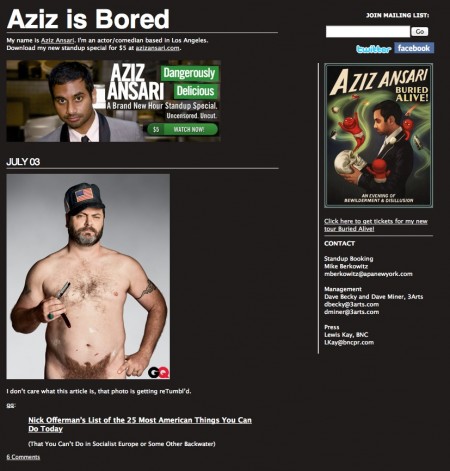
Aziz Ansari

The Lesson: Be an early adopter.

Not only has Aziz been using the Internet actively since the early days of his career, he was one of the first comedians to use the Tumblr platform for his official website. He first launched his site on Tumblr way back on January 1, 2008, and it’s likely he gained a lot by being one of the first to embrace what has become a hub for comedians and comedy fans.

You don’t have to build your own website on every new piece of technology that comes around, but keep an eye on trends and remember that there can be advantages to getting in on the ground floor of something big. And more importantly, recognize that Aziz has been posting content on his website in some form or other for years – something that has surely helped him grow his fanbase.

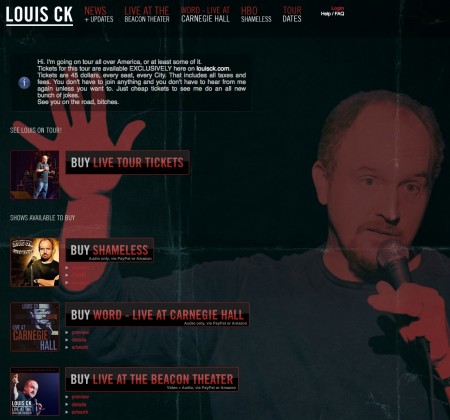
Louis CK

The Lesson: Use your site to control your career.

By now, you’ve probably heard a million times how Louis CK is revolutionizing the comedy business by proving the direct-to-fan model can work for selling everything from albums, to video specials, to tickets to shows. Well, what doesn’t get referenced often is that none of that is possible without a website that is well-designed, simple to use, and effective at converting interested fans into actual paid customers of what you do.

Louis CK’s “new business model” wouldn’t work if his website didn’t live up to its goals.

Zach Galifianakis

The Lesson: Use your domain – even if you don’t have a website.

Just because you don’t have the time, money, or interest in building a new website for yourself, that doesn’t mean you shouldn’t own your own domain and use it in some way until you finally get your act together to put up a proper website. Zach Galifianakis’ website doesn’t exist, but at least he’s put up a clever holding page on his domain that is right in line with his sense of humor.

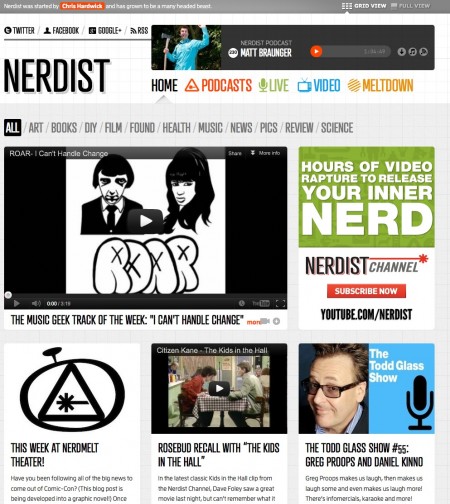
Chris Hardwick

The Lesson: Your website can be more than just your website.

I’ve written extensively before about all the things you can learn from Chris Hardwick’s Nerdist website, but I think the most important thing you can take away from it is that your website can ultimately become much more than just a place to showcase the basic information about yourself and your career.

In Hardwick’s case, his website has literally been the hub to a reinvention of his career that has taken him to new heights and spawned an entire Nerdist empire that includes podcasts, web series, TV deals, and much more. Your website may not ultimately lead to all of those things for you, but it can if you use it the way Hardwick has. And that’s an important thing to remember.

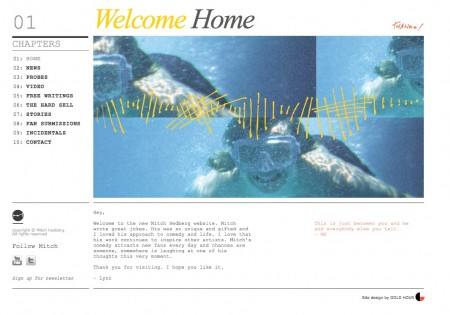
Mitch Hedberg

The Lesson: Everything you do has value to your fans.

Mitch Hedberg may be dead, but his posthumous website is a whole lot better than what most living comedians have. The site is filled with all kinds of interesting excerpts from Mitch’s notebooks, journals, and assorted other artifacts that most comedians probably don’t realize fans would love to see.

You should remember that your fans are likely interested in your process almost as much as they are the end results of that process and look for opportunities to let them more into your world by sharing elements of your process with them on your website.

TJ Miller

The Lesson: Make it fun.

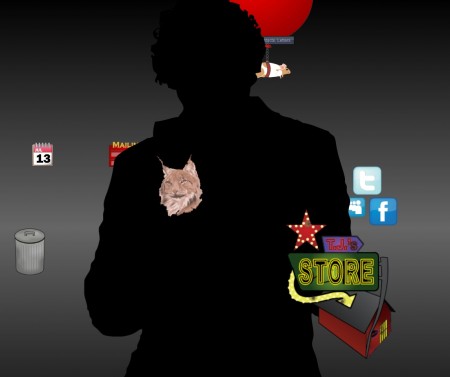
Besides being incredibly unique (which surprisingly most comedians websites are not), TJ Miller’s website is just plain fun. The site is designed for fans to interact with it in unusual ways and enjoy a look into TJ’s world.

A great example of this is TJ’s links page, which features random links to things he finds interesting or amusing. Lots of comedians have a page like this on their site, but very few comedians have it in the form of floating unidentified bubbles which only reveal where they take you once you’ve clicked them. It creates a fun mystery game – and a good way to kill some time.

Chris Rock

The Lesson: Fans are interested in what you’re interested in.

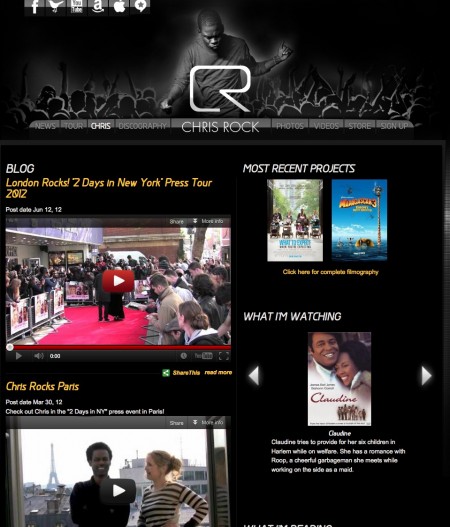
I’ve written before about how important it is to curate content on your website in addition to sharing your own original creations and Chris Rock’s website is a good example of that in action. On the blog section of his site, Chris regularly posts videos of stuff he finds funny – even if he had nothing to do with its creation.

Additionally, he has a section where he shares info about what he’s reading, watching, and listening to – much of which has nothing to do with comedy at all. Your fans – even if you don’t have as many as Chris Rock – are going to be interested in what interests you and your website is the perfect place to share that stuff with them.

 Jeffrey Ross

The Lesson: Enable your fans to get involved.

Another place where many comedians go wrong with their websites is they don’t include any opportunities for their fans to get involved by contributing content to the site. The simplest way to do this is just to allow and encourage comments on the content you post, but you can also get a lot more creative with it.

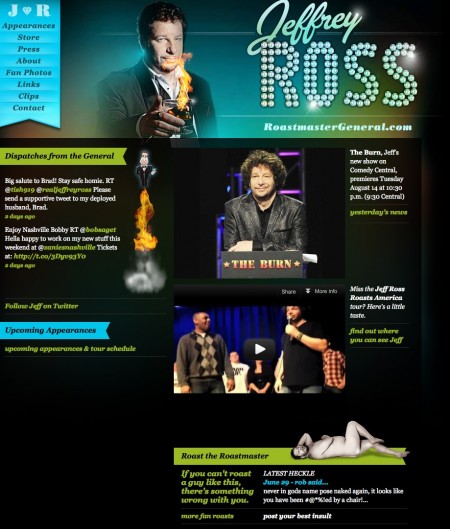
For example, Jeffrey Ross plays up his “Roastmaster General” brand by having a section of his website where he invites fans to “Roast the Roastmaster” by submitting their own roast jokes about him which he features on the site. It’s a nice way to connect with his fans and make them feel like a part of his site.

Jerry Seinfeld

The Lesson: Have a unique approach.

The bottom line is that most comedians are going to have many of the same sections and same basic info on their website. But that doesn’t mean that you can’t try to present it in your own unique way.

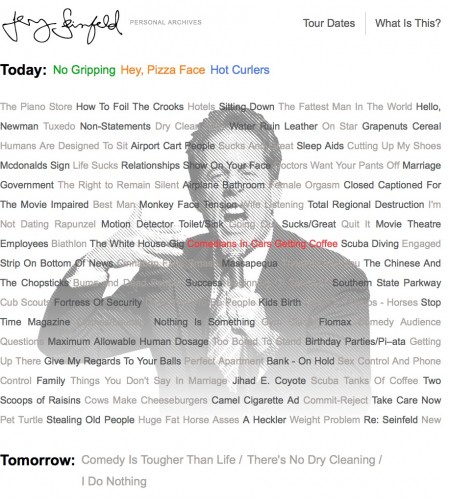
Jerry Seinfeld wanted to have his site showcase his collection of TV appearances over the years – something that is a very common thing for comedians to do. But he came up with a clever way to present it that makes it feel fresh by presenting just three of them a day. In doing so, he’s created a reason for people to keep coming back to the site and built a curiosity factor about what will come next.

In everything you do on your website, think about ways you can present the information that are unique and different than what everybody else does.

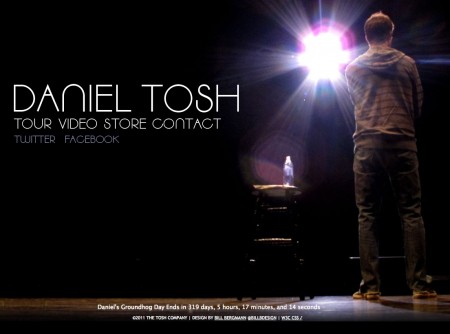
Daniel Tosh

The Lesson: Don’t include features you won’t update.

Another common mistake comedians make is filling their website with all kinds of sections and features that they then never actually update with fresh content. As much as I think you should have an active website that you update regularly, if you’re not going to follow through with that then you’re better off not including those sections at all because otherwise it looks like you’ve just abandoned your site or it’s not important to you.

Daniel Tosh’s site has shockingly little content on it, but at least he’s not promising any. There’s worse things than a clean, simple site like the one he’s currently using.

Now It’s Your Turn: What comedians do you think do a good job with their websites? Leave a comment below and let me know…

Connected Comedy Podcast Episode 7: You Ain’t Got More Sugar Than Me

We’re on iTunes! Please subscribe, rate or review this podcast there!

On the “monetization is not a real word” episode of the podcast, Jordan Cooper, Chelcie Rice, Josh Spector and Josh Homer discuss a comedy club’s role in cultivating local comics, what to do as a comedian if you have to choose between two clubs having a turf war, and the misconception that clubs are actually in the entertainment industry.

Also, Josh Spector gives a glimpse of his plan to grow e-mail subscribers, Josh Homer explains how he collects e-mail addresses at shows, and Jordan spends five minutes explaining how spam blocking works in all the technical detail. What’s your business strategy as a comedian? If you don’t know, then this week’s show is for you.

[powerpress]

Links from this episode:
Why Clean Comedy Clubs Don’t Exist [Jordan Cooper]
Definition of the word “monetization” [Dictionary.com]
Want To Grow Your Email List By 25% This Month? [Connected Comedy]
The Best Tool To Build And Manage Your Email Mailing List [Connected Comedy]
MailChimp

Participate with the CC community in our Connected Comedy Facebook Group or post your questions, suggestions or topics to cover in the future on our Facebook Page.

We always welcome your comments!

Want To Grow Your Email List By 25% This Month? Let’s Do It Together!

I’m going to increase the number of people that join my email list by 25% in the next 30 days.

Ok, maybe I’m not (we’ll see how it goes), but at least I’m setting that goal for myself and I’d like you to do it for yourself too.

Specifically, I’m hoping to increase the number of people that subscribe to my Free Tips Newsletter by 25% compared to the number of new subscribers that I attracted last month.

I’m going to document every step I take to achieve this in a series of  posts over the course of the next month and invite you to follow along. You’ll learn some things about what works and what doesn’t when it comes to building your own email list and I encourage you to participate in this by implementing many of the same tactics I use here over the course of the next month.

I encourage you all to take this “challenge” with me and share your results/findings in the comments. If you’re ready to give it a shot, click here to tell me on Twitter.

But if you’d rather just read along, of course that’s fine too. Now on to the details…

The Starting Point: Setting My Goal

I’ve written extensively about my thoughts regarding how to grow your email list in the past and the tools that I recommend you use to do so, but here’s a quick refresher for you.

The email list I’m asking people to join is my Free Tips Newsletter, through which I offer advice for comedians interested in furthering their career and growing their fanbase.

In the last 30 days, I’ve had 228 people subscribe to my list. Since my goal is to increase new subscriptions by 25% in the next 30 days, the magic number I’m hoping to achieve is 285 new subscribers.

If you’re planning to tackle this challenge along with me, just do the math and figure out your own target number to reach a 25% growth this month. Remember, it’s always important to have goals and metrics to track your progress.

A Closer Look At How I Currently Get New Email Subscribers

At the moment, there are four specific places that people have the opportunity to join my email list. Here’s what they look like and how successful they’ve been in the last month:

• My Popup Form

I have a popup form set to show to every visitor to my website once a month (I limit how often it shows so that I don’t annoy people). This was the most successful form in terms of generating new subscribers last month by a large margin with 137 new subscribers (60% of my total new subscribers) joining my list through this form in the last month. That said, only 3.3% of the people that see it, actually sign up to the list.

Here’s what it looks like:

• My Signup Page

I have a specific page on Connected Comedy that I drive people to for them to join my mailing list. They either get there by clicking the link in the navigation menu at the top of my site, or by clicking the link at the bottom of every single post on my site.

That page generated 49 new subscribers for me last month (21% of my total new subscribers), but converted a whopping 34% of people who visited to the page into new subscribers. That’s a great number and it’s clear the more people I can get to that page, the more subscribers I’ll get.

You can check out what that page looks like here.

• My Sidebar Form

On the sidebar of every page on this website, you’ll see a form for people to join my email list. That sidebar form generated 38 new subscribers for me last month, but converted a pretty low 0.6% of the total number of people that saw it. It’s not surprising that the conversion number is so low considering how often it’s seen and where it’s located on the page, but it would be nice to see that number increase a bit.

• My Facebook Page Tab

The only place that people can join my email list outside of this site is through a form on my Facebook page. That form only attracted 4 new subscribers last month (2% of my total new subscribers), but converted a solid 17% of the people that saw it.

That Facebook tab used to be a great subscription generator for me when you could set it as the landing page for my Facebook page (pre-Timeline), but now it rarely gets seen. It’s a shame since it is a form that converts pretty well.

How I Plan To Get 25% More New Subscribers Next Month

Now that you know what I’m working with, I’ll spell out exactly how I plan to go about increasing my number of new subscribers next month. There are basically five methods I’m going to use to gain new subscribers over the course of the next month:

1. Tweak My Signup Forms

I’m going to experiment with some different signup forms and see if I can improve the percentage of people that actually subscribe when they see the forms.

2. Offer A Special Bonus To People Who Subscribe

I’m not sure what yet, but I’ll come up with some kind of bonus content or exclusive product to encourage people to join my mailing list beyond what they already get.

3. Better Promote My List To My Existing Fans

I have a pretty large following on Facebook, Twitter, Tumblr, and this website. I’m going to experiment with ways to better promote my list to them to make sure that everybody who interacts with Connected Comedy in any way is aware that my Free Tips Newsletter exists and why they should join it.

4. Run Facebook Ads To Attract New Subscribers

I’m not going to spend a ton of money, but I will spend a little to target comedians and introduce them to the newsletter.

5. Incentivize My Current Subscribers To Spread The Word

The best marketers for my mailing list should (hopefully) be people who are already getting it and find it useful. I’m going to come up with some ways to incentivize them to spread the word to their friends and attract new subscribers for me.

Ok, Let’s Do This Thing!

Now that you know where I’m currently at with my email list and how I’m planning to grow it in the next 30 days, all that’s left is for me to actually get my hands dirty and make it happen. I have no idea whether I’ll be successful or not, but either way I will chronicle the results here over the course of the next month for you to see. In success or in failure, I’m sure there will be plenty we can all learn from this.

Again, I’d love for some of you to take this challenge along with me and try to implement some of these same techniques with your own email list and share the results of how it works out for you.

If you’re going to give it a shot, click here to tell me on Twitter.