Josh Spector

Connected Countdown: 10 Things You Need To See This Week

In a new feature here on Connected Comedy, I’m going to include a weekly wrap-up post that breaks down the 10 things I think you most need to see this week. It will include a mix of posts on this site and other stuff from around the web that I think should be on your radar. Here goes…

10. 100 Places To Promote Your Comedy Content

This week marked the release of my debut Premium Report, a 20-page report that is jam packed with tips and information about 100+ Places To Promote Your Comedy Content. I’ve gotten great feedback already from readers who have purchased it, and I want to remind you that it’s available for just $15 as an introductory offer. The price will be increased at this time next week, so if you’re considering buying it I recommend getting it now.

9. A Breakdown Of Kanye West’s Web Presence

This Read Write Web post breaks down exactly how Kanye West has used tools like Facebook, Twitter, and YouTube to conquer the Internet. Some interesting things that can be applied to comedy promotion as well. For even more Kanye-comedy connection, you can also check out my post about What You Can Learn From Kanye.

8. The Connected Comedy Reader Video Of The Day

Over on the Connected Comedy Facebook page, I’ve decided to start sharing a video each day from a Connected Comedy reader with the rest of the page fans. If you’d like to submit your video for consideration, become a fan of the page and post a link on the page discussion board.

7. Conan or Bust

Here’s a really clever promotion/stunt that I came across on Twitter. Comedy writer Joe Piccirillo and his producer friend Pete Jackson are in the midst of traveling across the country for three months where Joe is performing his writing packet to get a job on Conan and Pete is filming/documenting the journey. Should be interesting to see how it turns out.

6. Why You Should Work More Like Silicon Valley And Less Like Hollywood

In this Connected Comedy post, I break down the reasons there’s more for comedians to learn from the engaging methods of digital business culture than there is from the closed, fearful way that Hollywood operates.

5. Gary Vaynerchuk Q&A

This video is a couple months old and it’s about 45 minutes long, but you’ll both learn a lot and be inspired by watching the incredible social media machine that is Gary Vaynerchuk answer questions from the crowd at the Le Web conference.

4. The Hidden Value Of A Direct Relationship With Your Fans

In this Connected Comedy post, I explain how cementing a direct relationship with your fans and no longer needing to depend on gatekeepers like comedy bookers and record labels can free you up to do what’s best for your career in the long term.

3. Facebook Redesigns Its Fan Pages

Yesterday, Facebook rolled out a new design and some new features for its fan pages that many comedians (and all should) have. This Inside Facebook blog post breaks down what the changes are and what they mean for page owners.

2. 9 Questions To Ask Yourself Before You Launch A Live Comedy Show

The most popular post on Connected Comedy this week, lots of readers have found this breakdown of advice for starting your own show to be helpful and I’m guessing you will too if you haven’t checked it out yet.

1. A Breakdown Of How Digital Tools Saved Conan

This lengthy and fantastic article from Fortune breaks down exactly how the Web saved Conan O’Brien. But it goes beyond just chronicling the Team Coco stuff that you’ve likely seen before and provides an in-depth look at the role that digital tools have continued to play in Conan’s success.

Thanks to everybody that’s checked out Connected Comedy this week and especially to those of you that have helped spread the word about what I’m doing here. In case you don’t know – here’s a breakdown of all the ways you can get connected:

• Sign up for the Connected Comedy email newsletter on the sidebar of this page

• Join our Facebook page

• Follow Connected Comedy on Twitter

Email me to discuss other ways I can help you

The Hidden Value Of A Direct Relationship With Your Fans

Over the past couple weeks I’ve come across three different observations from marketing/business people I really respect who discussed the relationship between artists and their fans. These three things combined to remind me that many of you may not be aware of the hidden value of having a direct relationship with your fans.

Before I get into specifics, here’s a quick look at the three things that inspired this post.

Who Are Your Best Fans?

First, marketing genius Seth Godin wrote a post about considering how you treat your best customers, which can easily be applied to how you treat your biggest fans as well. In it, he makes this excellent observation:

If you define “best customer” as the customer who pays you the most, then I guess it’s not surprising that the reflex instinct is to charge them more. After all, they’re happy to pay.

But what if you define “best customer” as the person who brings you new customers through frequent referrals, and who sticks with you through thick and thin? That customer, I think, is worth far more than what she might pay you in any one transaction. In fact, if you think of that customer as your best marketer instead, it might change everything.

You Are The Product

The next thing that caught my eye recently was a post from Julien Smith (author of the highly recommended Trust Agents book), which suggests that the future of blogs is paid access. Again, this can easily be extrapolated to apply to fans. Here’s an excerpt that caught my eye:

Something big changed with the web. We could create personal brands, broadcast ourselves for free, and create a following. Except if we got popular, we started not being able to pay attention to everyone anymore. This is normal.

I’m thinking of Richard Nikoley. His (successful) experiment with not washing his hair for two years has led to articles in the Chicago Tribune and other places. He can’t handle the emails he gets anymore. Also Chris Guillebeau, who recently got 800 comments on a post he put out.

As Aaron Wall has said, popularity is an inequality between supply and demand. You solve it by raising price.

Books and conferences are price points– they are old methods that people are used to and don’t flinch at. I use both, and they work well. But there’s a problem with them.

Middlemen take over the old methods. They live as parasites off what you and I produce. Many of them do it without adding any value whatsoever.

There is something missing from Kevin Kelly’s 1000 True Fans method. It is fine for artists, for producers of actual artifacts, artists, etc. This is one reason Seth Godin’s Domino Project is so interesting. It cuts middlemen out. But it still requires the creation of an artifact… of a product.

What if YOU were the product?

I believe that what people want when they read your book, when they come to see you speak, or sing, or when they buy art from you– I believe that what they actually want is you.

Direct To Fan Marketing In The Music Biz

Finally, I watched an interesting video of a presentation given by Mike King, a music marketing expert, in which he spends an hour talking about direct-to-fan marketing methods in the music industry. Here’s the video:

So What?

Ok, so what do I take away from these three things and why should you care?

I believe there’s a tremendous hidden value to creating a direct relationship with your fans because when you have to go through the gatekeepers – club owners, bookers, record labels, etc. –  to reach an audience, you’re limited in what you can offer that audience. That’s not to say that you should ignore the gatekeepers completely and there’s nothing wrong with working with them, but the stronger the direct relationship you have with your fans, the more freedom you have to get creative in what you offer to them and ultimately how you monetize them.

Here’s a few examples:

Maybe your fans would love the opportunity to party with you and go on a bar crawl together? There’s probably people that would pay a lot of money to have that unique experience (this post keeps popping up). There may be lots of money in this for you, but there’s none in it for the gatekeepers. And you can’t do it unless you have a direct connection to your fans where you can make them that offer and they can take you up on it.

A direct relationship with your fans also allows you to better understand why they’re you’re fans and what they want from you. In the old model, you didn’t really have any way to communicate with your fans on a mass scale and therefore weren’t able to adjust your products and strategy to their interests. But now, if you have a direct relationship with your fans, you can ask them what types of venues they’d like to see you play. You can ask them who they’d like to see you perform with. You can ask them what they’d like to hear you discuss on your podcast. It allows you to better serve your audience, which in turn further cements your relationship with them.

A direct relationship with your fans also allows you to create your own pricing structure. For example, maybe you want to give a copy of your new album for free to anybody that bought your last album? Maybe you think that there’s more value in rewarding your best fans, than their is trying to get more money out of them. Well, the gatekeepers (your label) probably aren’t going to love that idea because there’s nothing in it for them. But if you’ve got a direct relationship with your fans and control your own sales process, then you’re free to do what you want.

Having a direct relationship with your fans allows you to think about what’s best for your career in the long term, as opposed to having to do what’s best for your gatekeepers in the short term. That’s the hidden value.

And is there anything more valuable than that?

9 Questions To Ask Yourself Before You Launch Your Own Live Comedy Show

Over on the Connected Comedy Facebook page, a reader recently asked a question about how he could get more bookings since he was having a hard time getting stage time in his town. I suggested that he consider starting his own stand up comedy show, to which he replied that he had no idea how to do that.

So, in addition to throwing the question out to the other Connected Comedy Facebook fans (who contributed some great advice on the Facebook page), I decided to take a moment to share some of my own advice here on the site.

Because every situation is different, rather than just tell you what to do I thought I’d give you 9 Questions To Ask Yourself Before You Launch Your Own Live Comedy Show. Giving some thought to these questions will help you figure out what will work best for you when it comes to launching and running your own show.

1. What Do You Hope To Get Out Of Running Your Own Show?

As with most things you undertake, I think it’s extremely important to take a moment to think about why you’re doing it and what you hope to get out of it. Answering that one simple question can help guide every decision you make in terms of how you put together the show.

For example, if you’re starting your own show because you need more stage time then you really just need to focus on creating a show that will be big enough to sustain and justify its existence in order to continue to give you more stage time. If you’re starting a show to make money, then you’re going to need to focus more on the economics and size of the show in order to do that. Most shows that fail probably fail in part because the person who created them didn’t really know what they hoped to get out of them and without a goal, they lost their way.

2. What Will Make Your Show Different?

This is a tough one, but it’s also one of the most important things you have to figure out when starting a show. In just about every city, there’s lots of different comedy shows that you’re going to have to compete with for performers and audience members. But oddly enough, most of those shows are pretty much the same – they have no hook, and there’s nothing setting the experience of attending them out from the crowd. You should try to avoid being “just another standup show” at all costs.

As I’ve written about before in my post about the value of creating unique experiences, you want to create a show that is unlike any other that your audience has seen. The more unique, the more likely it will be to catch people’s attention, the more likely they will be to check it out, the more likely they will be to come back, and the more likely they will be to tell their friends about it.

3. Who Is Your Audience?

Before you can find your audience and convince them to come to your show, you’re going to need to take a moment to figure out who you think is the right audience for the show you’re creating. It’s not good enough to just say that your audience is “people who like comedy,” you’re better off trying to think about exactly what kind of people like the kind of comedy you will feature in your show.

Is it family friendly? Is it filthy? Is it about couples and relationships? Is it about college life? Understanding what types of people will be most likely to enjoy your show is an important first step when it comes to finding your audience. Which leads me to my next question…

4. How Will You Find Your Audience?

Once you know the kinds of people that you think will enjoy your show, the next step is to start figuring out where you can reach them and how you can get them to know that your show exists. There’s lots of different ways to do this – everything from flyers, to online ads, to good old word of mouth. But I think that you’ll find that the more specifically targeted your audience, the easier they are to find. Once you know the community you’re going after, you can figure out where to find them.

For example, several years ago I produced a show featuring stoner comedians that I knew I was planning to launch as a monthly event in Los Angeles and then eventually take on the road across the country. Since I knew my show would appeal to marijuana smokers, I also knew how to find my audience. I did a deal with High Times magazine and pot legalization organization NORML to help promote and sponsor the show (having a defined audience – in this case pot smokers – also can help you get sponsors that want to reach that audience), and often promoted the local shows through medical marijuana clubs and marijuana-related websites.

5. What’s In It For The Venue?

Deciding on an appropriate venue to host your comedy show can be difficult and there’s lots of obvious factors that you need to take into account: size, location, cost, etc. But one thing that people often forget to think about is to ask themselves what’s in it for the venue? Before you approach a venue to discuss using it as a location for your show, you should know exactly what you are bringing to the table for them and be prepared to explain to them why they should let you host it there. Maybe you’re bringing an audience that will buy the venue’s food and alcohol. Maybe you’re exposing people to their business or other interest. Maybe you’re providing entertainment to their existing customers. There’s no right or wrong answer, but it’s a question you should be prepared to answer.

6. Are You Doing This To Make Money?

In my opinion, you’re either launching a show to make money or you’re not. If you’re not in it to make money (which is perfectly acceptable and in many cases a better idea), then you shouldn’t bother charging money for tickets. If you’re running the show for exposure or stage time, then give the tickets away, give away free beer (if you can), and give away as much as you can to make it a great experience for the audience. After all, you’re not in it for their money – you’re just hoping they’ll come out and support you and your show.

If you are in it for the money, then you should remember that with every decision you make. If you’re going to charge somebody $20 to come to your show, then you better make sure that you give them $20 worth of entertainment. And that may mean telling your buddy he can’t perform if he’s not really ready yet. And if the show’s about making money for you, then you should look for every possible way to monetize. Is a comedy club better for your personal career exposure? Maybe. But if you can make more money holding the show in a local bar, then do that. Again, if you’re starting a show to make money as your main goal, then remember that it’s your main goal and proceed accordingly.

7. Why Should Somebody Come Back To Your Show?

Assuming you successfully manage to get people to come to your show, the next big question is to figure out a reason for them to come back to the next one. Truly successful shows build up their audiences over time and ultimately about 50% of the crowd is probably a return visitor – maybe even more. To do this, you should think about why somebody would want to repeat the experience – maybe it’s new comics every time, maybe it’s returning comics who they loved doing new material, maybe it’s some kind of discount for “regulars.” Whatever it is, there needs to be some reason to give people to come back.

8. Are You Prepared To Put In The Necessary Time To Succeed?

Running your own comedy show can be great, but let’s be honest – it’s a LOT of hard work. It’s not the kind of thing you can half-ass, and it’s also the kind of project that takes some time to make successful. If you’re not really prepared to put the time and effort into running and promoting a show, then it’s probably not a good idea to start one. If you still want to start one and know you can’t do it on your own, then consider teaming up with somebody else who can help shoulder the load. Because it’s not going to be easy.

9. Is This Going To Be Fun For You?

It’s a simple question but one that too often people rarely ask themselves. Is launching and running your own live comedy show going to be fun for you? Are you passionate about doing it? If you’re not, it’s probably not going to work. And besides, why would you want to do something that’s not fun anyway?

For a look at what can happen when all of these things come together, check out this recent Carson Daly profile of the Comedy Meltdown show in Los Angeles which has become one of the best shows in town.

Why You Should Work More Like Silicon Valley And Less Like Hollywood

One of the things that fascinates me most these days about the business world is watching how Silicon Valley’s digital companies awkwardly try to interact and work with Hollywood’s entertainment industry behemoths. These partnerships rarely work out (see: AOL/Time Warner) and the reason is usually that the cultures and approaches to work in the digital world are so completely different from that of Hollywood.

Comedians tend to approach their business in much the same way that Hollywood companies do which makes sense given that they’re both based on entertaining an audience, but I think that’s a mistake. I believe that comedians would be better served to model their business strategy after the beliefs that are held by most digital companies, because those companies and their strategies will better prepare you for success in the new economy we’re inhabiting.

Here’s five specific ways in which I think you’d be better served by following the Silicon Valley line of thinking…

1. Silicon Valley Embraces Failure, Hollywood Runs From It

One of the biggest differences in philosophy between Hollywood and Silicon Valley is the way that they each deal with failure. In Hollywood, failure is so frowned upon that it’s created a culture where the entire industry is afraid to take a chance or risk saying “yes” to just about anything.

It’s led to filmmakers being thrown in “movie jail,” a term that refers to a filmmaker whose movie failed at the box office and is unable to get any more opportunities because the industry is afraid he’ll fail again – even if he’s previously had lots of other success.

It’s led to a culture of “No,” where executives at every level are afraid to say yes to projects they love because they know that actually taking a chance on something could cost them their job if it doesn’t work. It’s safer to just keep saying no to things, and then ultimately only saying yes to safe projects. And inevitably, safe projects are safe because they are mediocre. Thus, the incredible amount of mediocrity that Hollywood churns out each year.

But Silicon Valley has an opposite view of failure. In the digital world, failure is viewed as a positive thing and it’s expected that a digital entrepreneur have multiple failures before they ultimately succeed. After all, each failure brings with it important lessons and knowledge which helps a creator refine their vision and ultimately succeed.

In the comedy world, I believe this is also true. How can you develop great new material without being willing to have a few jokes fail? How will you know if you’re a better podcaster than sketch comedian, if you don’t try it?

To succeed in comedy you have to be willing to fail. And fail again. And keep failing…until you learn enough about your own strengths and weaknesses to succeed. No comedian ever made it big by playing it safe.

2. Silicon Valley Asks Its Audience What It Wants, Hollywood Tells Its Audience What To Like

If you look at most digital creations these days, they have social functionality built in and the companies behind them make it easy for users to communicate with them what they want in the product. This is because Silicon Valley understands that new technologies have empowered the audience to communicate exactly what they want or don’t want in a product and how they want to engage with it.

On the other hand, Hollywood rarely seems interested in hearing what its audience wants. Most Hollywood creations are pushed upon its audience through commercials, movie trailers, and advertisements that try to convince the audience that their product is exactly what the audience wants or needs. But the problem is, that’s not true. Years ago, the audience had no direct way to convey its desires  to Hollywood or amongst itself, but now it does. Hollywood just doesn’t care enough to listen.

The same applies for the comedy world. The audience is out there and they can now easily tell you what kind of stuff they want or don’t want. They will tell you what they think is funny and what they don’t. Things like tweets and YouTube comments may seem meaningless, but they’re not. They’re your audience trying to tell you what they want – you should probably take a couple minutes to listen.

3. Silicon Valley Gives Things Away, Hollywood Charges For Everything

Here’s an obvious one. Many of the Silicon Valley creations that you probably value most are given away for free – Facebook, Twitter, YouTube, Google, etc. Despite the fact that many people would probably pay for the use of these services, Silicon Valley understands that they can generate more value by giving them away for free than they can by charging for them.

As far as Hollywood goes, well…they don’t love giving stuff away. In another completely opposite business approach, Hollywood tries to figure out ways to charge you multiple times for the same content by creating distribution windows – i.e., pay to watch a movie in a theater, then pay to watch it on demand, then pay to buy the DVD. This system has made a lot of money for Hollywood over the years, but it’s all starting to come crashing down thanks to digital companies that don’t share the same mindset (see: Netflix).

As a comedian, you would be wise to side with the Silicon Valley strategy here and understand that you are better served in most cases by giving away your content than you are to cling to the idea that you have to monetize every little thing you do. Dane Cook built his empire of college fans by flooding Napster with free downloads of his material – he realized early on that there was more value in people hearing his act and becoming fans than there was in trying to make people pay for the privilege of getting to know him. And that was already several years ago – the pendulum has swung even more towards the value of free these days than it was then.
4. Silicon Valley Bets Small And Wins Big. Hollywood Bets Big And Loses Bigger

This is related to my previous point about Hollywood’s fear of failure and Silicon Valley’s embracing of it. One of the reasons that Hollywood is afraid of failure is because it bets big on just about everything it does. When a movie costs $200 million to make, it’s understandable that you might be a little hesitant to take risks. But here’s the thing: movies don’t need to cost $200 million.

Hollywood chooses to bet big (and waste big money – I’ve worked at studios and seen it first hand), and as a result it often loses bigger. Hollywood even brags about its bets, acting as if spending $100 million to make a 90-minute movie is somehow a badge of honor. It’s not. It’s just stupid.

Silicon Valley on the other hand prides itself on doing things on the cheap, betting small on things that have the chance to pay off huge. There’s endless examples of this even if the Mark Zuckerberg story of launching a multi-billion dollar company out of his dorm room happens to be the one on the top of everybody’s mind at the moment.

As a comedy creator, you should relish in the fact that you no longer need to bet big like Hollywood in order to create things and build an audience. Thanks to so many of the free tools that Silicon Valley has created for you, you don’t need a studio’s money to fund your passion projects. Sure, you’ll always wish you had a little bigger budget to do things, but you don’t need it. And if you can learn how to succeed by betting small, there will be much bigger things that come your way down the road.

5. Silicon Valley Empowers Its Audience To Do Its Marketing. Hollywood Empowers Advertising Agencies To Do Its Marketing

How did you hear about YouTube? A friend probably sent you a video. How did you hear about Facebook and Twitter? A friend probably sent you an invite to join. You know what it cost YouTube, Facebook, and Twitter to get you to know that they exist? Nothing. That’s the brilliance of Silicon Valley marketing.

Digital companies understand that in the new media landscape quality products can market themselves by allowing (and encouraging) their audience to do the marketing for them. Not only is this more cost effective than traditional marketing, but it’s also just more effective period because people trust their friends more than they do a brand or company.

Meanwhile, Hollywood believes the best way to introduce their products to you is to hire ad agencies and media buyers to cram advertisements down your throat. This is expensive, and ultimately not as effective as word of mouth.

Many comedians think that the key to selling more tickets to their shows or copies of their albums is to have a bigger advertising budget (the way Hollywood does it), but they’re wrong. The key is to figure out how to empower your audience to do your marketing for you. The same way digital companies do.


5 Free Tips For Sketch Group Dizzy Peoples Comedy

In 5 Free Tips, I provide some free advice specifically tailored to one person’s content. If you’d like me to give you 5 Free Tips, please send me an email and tell me a little about yourself.

Today’s free tips are for sketch group Dizzy People’s Comedy, who sent me the following email:

Hi, Josh,

I’ve been reading your blog and thought I’d write in.  I’m part of a sketch comedy group at Skidmore College in Saratoga Springs, NY.  We built a strong campus following (and even some online) during our first two years with a sitcom called “College is HARD” (youtube.com/collegeishardtheshow) and now we’re working on sketches as Dizzy Peoples Comedy (facebook.com/DizzyPeoplesComedy, youtube.com/DizzyPeoplesComedy).

We’ve tried to make the most of the campus audience and the people who have found us online and we’re wondering how to reach more people and build an audience we can keep after graduation.

Thanks a lot for reading and for your blog,

Alex Dayan

I checked out Dizzy Peoples Comedy’s videos and came up with the following 5 Free Tips for them:

TIP #1: Get A Website

I know it seems simplistic, but the first thing you need to do if you’re looking to build a following is to get your group a website so that you have a hub for people to find information about the group and your work. It’s great to be on YouTube and Facebook, but you should also set up DizzyPeoplesComedy.com (it’s available, I checked) and make that your base of operations.

Having your own website is important not only because it makes it easier for fans to find you and information about what you do, but it will also come in handy as you grow and want to start interacting with the industry and people who can give you new opportunities. Not having a website just looks unprofessional and conveys that you’re not really serious about what you’re doing – even to casual fans.

On a side note, your website doesn’t have to be expensive or elaborate. You just need something functional that explains who you are and what you do. Ideally, you can also use it to attract new fans and grow your following by posting other content (blog posts, funny pictures, etc.) on your site that you currently have no outlet for.

TIP #2: Use YouTube Annotations

It looks like you haven’t been using annotations on your YouTube videos and that’s a missed opportunity. Here’s a basic overview of how annotations work, but they can be very effective in driving more views to your videos and subscribers to your channel. They can also be used to plug your new website once you’ve got that up and running.

There’s no set rules for how to best use annotations, but I’d recommend checking out how many of the most subscribed comedy channels use them on their videos and you’ll likely get some good ideas of what’s possible with them.

TIP #3: Convert Your “College Is Hard” Fans

I noticed that your previous YouTube channel, College Is Hard, has 900+ subscribers while your new Dizzy Peoples Comedy channel only has about 100. You should do everything you can to convince those College Is Hard subscribers to sign up for your new channel.

I’d suggest messaging the subscribers individually and/or commenting on their pages to tell them about the new channel, and you also may want to consider putting a new video on the College channel that’s a promotion for your new channel and asking people to subscribe by clicking an annotation that you can place on the video with a subscribe link.

Another thing you can do is to send a bulletin to your College Is Hard subscribers telling them about your new channel and new videos. You put a lot of time and effort into gaining those 900 subscribers on your first channel I’m sure, and it would be a real waste to leave them behind.

TIP #4: Brand Everything You Create

If your goal is to increase the exposure for Dizzy Peoples Comedy, then you want to do everything in your power to associate that brand name with your work. This means that if somebody who doesn’t know about you guys happens to come across one of your videos and likes it, they should be able to easily see that it was a Dizzy Peoples creation. There’s a lot of ways to do this, but a couple things I would suggest is to include a watermark on your videos that says the group’s name and to include the group’s name in the title of all of your videos.

For example, your “They Were Dead The Whole Time” video should be titled “They Were Dead The Whole Time – Dizzy Peoples Comedy.” When somebody who doesn’t know you sees one of your videos and likes it, you want them to know who made it and ideally to go seek out more of your work. And when they do, they’ll find other videos with your brand name in the title and when they search Google, they’ll (hopefully) see your new official website which will be a great entry into becoming a Dizzy Peoples fan.

TIP #5: Encourage Your Existing Fans To Help You Gain New Fans

You’re lucky that you’ve already got a bit of a fanbase because you’ve been doing this for a little while and people like your work. You should try to come up with creative ways to encourage your existing fans to help spread the word about you to people who may not know you exist.

For example, you could have a contest or promotion where any of your fans that gets 20 of their friends to like your Facebook page will then get to have their name mentioned in one of your sketches. This will encourage your fans to be more active in spreading the word about you, as opposed to just sitting back and enjoying your work.

There’s lots of different ways to do this, but the main takeaway is to think about things you can do to get each of your fans to spread the word and to feel like they want to help you grow and succeed.

I hope these tips help you guys, and if anybody else would like to get 5 Free Tips, please let me know.

Why You Should Get To Know A Viral Agency

One of the great things about the explosion of social media has been that it’s created a lot of new opportunities for comedians to get exposure (and paying work) that were never out there before. But, there’s really no place that talks about these new opportunities because most people working in the traditional comedy business (managers, agents, comedy clubs, bookers) tend to ignore their existence. As a result, it’s often up to individual comedians to seek out connections with people and companies that can provide them with new opportunities on their own.

One example of this that I wanted to mention today is viral or social media agencies. This is a very broad term, but essentially I’m talking about companies that work with brands and advertisers to create digital marketing campaigns. These campaigns are usually driven by content, and that content is often times meant to be funny because funny stuff tends to go viral. As a result, lots of these viral agencies are always looking to hire comedians to work on their campaigns as writers, and performers.

One example of this in action is a recent campaign from the Los Angeles-based agency Famous Interactive. They recently launched My 4Square Alibi, an entertaining viral campaign designed to showcase what they can do for brands. It’s a cool and fun campaign centered around allowing people to “check in” to fake 4square locations, but what’s really worth noting for me is the role that comedians played in its creation.

While the site was the brainchild of Famous social media strategist Sonya Cifuentes-Hiss, comedians Mike Holmes and Dan Bialek teamed up with copywriter Andrew Menendez to write all the copy for the website and the scripts for the testimonials.

Additionally, a slew of Los Angeles comedians were tapped to portray various funny characters in the viral videos that were produced to promote the site. Bil Dwyer, Frank Conniff, Brady Novak, Andrew DeWitt, Barry Rothbart, Shannon Hatch, Heather Thomson, Mike Burns, Raj Desai, Lizzy Cooperman, Mike Holmes and Dan Bialek all appeared in videos as part of the promotion. They also got themselves on the radar of the agency that can provide them with additional work and exposure on future campaigns.

Here’s a couple examples of the finished videos:

This is a whole new element to the comedy industry that most comedians haven’t figured out exists yet. There’s hundreds of viral marketing agencies out there and all of them are potential sources of work and exposure for you if you can get on their radar. All you have to do is track them down and let them know what you can do.

You never know, you might find yourself in the next viral video smash.

Looking for more? Check out some of my other money making tips for comedians.

The Power Of Momentum

With so many outlets and tools available to grow your fanbase and promote your content these days, it’s very easy to get overwhelmed.

Comedians are bombarded with messages (including from people like me) that they need to use tools like Twitter, Facebook, Tumblr, YouTube, a blog and more to grow their career. But often times, the scope of it all leads you to throw your hands up in the air and give up in exasperation at the thought of it all.

But here’s the secret: You don’t have to do everything. You just have to do something.

To embrace all these tools and use them correctly takes time and it’s just not realistic to think that everybody has the time to do it all. However, I do think it’s feasible for you to embrace at least one of these opportunities and make a genuine effort to use it to further your career.

If you do, I’m sure you’ll find that your commitment to develop your presence or create content using one of these platforms will lead to better results than you would have expected.

I’m a big believer in the power of momentum. Things don’t just happen all at once, they happen gradually. But they progress at an increasing rate as you continue to take small steps to your goal. You build momentum, and that momentum ultimately takes on a life of its own.

So my advice to any of you that may be reading Connected Comedy and getting equal parts inspired and overwhelmed at everything that’s out there is to take a breath and start small. Pick one thing that you’re not doing at this point and just concentrate on that for a month.

It doesn’t matter what you start with, all that matters is that you start.

I guarantee if you do that, and if you focus on that one thing and one thing only for a month, you will see positive results. And those positive results will fuel you to move on and tackle another thing in the next month.

That’s the power of momentum.

How I Increased My Facebook Fans By 470% In Two Days For $20

Until a couple days ago, I hadn’t really done much to grow my Connected Comedy Facebook fan page and therefore it had only accumulated 66 fans. Those fans came mainly from a mix of friends and people I knew personally, as well as people who happened to stumble across the page as promoted in the sidebar of this site.

But I decided to put a little effort into growing the page and, more importantly, to introduce Connected Comedy to a larger audience through Facebook. To do so, I ran an ad for the page on Facebook. The ad has been very effective so far, and despite only spending $20, I more than quadrupled the fans of the page and I’m now up to 311 fans as I type this.

Here’s a basic primer to running Facebook ads, but I thought I’d share with you my strategy behind the ad and a glimpse at the stats behind the end results, because there’s probably a few things you can learn and apply to promoting your own Facebook pages.

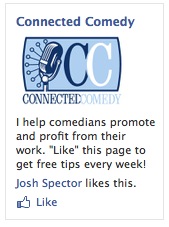
For starters, here’s a copy of the ad that I created:

Simple enough, right? Well, here’s a few things you should know about the thinking behind its creation:

1. It’s A Facebook Page, Not A Group or Personal Profile

The first thing you should understand is that I set up Connected Comedy as a Facebook Page, as opposed to a Group or Personal Profile page. This has a lot of advantages, but one of them is that when running an ad for the page I had the option to include a “Like” button in the ad so that people can like it from the ad without even clicking through if they don’t want to.

2. It’s Informal

While your instincts may be to make yourself seem more “professional” and write in a formal manner, I’ve found that informal and personal is always better. Even for Connected Comedy, which offers professional advice, I decided to write informal copy in the ad. This is why it’s written in first person (“I help comedians…”), and why I avoided words like “marketing” and “business” that sounded too corporate. People want to connect with other people, not companies.

3. It Gives People A Reason To Join

Nothing’s more important in a Facebook ad than presenting a clear explanation of what somebody gets in return for doing what you want them to do. In this case, my ad clearly explains that you will get free tips if you “Like” the page – that’s a compelling reason to join if you’re a comedian. You should always figure out what you can offer people of value as a reason to “Like” your page. Make the ad about what’s in it for them, not what’s in it for you.

4. It’s Hyper Targeted

I was running a CPC campaign (which means I only pay when somebody actually clicks on the ad as opposed to a CPM campaign in which you pay every time the ad is displayed), so I wanted to make sure I targeted the ad as specifically as possible on people that I thought would enjoy Connected Comedy if they actually clicked the ad. This means I didn’t want people who were just casual comedy fans, or curious about what Connected Comedy was. I wanted comedy professionals who would be most likely to convert to fans after they clicked the ad and saw my page. That way I would get the most bang for my buck.

To do this, I targeted very specific keywords including “Comedian,” “Stand Up Comedian,” and “Laughstub” (a website that’s primarily used by professional comedians) and avoided broader keywords like Comedy, Comedy Central, and Funny Videos. Again, I knew the key to getting the highest conversion rate was getting comedy creators seeing and clicking the ad and making sure that general comedy consumers didn’t click on it.

5. It Leverages The Power Of Endorsements

Here’s the biggest reason I think this ad has been so effective. I set the ad to target people whose friends were already connected to the Connected Comedy Facebook page. What that means is that I targeted the friends of the 66 fans I already had of the page. As a result, when those people saw the ad, it appeared with a line that referenced that their friend was already a fan of Connected Comedy (it looks just like the line you see above that says “Josh Spector likes this.”)

This is very important in my opinion because it means that my ad is essentially running with the implied endorsement of people’s friends. In fact, so far 87% of the people who have seen my ad saw it with one of their friends referenced as already liking the page in the ad (Facebook provides this stat in its ad analytics). Needless to say, if you see a page that your friend already likes you are going to be way more likely to check out the page yourself as opposed to just seeing a random ad for a page you know nothing about. Also, even though I only had 66 fans of my page initially, I was still able to generate an initial pool of 5,000 people to target the ad to, so you don’t need a huge initial fan base to implement this strategy.

INSIDE THE NUMBERS

I’m a big stats junkie, so here’s a breakdown of exactly what happened in the first two days I ran this ad for the Connected Comedy Facebook page:

• The ad was displayed 77,946 times (Facebook has a LOT of traffic in case you didn’t realize that by now).

• The ad was clicked 258 times.

• Of the 258 people who clicked through the ad to the Connected Comedy Facebook page, 104 of them took an action. This means that they either liked the page, shared a post, or commented on a post. But it mostly means they liked the page.

• The average cost per click it cost me was $0.07, which means I spent a total of $20. Remember, I was running a CPC campaign so I only paid when people actually clicked the ads.

• Here’s a fun stat for you: The average Facebook user has 150 friends, which means that if 245 new people fanned my page and their friends saw that action in their news feeds, then those 245 new fans actually exposed Connected Comedy to an estimated 36,750 of their friends!

Obviously, I’m pleased with the results of this little ad experiment, but the real reason I’m happy is not just because I added a bunch more fans. Rather, it’s because I added high quality targeted fans who will care about the content I share and will likely become a part of the community we’re building here and then ultimately spread the word to others.

How do I know? Because I’ve already had multiple people email me with questions, comments, and compliments about Connected Comedy, a site they didn’t know existed two days and $20 ago. Pretty cool, huh?

Looking for more help? Check out some of my other comedy promotion tips.

QUICK CLICKS: The Oatmeal’s Success, $30 Million For LOLCats, Tweet Frequency Stats, & More!

Here’s a few  things I’ve come across recently that are worth a click:

Mashable has an interesting interview with Matthew Inman, the creator of The Oatmeal, about how he does his work and why he thinks his site has become one of the most popular humor sites on the web in less than two years since its launch.

• The Cheezburger Network, also known as the guys behind such Internet phenomenons as LOLCats and FailBlog (and whose founder I previously wrote about here), have raised a whopping $30 million to expand their crowd-sourced Internet dominance. This article has the details, including an interesting revelation that “only about one percent of the content that comes into the various hubs the company operates — there are more than 50 of them in all — gets used on the websites. The rest winds up being used for merchandise related to the sites, such as T-shirts, laptop stickers and so on.”

• In something of a landmark for the Sundance Film Festival, the comedy The Woods became the first ever film funded by Kickstarter to make it into the festival. The film’s director was able to raise more than $11,000 on Kickstarter from 95 different contributors in order to get his film made.

• There’s a bit of a chicken and egg argument to be had here, but a new study has found that the more Twitter followers you have, the more you tweet. Or, to look at it another way, the more you tweet, the more followers you get. Another interesting finding from the study is the fact that the top 10 percent of Twitter users produce 86% of all the tweets on the service.

• HP teamed up with the UCB Theater to put on an interesting promotional stunt in which improv comedians performed sketches live on YouTube based on suggestions emailed in from viewers. Not sure the promotion was a slam dunk exactly, but it was an interesting effort nonetheless.

• This one’s not directly comedy related, but could be applicable. The band Social Distortion has tried an interesting distribution strategy with their new album, allowing fans to lower the price of their album by listening to the full album streaming on their site before they buy it. It’s an interesting strategy to emphasize the full album in a world that’s now dominated by singles downloads.

• Finally, I’d like to invite all of my new readers to check out my own personal blog at JoshSpector.com, where you can find all sorts of non-comedy related nonsense in addition to the occasional comedy stuff as well.

Looking for more? Check out my previous Quick Clicks posts.

The State Of The Comedy Union: January 2011

Each month I take a few moments to look at the good, the bad, and the ugly of what’s happening in the comedy world with my State of the Comedy Union column. In last month’s column, I talked about the content people are paying for, the relaunch of MySpace Comedy, and how comedy clubs were embracing social media. Here’s how I see things this month…

THE BIG NEWS: Kevin Smith Tells Hollywood To Screw Off

Filmmaker, podcaster, and epic Twitter ranter Kevin Smith recently caused a huge splash when he sold his latest film to himself at Sundance in an elaborate stunt that pissed off more than a few people in Hollywood. But while the stunt – and the anger it inspired from would-be movie acquisition executives – was newsworthy, the real big news is that Smith is essentially saying (realizing?) that he no longer needs the studio distribution system to make money on his films. As Smith points out, he made a movie for $4 million which a distributor will then want to pour $20 million worth of advertising behind, meaning that the film will have to make at least $50 million at the box office in order to break even. This model, which has been the standard for decades, is insane and Smith is setting out to prove that there’s a better way to do things.

Smith’s plan is to put out the movie himself in theaters, leveraging his relationships with his fanbase (largely cemented through Twitter and his podcasts) and providing them with unique experiences (sound familiar?) like his own appearances and Q&A’s tied to the film screenings, while not spending any money on advertising. As a result, all the film will need to make to recoup its investors money is $4 million and the rest is profit.

It will be very interesting to see how this turns out for Smith, but personally I think the plan makes sense and will likely succeed. The mere fact that Smith has the audacity to try it has Hollywood’s distributors very upset and nervous, and I can’t imagine how they’ll react if it actually succeeds.

THE LITTLE NEWS: The Onion Creates The Best Web-to-TV Series Yet

The Onion News Network is a new series that’s airing on IFC and I think without a doubt it’s the best programming I’ve seen make the leap from the web to television (unless you count TMZ, but that’s a totally different deal). The series is only one episode in, but I thought the first episode was hilarious (here’s some clips) and a great start. Unfortunately, I don’t hear a lot of buzz about the show and not sure many people will find it on IFC, but it deserves more attention than it’s getting at this point.

TREND I LOVE: More Progress For Podcasts

I feel like a broken record sometimes, but podcasts continue to become more and more relevant these days both from a creative perspective and (more importantly) from a business perspective. This month saw a couple big steps for the comedy podcast market, including AOL’s rollout of a late night comedy programing lineup that is essentially just video highlights from comedy podcasts including Adam Carolla’s, Kevin Smith’s and Kevin Pollak’s shows. Additionally, news broke that iTunes is apparently working on integrating a system that will allow podcasters to easily charge for their podcasts on a pay-per-episode basis, similar to the way musicians can charge for single songs.

DOING IT RIGHT: The Oatmeal

For those of you that don’t know, The Oatmeal is an online comic that has become one of the most popular sites on the web thanks to its creator’s simple and hilarious illustrations. The Oatmeal does a lot of things right, but its recent unsolicited creation of a fail image for Tumblr to use when it inevitably crashes turned out to be a stroke of marketing genius. Here’s a breakdown of how The Oatmeal managed to attract 55 million eyes in just 4 hours.

DOING IT WRONG: Talent Reps

One of the things that continues to amaze me is the way most comedy managers and agents seem to be relatively clueless about how to navigate the new comedy world that we live in. I’ve had multiple conversations recently with talent reps who seem to understand how to break and find talent in the old media world (i.e., get a comedian an audition or get a comedian booked once they’re already well known), but have no clue what to do in the new media world. Talent reps don’t seem to have any interest in helping their clients develop their own followings and really have no clue about what to do with a podcaster or blogger that has a huge following. I’m not saying there aren’t any talent reps who “get it,” but the vast majority of them are still pretty far behind the curve and spend most of their time waiting for a network or studio to give their clients “permission” to become successful. And don’t even get me started about agency hiring practices

JUST WONDERING…

At what point are big-name comedians going to realize they should have their own YouTube channels? It’s insane to me that the majority of well-known comedians are ignoring YouTube and leaving millions of views that they could be monetizing on the table because they’re loo lazy or ignorant to set up an official channel to showcase their material. It’s all up there anyway, so why not capitalize on all  the views of your content that are currently going to whatever kids uploaded your work on to their own channels?