Josh Spector

Not All Fans Are Created Equal – The 4 Types Of Fans

Almost every post on this site provides tips and tricks to grow your fanbase, but one thing I haven’t yet addressed is the fact that not all fans are created equal. Specifically, I believe that all of your fans can fall into one of four different categories, and that those categories form a pyramid of sorts with the most desirable type of fan at the top of the pyramid.

As much as your goal should be to attract new fans, it should also be to convert your existing fans from whatever level they’re at now to the next level of the pyramid.

Here’s a break down each of these four types of fans and some suggestions about how you can get your fans moving up the pyramid. We’ll start with what is probably the majority of your fanbase and the bottom of the pyramid…

THE IGNORERS

Thanks to social media, the word “fan” has taken on a different meaning than it used to. Is everybody that follows you on Twitter, Facebook, YouTube, or Tumblr technically a “fan?” Well, they at least took a moment to bother following you so that indicates that they are a fan of you or your work on at least some level.

Unfortunately, the vast majority of people following you on these social networks probably aren’t really paying any attention to what you’re doing. This is the group of fans that I call Ignorers – they’ve got some kind of a connection with you and they took a voluntary action to follow you in some form, but you’re not really connecting with them and they’re kind of a fan in name only.

This could also apply to people who may have paid to go to a comedy club and see you, but that was more of a coincidence that you happened to be performing there. It also fits people who visited your blog because they found a link to it from someplace else, but they’re not really paying much attention to you beyond that.

The concept of having Ignorers as fans may seem very negative, but it’s actually a good thing. Ignorers are entry-level fans, each Ignorer that you have presents an opportunity to move them up the fan ladder.

How To Move Ignorers Up The Fan Pyramid:

The key to converting Ignorers is to make sure that they’re seeing your content. Try to come up with ways to encourage people to engage with what you’re producing and figure out ways to connect with them so that they won’t miss what you’re doing. For example, try to get an Ignorer who’s only following you on Twitter and usually misses your posts to subscribe to your email list where they’ll be more likely to see what you want them to see.

The first step in making somebody a more passionate fan is to make sure they’re exposed to what you create. This is the best way to move them to the next level of the Fan Pyramid which is…

THE WATCHERS

The Watchers are your fans who have built a more solid connection to you and they are now at least watching or reading all of the things that you create. You’ve moved them beyond the Ignorer stage, and you’ve now got their attention which is a great asset.

However, while Watchers are generally paying attention to what you’re up to, they’re still relatively passive. They’re not telling other people about your stuff, and they’re probably not spending money on anything you’re trying to sell. They view you as a fun or interesting diversion from their day – worth a few minutes of their time, but not necessarily worth anything beyond that.

How To Move Watchers Up The Fan Pyramid:

Once you’ve got somebody regularly watching your stuff, the next important step is to get them to engage with it. Come up with creative ways to encourage them to share your content, comment on it, or engage with you in some way. You want to show them that you appreciate them paying attention to you, and figure out ways to invite them to become a bigger part of your world. If you can succeed at doing that, they will move up the Fan Pyramid and become one of…

THE SHARERS

When a fan takes the leap from being somebody who just watches your content to actually sharing it, that’s a huge coup for you. This is because you’ve now converted a fan into an advocate who you can count on to help spread the word about you and your work.

Sharers are the kind of people that will post your latest video on their Facebook wall for their friends to see, they’ll invite their friends to come with them to see your live show, and they’ll be emotionally vested in your success because they feel like they’re having a part in making it happen.

Even though Sharers are not at the top of the Fan Pyramid, in some ways they are the most important types of fans you can acquire. The more you have, the more your fanbase will grow.

How To Move Sharers Up The Fan Pyramid:

When dealing with fans who are Sharers, you no longer have to convince them to connect with what you’re creating – they’re already sold. The challenge becomes how to monetize somebody that digs what you do, and that’s what you should concentrate on with this group.

Specifically, you should pay attention to what kinds of things they’re sharing and even consider asking them what kind of stuff they would value. You want to create different products with different price points so that you can monetize on some level anybody that likes you enough to be a Sharer regardless of their financial situation.

Additionally, be sure to create products and services that will appeal to your Sharers – don’t just try to sell them a T-shirt because it’s easy if that’s not what they want. Check out my previous post about the value of creating experiences to see how some people are monetizing Sharers with unique ideas. If you succeed, you’ll turn your Sharers into…

THE BUYERS

The peak of the fan pyramid, the Buyers are your most financially valuable fans. They are the ones that will purchase your album, pay for your podcast, donate to your web series, buy tickets to your shows, and more. Their commitment to you is what will allow you to turn your passion into a career and they should obviously be appreciated as such.

Also, it should be noted that nobody becomes a Buyer without previously going through the other stages of the Fan Pyramid. A lot of times, you may create an album or plan a tour and then wonder why nobody’s buying it? Well, too often comedians think they can skip the other steps and just find a bunch of Buyers when they’ve got something to sell – it doesn’t work like that.

How To Keep Buyers As Buyers:

Another mistake I see too often is that once a comedian manages to turn somebody into a Buyer, they think their work is done. It’s quite the opposite. You should spend as much time and effort – if not more – trying to satisfy people who are already buying from you as you do trying to find new people to buy from you.

For example, if somebody bought your last album and you’ve got a new one coming out – maybe you should give it to them for free as a thanks for supporting you earlier in your career? If somebody bought tickets and brought a bunch of their co-workers to your show because they want to spread the word about you, maybe you should buy them a round of drinks?

There’s no rules in any of this, but that’s a great advantage if you think about it that way. I can’t say this any better than Seth Godin does, so I’ll close by just sharing a recent post from his site:

Here’s what most businesses do with their best customers: They take the money.

The biggest fan of that Broadway show, the one who comes a lot and sits up front? She’s paying three times what the person just three rows back paid.

That loyal Verizon customer, the one who hasn’t traded in his phone and has a contract for six years running? He’s generating far more profit than the guy who switches every time a contract expires and a better offer comes along.

Or consider the loyal customer of a local business. The business chooses to offer new customers a coupon for half off—but makes him pay full price…

If you define “best customer” as the customer who pays you the most, then I guess it’s not surprising that the reflex instinct is to charge them more. After all, they’re happy to pay.

But what if you define “best customer” as the person who brings you new customers through frequent referrals, and who sticks with you through thick and thin? That customer, I think, is worth far more than what she might pay you in any one transaction. In fact, if you think of that customer as your best marketer instead, it might change everything.

Yeah, Seth’s a pretty smart guy.

For a better understanding of fans, check out this post about The 1,000 True Fans Theory.

5 Tips For Comedian And Writer Ross “Teddy” Craig

In 5 Free Tips, I provide some free advice specifically tailored to one person’s content. If you’d like me to give you 5 Free Tips, please send me an email and tell me a little about yourself.

Today’s tips are for Scottish comedian Ross “Teddy” Craig, who sent me the following email:

Hi Josh,

I’m a 31 year-old comedian based in Scotland and I’ve been gigging for the past 13 years. For the past 7 years I’ve also been writing for TV/Radio, and whatever other media will have my work. I’ve written on occasion for network television and am confident in my ability to write gags to that level as a result, however my CV is mainly based on local Scottish media writing so it’s difficult to get representation. Without that representation it’s difficult to get the high-level gag-writing work that I crave, hence a slight chicken and egg situation.

I’ve been using twitter to write and post gags, building up a following that way. I then compile the gags on my website, along with clips, a gig calendar, and a blog – all in an attempt to both build my profile and put together an archive of sample work for any potential agents or employers.

Any suggestions on changes I can make to maximise the benefit of my efforts?

Thanks,
Teddy

After checking out Teddy’s site, I came up with the following 5 Free Tips for him:

TIP #1: Your Resume And Background Doesn’t Matter To Your Fans

It’s always tricky to strike a balance between providing things on your website that will appeal to your fans and showcasing things that you think prospective employers will want to see. In your case, I think your site is a little bit too career-oriented and not enough fan-oriented.

You’re using your About page as your home page, and your About description on that page is essentially a long list of things you’ve done in your career. That’s ok, but does that really interest potential fans and people who may be interested in your site? Do they really care that you made the Scottish Comedian of the Year finals a bunch of years or would they be more interested in seeing some funny jokes or videos you’ve created? My guess is the latter.

There’s nothing wrong with having your background credentials on your site – you should – but that doesn’t mean they should the first thing people see. Which leads me to my next tip…

TIP #2: Your Fans And Your Employers Care About Different Things

You should give some thought to what is the primary goal of your website – is it to grow your fanbase or is it to function as a glorified business card for your career? If it’s to grow your fanbase, which is what I usually feel should be your website’s purpose, then every decision you make about the site’s design and content should be with the goal of providing value to fans. It’s fine to have a section that you can use for business purposes, but your site can only have one main goal and you need to figure out what that is.

I would recommend focusing the site on entertaining and attracting new fans, and creating a separate section or page that you can use to serve your business purposes. For example, you could easily create a page at ComedyTeddy.com/Career and have that hold all of your business-related details. Then, when you want to direct bookers or employers to that info, just send them directly to that page.

TIP #3: Make Some Sidebar Tweaks

This is minor and logistical, but I noticed a couple things on your sidebar. First, you should replace your Facebook plug with a Facebook Like Box which you can set up here. That will not only look better, but it will also allow people to “Like” your Facebook page without leaving your website.

Also, it looks like there’s some words missing around the email signup in your sidebar. You might want to fix that and possible considering switching over to AWeber’s email service which you can read about here.

TIP #4: Don’t Be Afraid To Make Your Goals Public

You mentioned that you’d like to get more work writing jokes, so you may want to consider publicly stating those goals prominently on your site. Maybe even encourage your readers to help you achieve that goal?

For example, instead of just asking people to share jokes or tweets they like with their friends, why not ask them to tweet the jokes they like at the writers or producers of specific shows? Sure, most likely nothing will come of it, but it can’t hurt, right? And if a bunch of fans are regularly telling TV people to check out your work, at a minimum they’ll probably at least look at your stuff and you’ll get on their radar.

For a little extra inspiration, check out what the guys at Conan or Bust are up to.

TIP #5: Start A Second Site

Since you want to be a writer, you might want to consider launching a separate themed website or blog that would allow you showcase your writing. I don’t think you should start another blog to just showcase random bits of your writing, but if you came up with a specific concept and all the writing on that site fit that concept, then you’d be showcasing your talent and potentially building a property that might interest TV executive some day.

For example, you could start a site that just featured a daily monologue written by you. Or, you could create a funny character and blog as that character. The possibilities are really limitless, and it would basically cost you next to nothing to experiment and see if you can create something cool. Remember, these days TV shows are being made from blogs and Twitter accounts on a regular basis – why not go try to start something and see if you can build a big enough audience to catch somebody’s attention?

I hope these tips help, and if anybody else would like to get 5 Free Tips, please let me know.

5 Reasons You Should Curate As Much As You Create

One of the biggest missed opportunities I see out there among people trying to grow their fanbase online is that too often they seem to believe that there’s some kind of “rule” that says you can only use your own content to attract an audience. Not only is this a false premise, it’s actually the exact opposite of what I believe – not only can you use other people’s creations to grow your own audience, but you absolutely should be doing that.

Acting as a curator, showcasing content that you may not have created but that you believe is interesting, can be a great way to grow your website and social media following. Here’s a few reasons why you should think of yourself as a curator in addition to a creator.

It Can Introduce You To A Lot Of New Potential Fans

As you may or may not know, I’ve got my own personal blog over at JoshSpector.com. On the site, I post random videos and links to things I come across and find interesting, as well as whatever else I feel like sharing with the world. A couple weeks ago, I posted this fantastic Taiwanese commercial because I thought it was worth sharing with my readers. Apparently, I wasn’t the only one that felt that way.

Without any promotion on my part, the post got discovered and passed along – from one person, to another, to another, and it eventually went “viral.” Since it was originally posted on Feb. 13th, a whopping 286,000 people have visited that page on my site (I know that because I listen to my own advice). And a lot of those people went on to check out other posts on my site, started following me on Twitter, and/or subscribed to get my site’s posts by email. I’m still getting 25,000+ people a day visiting that post on my site!

All of this from an interesting video I found and took a minute to post. It cost me nothing and it introduced more than a quarter million people to me, many of whom have now become regular fans of the site – how else can you do that?

What’s Interesting To You Is Interesting To Your Fans

Another reason you should curate content is because usually what’s interesting to you will also be of interest to your fans. You may think that people are following you because they only want to see the stuff you create, but that’s not true. If they like what you create, then they will also care about what you consume.

For example, think about your favorite comedians, or writers, or musicians – would you be interested in seeing them post one thing a day on their blog that they find interesting? I’m guessing the answer is yes and the same will apply for your fans.

It’s No-Cost Content

One of the first things I suggest to comedians is that in order to grow their fanbase, they need to generate new content on an almost daily basis. Well, as great as that sounds, it’s often just not feasible. Original content can cost a lot of money and take a lot of time that some people just aren’t able to devote to it.

But everybody can curate content in just a little bit of time and with no cost at all. There’s no reason you can’t commit to sharing one interesting video, photo, or link each day. And doing that gives fans a reason to check in with your blog, Twitter, or Facebook account every day.

It Further Establishes Your Point Of View

One of the things you hear over and over again is how important it is for a comedian to establish a unique point of view. Well, what you curate can help you establish your point of view just as much as your original content. Every item that you post (and ideally comment on) conveys something about how you see the world. If somebody comes to your website for the first time and is able to browse through your curated collection of content, they will be able to better get a sense of where you’re coming from and if you’re the kind of person that they can relate to.

It Builds Relationships That Will Help You With Future Promotion

If you’re regularly posting links to other websites or sharing other people’s videos, you’re building up some goodwill in the process which can later come in handy when you have something to promote of your own. For example, if you’re reaching out to one of my 100 Places To Promote Comedy Content and asking them to share your new video with their readers, it will be a lot easier if you’ve been linking to their content and sending them readers over the past couple months.

Every time you link to or share somebody else’s content, you’re essentially introducing yourself to that person in an extremely generous way. That will come in handy when you want them to return the favor someday.

Need some more ideas for how you can attract an audience? Check out these content tips.

Connected Countdown: 10 Things You Need To See This Week

Every Friday I break down the 10 things I think you most need to see this week, including a mix of posts on this site and other stuff from around the web that I think should be on your radar. Here’s this week’s countdown…

10. An Interview With Baratunde Thurston, The Onion‘s Director Of Digital

In this 15-minute audio interview, Thurston talks to Australia’s Anthill magazine about how The Onion approaches social media and its content.

9. 6 Tools That Can Teach You About Your Audience

In this Connected Comedy post, I recommend 6 analytics tools that are (mostly) free and explain why you should be using them to learn more about your fanbase.

8. Lessons Learned As A Comedian

This post on British comedian Jo Caulfield’s website features an ongoing list of lessons she’s learned over the course of her time doing comedy.

7. How Many New Followers Do You Get When Charlie Sheen Mentions You On Twitter?

In this Connected Comedy post, I break down the number of new followers that a couple comedians got on Twitter after Charlie Sheen responded to their tweets.

6. YouTube Millionaires?

The New York Post weighs in on the increasing number of content creators that are starting to make some big bucks on their YouTube channels.

5. The Funniest Guy In Philly

Philadelphia Magazine profiles comedian Doogie Horner and the Philly comedy scene in this lengthy feature story.

4. 5 Free Tips For Eric’s Fake Fliers Blog

In this Connected Comedy post, I offer up 5 Free Tips for comedian Eric Johnson to get more attention for his new funny photos blog.

3. The New User’s Guide To Reddit

As I’ve mentioned before, I love Reddit and believe that every comedian should be using it to promote their work. This post from The Next Web is a great crash course in how the site works.

2. 5 Reasons Your Podcast Should Include Video

In this Connected Comedy post, I explain the many advantages of videotaping your comedy podcast including how it can help you gain more fans and make more money.

1. How Amanda Hocking Is Making Millions Selling Her Own Books

This Business Insider story looks at the success of indie writer Amanda Hocking, who it estimates is making millions of dollars after selling books independently to the fans of her blog.

Thanks for another week of reading Connected Comedy. If you like what you see, please take a moment to go subscribe and join our community.

How Many New Followers Do You Get When Charlie Sheen Mentions You On Twitter?

As the world continues to obsess about all things Charlie Sheen, I couldn’t help but notice that he actually replied to a couple tweets from comedians in the past couple days. Charlie’s Twitter account is now up to almost 1.5 million followers, so I assumed that anybody lucky enough to get him to respond to them would probably see a nice uptick in their own followers.

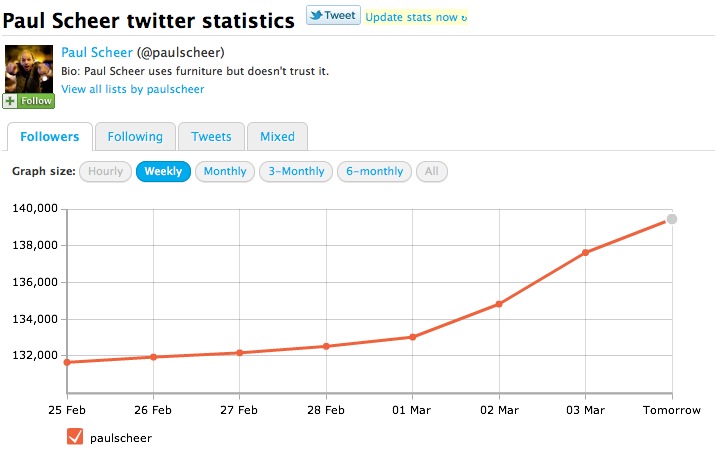
To test my theory, I went to TwitterCounter.com and checked the stats for comedians Natasha Leggero and Paul Scheer, both of whom were referenced in Sheen tweets. Sure enough, both saw big gains in followers the past couple days.

Here’s a chart for Natasha’s account that shows she’s added 3,558 new followers (as of now) in the two days since Sheen referenced her account:

And here’s a chart showing that Scheer has added 6,347 new followers since he got a Sheen plug:

So that means according this incredibly small sample size, getting Charlie Sheen to reference you on Twitter will get you about 4,900 new followers. Let the @CharlieSheen tweeting commence!

In case you can’t get Charlie Sheen to acknowledge you on Twitter, you may want to get followers by checking out these tips to get more twitter followers.

5 Reasons Your Podcast Should Include Video

As the number of comedy podcasts being produced continues to explode, there’s been one thing about them that continues to confuse me: most comedy podcasters don’t bother to shoot video of their podcasts. In my opinion, this is a HUGE missed opportunity.

Even though most podcasts are primarily an audio experience and the majority of fans will listen to them as opposed to watching them, there are a lot of advantages to shooting video of your podcasts that I’ve found most podcasters haven’t considered. Here’s 5 reasons why I think every podcaster should be videotaping their podcasts…

1. It Will Make Your Podcast Easier To Promote

One of the biggest challenges in podcast promotion is that it’s infinitely more difficult to get somebody to check out a 40-minute audio clip than it is to get somebody to watch a 3-minute video. If you’re videotaping your podcast episodes, it becomes easy to pull highlights from the show, post them on YouTube, and send them around to blogs or websites to get more attention for your show (here’s 100 Places To Promote Your Content to get you started).

Additionally, having video of your podcast allows you to promote it in places with huge comedy audiences where you otherwise couldn’t be. For example, video sites like YouTube, Funny or Die, and UStream have literally millions of comedy fans who you can’t reach unless you have a video to show them.

2. It Will Make Your Podcast Easier To Monetize

As a general rule, sponsors and advertisers will pay way more to advertise on video content than they will on audio content. If you’re ultimately hoping to monetize your show with sponsors, this is definitely something that you should consider.

Also, having video of your podcast will give you another product to sell. For example, if your average podcast episode gets 25,000 downloads, that’s all you can charge a sponsor for. But if that same episode gets 25,000 audio downloads and another 10,000 video views, that’s an expanded audience and one which you can charge more money for an advertiser to reach.

3. It Will Make Your Podcast More Interactive

If you’re shooting video of your podcast episodes, you will have the option of broadcasting your recordings live through a live-streaming video site such as UStream or Justin.tv. This can create a really interesting experience for fans who get to not only watch the show live and participate in chat rooms during the broadcast, but can also interact more with the episodes.

By broadcasting live video of your podcast, fans will be able to become part of the show as it’s happening be calling in to talk to you on the air, or interacting with you in real-time through the chat room or via Twitter. Plus, these live broadcasts have the added value of connecting your fanbase to each other and giving you another “event” to promote the show.

4. It Will Not Cost You Much Money

A few years ago, shooting video was often too expensive an undertaking for podcasters. But now, thanks to new technology and declining costs of video cameras, it’s incredibly easy to shoot video of what you’re doing. You don’t have to have an elaborate production, you can simply turn on your laptop video camera or buy a Flip Cam and press record when you do the show.

In the case of most podcasts, the show is basically a couple people sitting around and talking so you don’t need amazing production value. You just want to be able to capture what’s happening on video so  that you have another way to promote and monetize what you’re creating.

5. It Allows You To Include Different Kinds Of Content In The Show

Once you commit to a video version of your podcast, it frees you up to include all kinds of different segments in the show that would not have worked when it was just an audio podcast. For example, you can now go shoot remote video segments or sketches in advance of the show and show them during the podcast. You can also show various videos you find online that you may want to riff on during the show. Plus, your fans could send you videos of themselves that you could work in to the show as well.

You don’t have to incorporate these kinds of videos in your show of course, but by having a video version of your podcast will give you a lot more creative freedom to do so if you want.

Do you have your own podcast? If so, leave a comment on this post with a link for people to check it out…

5 Tips For The “Eric’s Fake Fliers” Blog

In 5 Free Tips, I provide some free advice specifically tailored to one person’s content. If you’d like me to give you 5 Free Tips, please send me an email and tell me a little about yourself.

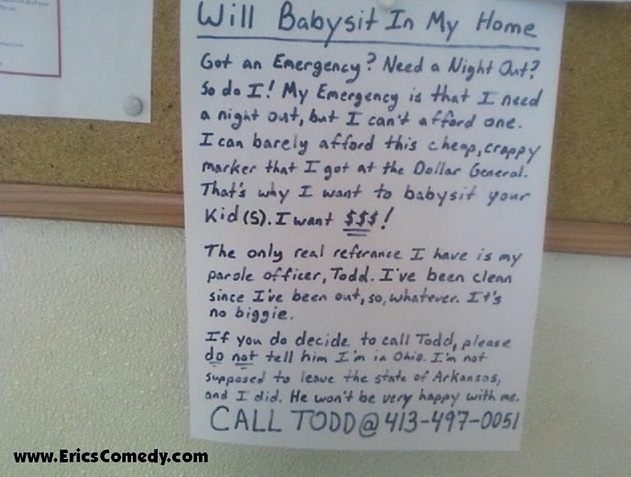
Today’s tips are for a relatively new comedy blog called Eric’s Fake Fliers, that was launched by Connected Comedy reader Eric Johnson. The blog features photos of fake fliers that Eric’s created and posted in public places. Here’s an example:

I checked out the blog and came up with the following 5 Free Tips for Eric to help grow the site:

TIP #1: Encourage The Community To Participate In The Site

Photo blogs like this tend to work best when you allow your readers to contribute to the site by submitting their own photos. Even though you’re using this site as a way to ultimately gain new fans of your own comedy creations, it’s still a good idea to allow other fans to contribute to the site. You can (and should) curate any submissions you get from people so that only truly funny stuff goes on the site, but you should be open to including photos of fliers that weren’t necessarily created by you.

Doing this has a couple of big advantages: First, people will become much more connected to a site that they feel a part of as opposed to just a passive reader of. Also, anybody who gets their submission featured on the site will love you for it and will spread the word to all their friends, essentially promoting your site for you. Finally, it will allow you to get a lot more content on the site than you could create by yourself, which will drive more traffic and make for a better experience for everybody.

In addition to encouraging readers to submit their own photos, you also may want to experiment with caption contests and other ways to encourage participation in the comments. You can also take flier requests from people, so they could feel involved in inspiring some of your creations – even if they didn’t make them themselves. Remember, the more involved somebody is in the site, the more likely they are to come back and promote it.

TIP #2: What’s The One Action You Want People To Take When They Find The Site?

It’s great that you’ve got a lot of messaging on the site promoting yourself and your other projects, but I’d also take a moment to think about what the one action is that you want somebody to take when they first find your site. Do you want them to subscribe to it somehow? Do you want them to share it somehow? What do you want them to do?

At the moment, it seems like you’re encouraging them to go to your personal website, which is plugged at the top of the page as well as being the URL that’s watermarked on the pictures. That’s fine, but is that really the best outcome for you? If they go to your personal website, then what?

There’s no right or wrong answer to these questions, but you should think through exactly what action you most want people to take and then promote that the hardest. It may not be sending them to your personal site – if they like what they see on this site, you might want to promote a way for them to subscribe/connect to this one instead.

TIP #3: Get A Real Domain

I know the site is new and maybe you’re still figuring out if you’re going to stick with it or not, but if you are then you should definitely get a “real” dot-com domain name. There’s a couple reasons for this: running a website off a blogspot domain name is fine (and it’s free), but it also conveys to the reader that the site is amateur and/or temporary. It makes it seem like you’re not fully committed to doing it for the long term, so subconsciously it tells a reader that it may not be worth their time to connect to.

Also, Google’s search algorithms downgrade blogs that don’t have their own domain (for the same reasons), so you’ll be less likely to get free search traffic with a blogspot domain than you will with a “real” domain.

TIP #4: Use A Real Phone Number And Post The Messages You Get

I noticed that on one of the fliers it included a phone number for people to call. If you’re going to do that, you might want to use an actual phone number which you can get through Google Voice. That would allow you to set up a voice mail, and then post the voice mail messages you get from anybody that actually calls the number on the flier on the site. It could be a really fun way to expand this idea and probably open up a lot of other creative possibilities.

TIP #5: Categorize Your Entries

It’s a good idea to start categorizing your posts using the labels function that’s built into Blogger’s blog software. You should think about categorizing each post using broad terms like “Pet Fliers” or “For Sale Fliers,” that will ultimately feature various genres of posts you’ll be creating.

The reason for doing this is because when you have a lot more content on the site, it will create an easy menu that you can offer people to browse the content on your site. Also, you can use it to link people to other related posts on your site. And I would definitely start doing this from the beginning, because once you have a lot of content on the site, it will be a pain to go back and try to do it then.

I hope these tips help, and if anybody else would like to get 5 Free Tips, please let me know.

6 Tools That Can Teach You About Your Audience

One of the nice things about distributing your content online is that it gives you the opportunity to collect all kinds of data about how your audience engages with your content. If you’re smart about it, you can use that data to figure out what people want more of from you, how best to get them to see and share your new content, and to how to convert first-time viewers into long-term fans.

But in order to learn any of this, you need to use a few basic analytics tools that can provide you crucial details about your content and how people engage with it. To help you out with this, I’ve put together a list of six basic analytics tools that are (mostly) free and provide you with lots of great insight. Each of these analytics provide insane amounts of information if you’re a stat porn geek like I am, but they can also be used in a simpler manner to just get an overview of what’s happening with your content.

Here’s the analytics tools I recommend you check out…

1. Use Google Analytics to track your website traffic.

If you’ve got a website of any kind, you should absolutely install Google Analytics. It’s easy to install – you just cut and paste a snippet of code onto your site – and provides you with tons of information about what’s happening on your website. Once it’s installed on your site, you’ll be able to see how many people visit your site, which content they look at, how they found your site, where they live (or at least where they logged on from), and loads of other details.

Most importantly, you’ll be able to track changes in your site over time – for example, do you get more visitors if you write one blog post a day compared to one a week? Are more people checking out your merchandise page since you started promoting it on the front page of your site? Google Analytics allows you to understand exactly what’s happening on your site and why.

Here’s a basic guide to Google Analytics to get you started.

2. Use bit.ly to track how many people click links that you promote on Twitter or Facebook.

You probably already know that bit.ly is a URL shortener t hat saves you some characters when you use it to share links on Twitter, Facebook, or elsewhere around the web. What you may not know is that any bit.ly link also comes with back-end analytics that will show you exactly how many people clicked that link and at what times. It will also show you who else shared that link.

All you have to do to see that information is add a “+” sign at the end of the link and it will take you to a page with the click statistics for that link. It will show you how many times that link has been clicked, a breakdown of when it was clicked, and even show you the tweets that referenced that link so you can see who else shared it. For example, here’s the bit.ly stats for a link I sent out a few weeks ago.

Looking at who clicks your links and when can help you figure out what time of day is best to promote your stuff and help you understand which stuff gets shared more than others. For that matter, you could even try to send out the same link twice with two different titles and see which one gets clicked more. This kind of info can really help you hone your marketing skills.

I should also mention that bit.ly isn’t the only URL shortener that offers these kinds of stats – most URL shorteners do at this point so whichever you use, you should take a moment to check out the stats and see what you can learn.

3. Use YouTube’s Video Insights to see how people are finding and sharing your videos.

Another great stats package that you may not know exists is YouTube’s Video Insights tool. When you’re logged into your account on YouTube, you can go to the My Videos option and then select Insights, and what you’ll find is a treasure trove of information. YouTube offers up detailed statistics on all of your videos including information about everything from how people found your videos to how long the average person watched a given video before they stopped watching.

This is powerful information that can help you understand why one video gets more views than another, how titles can impact views because of search traffic, and can tip you off to what other websites may have posted your videos among other things.

Here’s a breakdown of the YouTube Insight tool.

4. Use Facebook Page Insights to learn about how people are engaging with your Facebook fan page.

Just like YouTube, Facebook comes equipped with some great built-in analytics for your fan page. This is not available if you’re using your regular profile page as opposed to an actual fan page, and is yet another reason why you should be using a Fan Page.

The Fan Page Insights are available by clicking “View Insights” on the right side of your fan page. Once you do, you’ll see a variety of stats including the demographic and location of the page’s fans as well as details about how engaging each of your individual status updates have been. This is important because understanding your fan page demographic can help you figure out where your audience is, and the engagement numbers impact whether or not your updates get seen in people’s news feeds so this is the place to track your progress in improving that.

5. Use AWeber’s email stats to monitor the effectiveness of your mailing list.

If you followed my previous advice and started to use AWeber to host your mailing list, then you’ll be able to take advantage of the software’s built-in analytics package. Besides the basics like how many people are on your mailing list and where they live, you’ll also be able to check the effectiveness of each email blast you send.

For example, AWeber’s software will show you exactly how many people on your list opened your email, how many clicked links in the email, and which links they clicked. Plus, it will tell you how many unsubscribed from the list. It even allows you to send follow-up emails to just the people who clicked certain links in the email. This stats package is another reason why I so strongly recommend using AWeber to power your mailing list.

6. Use ClickTale to literally watch people surf your site.

Ok, this one’s definitely not a must-have tool, but it is a fascinating one to try out. ClickTale offers “customer experience analytics,” which is a fancy way of saying that they let you figure out how people are using your website by allowing you to literally watch them click around your site.

The way it works is that once you install ClickTale on your site, the software records every visitor to your site and then allows you to watch each visit. That’s right, you get to look up any visit to your site and watch the mouse move as they surf through your site and click different pages and links. It’s pretty educational and completely addictive.

ClickTale is not free (though I believe you can try out a demo version for free), and I wouldn’t really recommend using it unless you have a decent amount of traffic on your site, but if you do it’s about as big a voyeuristic thrill as a stat junkie could hope for.

Looking for a little more help with your projects? Here’s some of the ways I can help.

Connected Countdown: 10 Things You Need To See This Week

Every Friday I break down the 10 things I think you most need to see this week, including a mix of posts on this site and other stuff from around the web that I think should be on your radar. Here this week’s countdown…

10. 5 Things You’ll Be Shocked To Find Out About How Your Facebook Page Works

In this Connected Comedy post, I break down some of the reasons that you may feel like nobody’s seeing your Facebook status updates and what you can do to change that.

9. Jeff Ross and Adam Carolla Team Up To Launch A Roast Of Dead Celebrities

The Comic’s Comic interviews comedian Jeff Ross to get the details about a new experimental live show that’s happening at The Comedy Store in Hollywood.

8. 5 Types of Blog Posts That Get Good Traffic

In this Connected Comedy post, I share some examples of easy comedy blog posts that will help you get over your writer’s block and get some more traffic to your blog.

7. Support Connected Comedy Reader Ramon Rivas By Downloading His New Album

I like the idea of the Connected Comedy community supporting each other, so here’s a link to Connected Comedy reader Ramon Rivas’ new album. He’s made it available for free download, so go check it out and spread the word about it if you like it. Thanks.

6. Why It Works: The Action Figure Therapy Web Series

In this Connected Comedy post, I take a look at a YouTube series that’s about to get its one millionth view and explain some of the reasons I think it’s been so successful.

5. How To Make Kickstarter Work For You

This 10-minute video features the founder of Kickstarter explaining how you can use his site to raise money for your creative projects.

4. Become One Of The Connected 20

There’s still a couple spots left in my new Connected 20 program, so go check it out and see how I can help you promote your content at a ridiculously low rate.

3. How A Guy Is Trying To Get A Job On The Colbert Report By Putting On His Own Version Of The Show

The Comic’s Comic details the efforts of New York-based comedian J.D. Durkin who is trying to capture Colbert’s attention by putting on his own live version of the show.

2. The Dirty Secret of Comedy Clubs

This Connected Comedy post has stirred up a lot of comments both on the site and over on the Connected Comedy Facebook page.

1. A Step-By-Step Guide To Building An Online Marketing Plan That Works

If you read one thing on this list this week, this should be it. It’s a transcription of an entire presentation delivered by Ian Rogers of Topspin, which is a leading marketing services company for musicians and bands. It’s music focused, but completely applicable to comedy and packed with great information.

Thanks for another week of reading Connected Comedy. If you like what you see, please take a moment to go subscribe and join our community.

“Press Pause Play” Looks Like A Must-See Documentary

I had never heard about the upcoming documentary Press Pause Play until about an hour ago, but after first discovering the film’s trailer I became hooked on watching the various clips featured on the film’s YouTube channel. As somebody that’s interested in the way creative media is evolving, I can’t wait to see it and figured it would likely interest many of you as well.

Here’s how the film’s website describes what it’s about:

The digital revolution of the last decade has unleashed creativity and talent of people in an unprecedented way, unleashing unlimited creative opportunites.

But does democratized culture mean better art, film, music and literature or is true talent instead flooded and drowned in the vast digital ocean of mass culture? Is it cultural democracy or mediocrity?

This is the question addressed by PressPausePlay, a documentary film containing interviews with some of the world’s most influential creators of the digital era.

Sounds pretty interesting, huh? Well, if you need more convincing, here’s a few video teasers from the film.

An early teaser for the film…

The film’s official trailer…

A clip featuring an interview with Seth Godin (a genius, whose blog you should definitely be reading)…

The film debuts at the SXSW Festival – no word yet on its release beyond that as far as I know.