Josh Spector

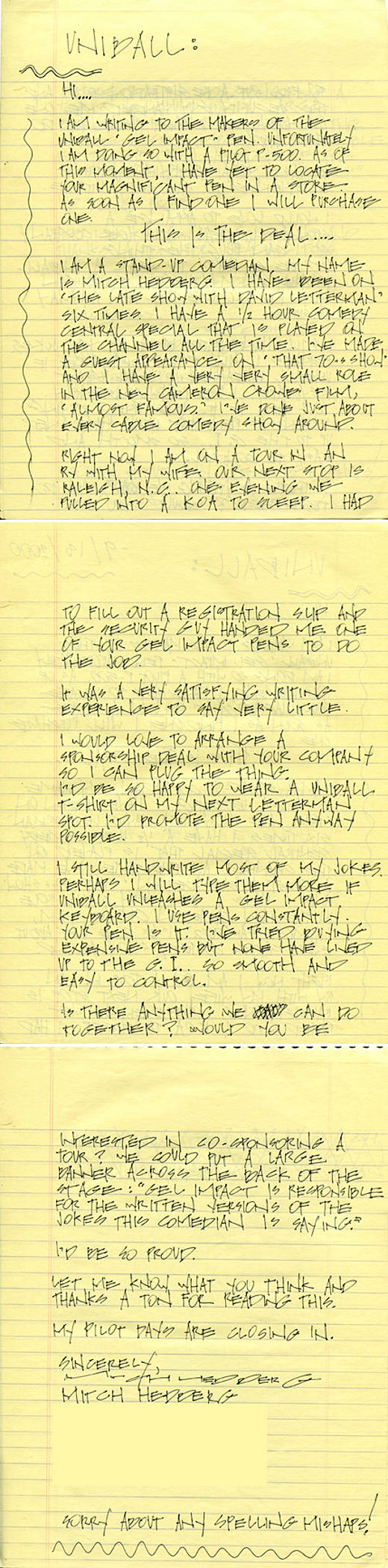
Mitch Hedberg’s Letter To Uniball In An Attempt To Get Them To Sponsor His Tour

Too often comedians who don’t put any effort into the marketing or business side of their career justify their inactivity by convincing themselves that successful artists pay no attention to business matters and that their comedy idols would never worry about such things.

However, that’s just not true.

In almost all cases, comedians who have successful careers have also paid attention to the business side of their career – even if they did so in a way that may not have necessarily been public knowledge.

A perfect example of this is the following letter I just discovered on Mitch Hedberg’s website. It’s a handwritten note that Mitch wrote to the Uniball pen company in an attempt to solicit a sponsorship for his tour. Sure, it’s an amusing letter, but it also shows Mitch wasn’t afraid to try to create business opportunities to support his art.

4 Things You Can Learn From A Website For Teenage Girls

Rookie magazine is a new online publication for teenage girls that’s generated a lot of attention recently in media circles, in part because it’s editor-in-chief is a 15-year-old former fashion blogger.

But it caught my eye for a different reason. After stumbling across a recent article in which a 25-year-old writer interviewed the first boy she kissed on the 10 year anniversary of their kiss, I started surfing around the site and realized that there are a lot of lessons to be learned from what Rookie is doing. Even though it’s not a comedy site and most comedians’ target audience isn’t teenage girls (insert your own joke here), the site’s creation, philosophy, and content can teach you a lot of lessons about how to create successful content online.

Here’s four lessons you can learn from what Rookie’s been doing…

1. Be Different Than Anything Else On The Web

I’m far from an expert on what teenage girls read on the Internet, but I do scour an insane amount of online publications and I don’t think I’ve really ever seen one that approaches its content the way Rookie does. Its article topics are unique, its writers write in a style that doesn’t feel like everything else on the web, and it only publishes three articles a day. Even the look of the site is much more simple and clean than most websites out there that are chasing a teenage audience.

In your own efforts to post content online, you should also look for ways you can be different. The more unique your website, videos, and content is, the more likely it will be to get noticed. I didn’t just notice Rookie because it was good – I noticed it because I had never really seen anything else like it before.

2. Target A Specific Audience And Know Who That Audience Is

I’ve written before about the importance of finding your niche, and Rookie clearly does that. Everything on their site is aimed at teenage girls and it’s clear not only in the subject matter, but in the way everything on the site is written that they are only speaking to that audience. They don’t care if people who aren’t teenage girls “get” what they’re doing because what they’re doing isn’t for them.

In your own work it’s important to know who your creations are for – and it’s not enough to just say “anybody that likes funny stuff.” If Rookie was just targeting “anybody who likes interesting articles,” it ultimately wouldn’t work.

Your audience should help define the content you create if you want to succeed. So if you don’t know who you’re targeting, you’re putting yourself at a huge disadvantage.

3. Tease Your Content

One of the things I love on Rookie is that they actually tease each day’s upcoming articles. They only post three things a day – cleverly rolled out around “After School,” “Dinner Time,” and “Sweet Dreams” – but you can log on in the morning and see a headline/photo for whatever that day’s posts are going to be. This creates some excitement and encourages people to come back to the site.

I’ve rarely seen people tease their upcoming content in this way, but I think it’s something that may be worth incorporating into your own content when it makes sense. For example, if you’re releasing a big new sketch video on Friday, why not post a teaser clip on Wednesday featuring some funny outtakes or a sneak preview of the sketch?

4. Remind Your Readers That Your Site Is Theirs Too

The more engaged your audience is with your content, the more connected they will become to it and to you. Rookie knows this and that’s why the site is pushing hard to encourage its readership to get involved with (and in some cases to help create) its content. They’ve even created a page specifically to invite readers to contribute to the site.

Too often, comedians tend to be self-centered and think their content is just a way for them to showcase how great they are. The more you’re willing to invite your fans and readers into the process of the content you create, the more you’ll be rewarded. Just because it’s your website or YouTube channel, that doesn’t mean that you have to be the only one who ever posts anything on it.

Rookie knows its success will ultimately depend on an active community of readers, commenters, and contributors – it’s a lesson that too many comedians have ignored.


Your Twitter Bio Says More (Or Less) About You Than You Realize

It may only be 140 characters, but you’d be surprised how helpful your Twitter bio can be in helping to define your brand as a comedian.

Just like with everything you do online, the secret to a successful Twitter bio is to be as specific as possible in describing yourself and what you do. The more to write, speak, and talk about yourself and your comedy in specifics (and the less you do so in generic terms), the easier it will be for you to establish your personal brand.

Unfortunately, the vast majority of comedians don’t follow this advice and that’s why 90% of comedians’ Twitter bios read like they could be describing just about anybody as opposed to properly representing that individual comedian’s brand and viewpoint.

This may seem like a bit of an abstract concept, so here’s a few examples of what I mean for you to consider.

Go take a quick look at your Twitter, Facebook, or YouTube bios and ask yourself this question: Is what you’ve written to describe yourself applicable to anybody else in the world but you? Could your bio also be used to describe thousands of other comedians out there? If so, it’s way too generic.

For example, here’s three random comedians’ Twitter bios that I just read:

“I write jokes.”

“Actress. Stand up comedienne. Extraordinaire.”

“I think I’m funny. You may not.”

It doesn’t matter whose bios these are, because they could be just about anybody’s – and that’s the problem. If you’re describing yourself in generic terms like this, you’re not doing anything to separate yourself from the rest of the comedians in the world, which is ultimately what building a brand is all about.

By positioning yourself in generic terms, you’re essentially sending a message to would-be followers that there’s no reason why they should care about you and what you have to say any more than they care about every other random comedian out there. Needless to say, that’s not the kind of message you want to send.

By comparison, here’s some examples of Twitter bios that include more specifics about the person’s interests, background, or viewpoint:

Sean O’Connor: “I wrote for the Sports Show with Norm MacDonald and now I’m just a stand up comic who really likes the Smiths. http://teamcoco.com/video/sean-oconnor-dirty-talk

Sean’s Twitter bio establishes his credibility (he’s written for Norm MacDonald and performed on Conan) and gives me a sense of who he is by sharing his interest in the Smiths. If I don’t care about sports and don’t like Smiths fans, then I may instantly know Sean’s not for me. But…if I do like sports and The Smiths, I’m significantly more interested in following Sean and learning more about him than I would be if his bio just said something like “I tell jokes.”

Ngaio Bealum: “I am a comedian, magazine publisher, juggler, musician, parent, activist, Sacramentan, and a great cook. I also like hard beats and soft drugs http://www.facebook.com/ngaio420#!/pages/Ngaio-Bealum/128933910481488

Ngaio’s Twitter bio showcases his eclectic interests, location, and includes a link to his Facebook page if I’m curious to learn more about him. Again, in 140 characters he delivers enough valuable (and specific) information about himself for potential followers to figure out whether or not he’s somebody they’d be interested in.

And in case you’re wondering, here’s my personal Twitter bio:

Josh Spector: “I write, produce, market, create, and share things. Some are funny, some are smart, some are neither. http://www.joshspector.com

As with all things in the social media world, there’s no real “rules” when it comes to writing your Twitter bio. You’re free to do with it what you please, but if you want people to notice you and separate yourself from the crowd, try to come up with something that’s going to uniquely represent you and your comedy. It will help you in the long run.

Connected Comedy Success Stories: Marty Simpson and Ward Anderson

I dish out a lot of advice about things you can do to grow your fanbase and create opportunities for yourself. But I probably don’t share actual success stories from comedians who have implemented my advice as much as I should.

So, I’m going to start sharing Connected Comedy success stories every once in a while. If you’ve implemented my suggestions and seen good results, please shoot me an email and tell me about your experience so I can include it in a future post.

To kick things off, here’s two recent success stories I’d like to share with you…

Comedian Marty Simpson Finds A Football Niche, A New Audience, And A Paying Gig!

Marty Simpson is a comedian and Connected Comedy reader who decided to take me up on my repeated advice to broaden his comedy content offerings. As a former University of South Carolina football player who is still passionate about the team, Marty decided to start blogging on his website about South Carolina football.

Marty recently reached out to tell me about what happened after he started doing this – here’s what he had to say:

“One of the first articles I wrote went “mini-viral” among Gamecock fans. The Sunday morning after I posted the blog I had 3,600 unique visitors and have averaged over 1,000 a day since! I was happy because, honestly, I just figured my normal 12 subscribers would read it.”

But getting more exposure for himself and his writing was just the beginning. Marty’s writing also caught the attention of GamecockCentral.com, which then hired him as a paid columnist to break down each week’s games. You can see his first column here.

And Marty’s not done yet as he hopes this will be a launching pad to bigger and better things.

“I am holding out hope that it could grow quickly into something bigger. Without your blog I would not really have even thought about leveraging my other areas of expertise into my content sharing/comedy career.”

Good luck, Marty. Keep me posted.

Comedian Ward Anderson Takes My 5 Day Challenge And Grows His Website Traffic By 1,000%

A couple weeks ago, I challenged readers to create content on their website for 5 days based on some specific suggestions and guaranteed that if you did it, you’d see a substantial increase in the number of visitors to your website.

Toronto-based comedian Ward Anderson took the challenge and emailed me the following update about his results:

My readership has been decent.  I went from 10 to 20 hits per day to an average of 50 to 70 hits per day.  One day I had 30.  One day I had 80.  But, in general, it averaged out at 60.  Not bad for one week and simply tagging things on facebook.  I posted the article links on fan pages, as well, whenever it was applicable, like “Comedy” fan pages on facebook.  I mean, that’s an increase of five times the hits.  So, even if I’m not getting thousands (yet) of hits, I still more than quadrupled what I was getting.

I’m going to keep posting something new, at least five days per week, and see if readership continues to increase.  It will be interesting to track it and see what happens.

After that initial email, Ward then wrote back to tell me that his traffic continued to grow and he’s now averaging 100 visitors a day. He also added that he’s found his list posts (which he calls “My Fives”) have consistently attracted the most traffic for him – something that reinforces my recommendation that you write lists in my article about 5 Types of Blog Posts That Get Good Traffic.

I look forward to sharing more Connected Comedy Success Stories with you soon – if you’ve had some success as a result of something you’ve learned on Connected Comedy, please email me and tell me about it.

6 Things Comedians Need To Know About Facebook’s New Subscriptions Feature

As you may have noticed already, a couple days ago Facebook rolled out an important new feature on the social network which they are calling “Subscriptions.” In particular, you’ll notice that many people’s personal profiles (including mine) on the site now feature a Subscribe button, which allows you to subscribe to get their updates in your Facebook feed – even if you’re not friends with them on Facebook.

This is potentially a huge shift in how Facebook works, and one which could have a big impact on how comedians use the site. You can read a little more about the basics of the new Subscribe button in general here, but I’ve put together the following crash course for comedians featuring the six things you really need to know about it and how it may affect what you do.

1. It Makes Facebook More Like Twitter

The introduction of the Subscribe button is a huge step by Facebook to mimic some of the functionality of Twitter. One of the biggest differences between the two social networks used to be that on Twitter you could follow anybody without them having to follow you back – now, that’s exactly what Facebook is allowing you to do through this feature.

It’s too early to tell what impact this may have, but it’s possible that it could ultimately lead to people moving away from Twitter and focusing more on Facebook – at least that’s what Facebook is surely hoping.

2. You Need To Activate It To Use It

If you want to allow people to subscribe to your personal profile updates, you will need to first activate the functionality on your profile. To do so, just click here and then hit the green “Allow Subscribers” button.

Once you’ve enabled the Subscriptions function on your profile, people who subscribe to your profile will see any updates that you post publicly. It’s worth noting here that you still have the ability on each update to post it privately or only show it to your actual friends and hide it from subscribers.

3. It Allows Your Personal Profile To Function More Like A Fan Page

One of the most common mistakes that comedians make when using Facebook is using a personal profile page as opposed to a Fan Page as I’ve previously discussed. The introduction of Facebook’s Subscriptions feature really blurs the line between the two types of pages because it now eliminates one of the biggest disadvantages of using a personal profile page which was that you could only have a maximum of 5,000 friends.

While you still can’t have more than 5,000 friends of your personal profile, you can now have an unlimited number of Subscribers to your personal profile. This is a huge development for those of you that have never set up a fan page and prefer to just use your personal profile instead.

4. Your Fan Page Is Still More Powerful Than Your Personal Profile

While the introduction of the Subscribe feature greatly improves the power of your personal profile, it doesn’t completely make your fan page irrelevant. I believe having a fan page is still a much better option for comedians, because fan pages allow you to run Facebook ads targeting your fans – both ads to gain new fans and the equally important sponsored story ads.

Even if you don’t currently plan on running any Facebook ads, this is a huge difference and a major reason why the majority of your efforts should still be focused on growing your fan page as opposed to your personal profile. Facebook ads are incredibly powerful and you’re going to want the option to use them at some point.

5. It May Increase (Or Decrease) The Chances Of People Seeing Your Updates

As part of the new Subscriptions feature, users who subscribe to you are able to adjust their settings when they subscribe to control how many of your updates they see and what kind of updates they see. For example, they can choose to see all of your updates, some of your updates, or block particular updates such as event invites, etc.

It’s way too early to know much about how subscribers will use this functionality but it’s easy to see how it could have a big impact on what you post. If you’re posting too often, or things that are perceived as annoying, it will theoretically be easier for people to block your stuff from their feeds. But if you’re posting great stuff, people will have more control to increase the chances that they see your updates (in theory), which could lead to a lot more people seeing and interacting with your stuff.

6. It’s A Reminder Why Your Website And Email List Are More Important Than Your Social Network

While there’s really nothing negative about the rollout of this new Facebook feature, it is a subtle reminder that Facebook can change the rules of the game whenever it wants. That’s why it can be very dangerous to make a platform you don’t control the hub of your online activity.

Facebook is great and it’s not going anywhere any time soon, but always remember that your website and email list (both of which you can fully control) should be the hub of your activity. Because you never know what platforms like Facebook are going to do and how their users are going to react to what they do.

Watch The Debuts Of 8 Legendary Stand Up Comedians On The Tonight Show With Johnny Carson

It’s easy to forget that every successful comedian’s act and career is always a work in progress and rarely is what you see from them now the same thing you saw them from them when they first launched their career.

But thanks to the magic of YouTube, it’s now easy to look back and study what many legendary comedians were doing in the early days of their career. So, I thought I’d compile some video examples of that in this post to inspire and educate you.

Below you’ll find the debut appearance on the Tonight Show with Johnny Carson of 8 stand up comedians who would go on to become some of the most successful comics of all time.

Andy Kaufman – 1977

Jay Leno – 1977

Jerry Seinfeld – 1981

Garry Shandling – 1981

Eddie Murphy – 1982

Steven Wright – 1982

Jim Carrey – 1983

Ellen Degeneres – 1986

3 Advantages Of Not Having Any Fans

No matter what level you’re at in your comedy career,  you probably wish you had more fans than you currently do. And while that’s a worthy goal, it doesn’t mean there aren’t some advantages to not having much of a fanbase at all.

If you’re getting down on yourself and your struggles to grow your fanbase, here’s three advantages of not having any fans…enjoy them while you can before the world catches on to your talent.

1. You Can Experiment

When nobody’s paying attention to you and what you do, you have no excuse not to experiment with your comedy in as many ways as possible. After all, if nobody’s watching, you’ve got nothing to lose.

Take advantage of this time to try out new material, a new style of comedy, and as many different outlets for your comedy as you can. Try stand up, take an Improv class, put on a one-man show, write a screenplay, launch a blog, make a video, launch a fictional character-based Twitter account, or try anything you can think of that seems fun, interesting, or challenging.

Ultimately, your experimentation will likely lead you to something that clicks with audiences and triggers the growth of your fanbase. But if you don’t experiment, and instead stay stuck on whatever one thing you think is going to be the thing that “breaks” you, the chances are it will never happen for you.

2. There’s No Pressure

I know there’s a certain level of emotional pressure any time you step on stage or create something and release it to the world, but that’s nowhere near the pressure that will come later in your career when you’re more established.

Comparatively, you don’t really have anything to lose when you don’t really have any fans in the first place. Try to remind yourself that it doesn’t really matter if you bomb on stage sometimes or if you don’t nail an audition, because you’re still learning and growing as a comedian. It’s part of the process – you need to accept it and not let it get to you.

There will be plenty of time for you to feel pressure down the road when hundreds of people have shelled out a bunch of money to specifically see you, or when you land your dream gig and then have to deliver the goods in order to keep the job. But when you’re starting out the only pressure you should feel is being put on yourself by yourself – so try not to get too much in your own head and enjoy the process.

3. There’s No Preconceived Notions About Who You Are And What You Do

When you have success in your career and have built a fanbase, your fans will have certain expectations about who you are as a comedian and what you do. And while often those expectations will be based on your actual interests and style, many times they will be based on perceptions of your interests and lifestyle.

For example, in his recent appearance on Marc Maron’s WTF podcast, comedian Doug Stanhope talks extensively about living up to the perceptions his fans have about his lifestyle and world view. Stanhope has a large and rabid fanbase that I’m sure he wouldn’t trade for the world. However, he also struggles to deal with their perception of him and his act and how to balance who he is as he evolves with the comedian that his fanbase wants him to be.

But as a comedian who doesn’t yet have a fanbase, you don’t have to worry about any preconceived notions people may have about you. Most likely, when audiences see you (online or offline), they are seeing you for the very first time and you have the opportunity to present yourself in whatever manner you choose. That’s a cool opportunity and one which I encourage you to think about and have fun with.

Would you trade any of these advantages for a larger fanbase? Of course you would, but that’s not the point of this article. The point is that even if you’re frustrated at your lack of a fanbase, it’s worth taking a moment to look at the silver lining of being a relative unknown – it gives you some freedom to do things you won’t always be able to do once you’ve “made it.”

So, try to enjoy the moment while it lasts.

How To Figure Out What You Should Post On Each Of Your Social Media Platforms

With the explosion of social media platforms in the past couple years, it can be very confusing to figure out exactly what you should post on which platforms. In my previous post about how to get more traffic to your website in 5 days, comedian Derik Boik asked the following question in the comments, which I think is a frustration shared by many of you:

I think (emphasis on think) that my website is pretty good. I am not a web designer, I just bought a URL and used Word Press to build it, BUT I think it looks okay and is easily navigable. Also, my goal in making it, was for it to be for “fans” and have a separate tab for “booking.”

So, my home page is a blogroll. And the posts I put there are interesting updates like “I’m hosting the Otto & George show tonight” or new videos I’ve created, etc. I write short essays and articles (with pictures) all the time but I post them on my Tumblr: http://www.newsgood.tumblr.com.

I decided to keep all of that stuff separate from my website but was I wrong? Should I be posting all of that on my website too? I agree that it would make my website more dynamic and current, in fact I’d probably have something new to post every day. But, is it okay for your Tumblr and website to be almost identical? I feel crazy. I like the name NewsGood (because it lets readers know that the stuff will be topical) but should I just change it to DerikBoik.tumblr the way your Connected Comedy Tumblr is just an offshoot of your website?

Here’s my dilemma (and possibly the topic for your next article): I have a website, a Tumblr, Facebook (a personal profile AND a fan page), a Twitter and a YouTube channel. What stuff do I post where? Which stuff should I NOT post on what? What should be posted on multiple places and what SHOULDN’T be? Help.

It’s a great question and in order to answer it, I thought I’d spell out exactly how I personally recommend you use each individual social media platform to get the best results. Please note this isn’t the only way you can use these tools, but it’s what I’d recommend to get the most out of your efforts.

Your Website

Your personal website is by far the most important thing you have in your social media arsenal. It should function as the hub of all your activity, the base of your operations, and your goal should be to get your fans to visit it often – which typically means regularly posting new content to give them a reason to come back on a daily (or at least weekly) basis.

The majority of your time, effort, and resources should be put into creating and promoting the content that lives on your personal website. There are many reasons for this, but one of the biggest is that your website is the only actual “property” you will fully own and control on the web – forever.

The problem with focusing your efforts on Facebook, Twitter, or YouTube and trying to make them the hub of your online presence is that you’re ultimately building on a platform you don’t control. At any point, those services could change the way they operate and/or decline in popularity and the value of your presence on them can disappear in an instant.

Just ask any comedian who spent a lot of time on their MySpace page how that wound up working out for them in the end.

Your website is your real estate – invest in it and you’ll reap the rewards over the long term. Every other thing you do on social media will be done as an offshoot of your website.

Twitter

Twitter works best when you use it as a tool to facilitate conversations with fans and other people. Anybody in the world can see your tweets and contact you through @ replies on Twitter, and you can also start up conversations with anybody the same way. I’d recommend you use it for that purpose.

It’s fine to post jokes and occasionally promote your stuff, but you’ll really get the most out of Twitter if you use it as a way to seek out people with similar interests (using Twitter’s search function) and interact with them.

Think of Twitter as a tool you use for conversations, and you’ll find it to be a much more effective tool than just using it for promotion.

Facebook

Unlike Twitter, Facebook isn’t quite as good for facilitating conversations. However, its strength is in helping you find new fans and in introducing them to what you do. Running targeted Facebook ads is an incredible way to grow your fanbase and one that I highly recommend.

Also, Facebook is far better than Twitter at enabling your community of fans to engage with each other. Whether through your Facebook fan page and/or through a group, you’ll want to use Facebook to ignite conversations and build a sense of community amongst your fans. You may be the leader of the community, but it’s not just about you. It’s about something bigger because you’re ultimately connecting people with a shared viewpoint and sense of humor…with you at the center of it all.

To do this, you’ll want to post regular Facebook updates that encourage engagement – ask questions, have contests, create opportunities for your fans to talk about themselves and each other. It’s fine to promote your content sometimes and link people back to your website, but remember that your Facebook efforts should be at least as much about your fans as it is about yourself.

YouTube

YouTube is your video platform – period. If you make videos of any kind (and you should), you need to post them on YouTube. It’s fine to also post them on Funny or Die, or Break, or Vimeo, or some other video sharing sites, but you absolutely must also post them on YouTube if you want them to be seen.

Not only is YouTube the biggest video search site on the web, it’s also the second biggest search engine (after Google) of any kind on the Internet. Not posting videos on YouTube is inexcusable.

Also, when you do post your videos on YouTube you will want to use the YouTube player to embed those videos on your website because you really want the YouTube view counts to be as high as possible. For example, if you upload the same video to YouTube and Funny or Die, promote the YouTube version to your fans/friends. Those views will ultimately be more important to you than the Funny or Die ones.

On YouTube itself, you want to encourage people to subscribe to your channel because more subscribers equals more views. Also, you want to engage with commenters on your videos, leave comments and subscribe to other people’s channels, and generally try to become a part of the YouTube community – a community which can be very insular at times.

Tumblr

If you’re going to launch a Tumblr blog, there’s a couple different ways you can use it. First, you can use it as the base for your own website (as long as you have your own domain name). Personally, I’d recommend using WordPress to power your website, but it’s ok to use Tumblr if you prefer.

If you’re not going to use Tumblr to power your website but still want to have a presence on the site, it’s fine to set up a separate Tumblr page like I’ve done for Connected Comedy. if you go that route, I’d recommend using your Tumblr to share links to the content on your main website and to share some smaller content (like photos and videos) that may not necessarily warrant being posted on your main website.

Also, a presence on Tumblr will allow you to easily reblog content from other people’s Tumblrs that you may follow with just the click of a button. It’s basically an easy way to have a presence on the site and become part of that community without having to put a ton of time and effort into it.

Again, there’s no real “rules” for using any of these services to further your career, but I do believe that if you follow these strategy suggestions you’ll wind up having a lot more success than you otherwise might.


Want More Traffic On Your Website? Take The 5 Day Challenge

It’s easy to get overwhelmed when you’re trying to figure out how to get more people to visit your website, but it doesn’t have to be that complicated. To get you started, I’ve compiled a list of five simple things you can post on your website over the course of the next week that I guarantee you will get you more traffic to your website than you currently receive if you take a little time to do them.

Ideally, you should have some kind of blog functionality on your site which makes it easy for you to add content – if you don’t have that yet, then you’re going to want to set that up before you do this. But assuming you do have the ability to easily post content on your website, then here’s a simple outline you can follow to jumpstart your website.

Day 1: Write A Blog Post Telling A Great True Story From Your Life

To kick things off, take a moment to think about some hilarious, crazy, interesting, or monumental thing that’s happened to you in your life, write that story and post it on your website. Try to come up with something that’s genuinely entertaining and unique – don’t just tell a story that’s probably happened to lots of other people.

When you post it on your site, include a picture or two to illustrate the story (it’s ok if you just find a relevant picture through a Google image search if you don’t have your own photo to use). When you title your story, try to make sure it’s a compelling title that explains what the story is about – for example, “What It’s Like To Drive Into A Hurricane” is a much better title than “Crazy Story.”

Once It’s Posted: After you’ve posted your story, you’ll want to share a link to it with your Facebook, Twitter, and email subscribers. You’ll also want to seek out some relevant websites and blogs that you can email it to who may be interested in linking to it. For example, if your story is about cats then you may want to find some cat blogs and email it to the people that run the blogs.

If you’re looking for suggestions of where to send it, you can always check out my 100 Places To Promote Your Comedy Content list.

Day 2: Find A Cool Video On YouTube And Post It On Your Website

Here’s a really easy way to add content to your site that’s going to attract more traffic. Go spend a little time trolling around YouTube and find a really crazy (or inspiring) video you think people will enjoy. This shouldn’t be a video you created, just something you think is interesting for whatever reason.

Then, embed the video in a blog post on your website and write a couple sentences about why you’re sharing it and what you think of it.

Once It’s Posted: Share it with your friends/followers and encourage them to comment with links to their favorite YouTube videos and/or videos that are related to the subject matter of the one that you posted.

Day 3: Write A Top 10 List

Think about something you’re passionate about and would be likely to debate with friends over dinner or drinks. It could be comedy-related or it could be about anything. Then, take your opinion and turn it into a Top 10 List.

For example, you could write a list of The 10 Most Underrated Comedians Of All Time, or The 10 Athletes You’d Most Want To Sleep With, or The 10 Biggest Myths Politicians Tell Us, or anything else you come up with. And when you write the list, include an explanation for each choice and their ranking – don’t just post a list of names. Make it fun and compelling.

But whatever you choose, try to make it the kind of thing that will be controversial and that will be fun for people to agree/disagree with and something that people will want to debate. If you’re looking for some inspiration, you can always check out Cracked.com which publishes tons of great Top 10 lists.

Once It’s Posted: When you share this post with your friends/followers, encourage them to comment and debate the choices in your list. If you’ve written a good list about a compelling topic, then they’ll likely have a lot to say about your choices and want to engage with you about them.

Day 4: Write A Post Linking To At Least 5 Other Sites You Like

Here’s another simple post you can create that will help drive traffic to your site. All you have to do is find at least 5 other websites or blogs that you enjoy and do a post linking to a piece of content on each of them with a little description of why you’re linking to them.

Basically, you’re just sharing links with your readers to cool stuff that you find out there. It’s ok to link to big websites like the Huffington Post, but try to have most of the links be to smaller, more personal blogs. The reason for that is because the smaller the blog you link to, the more likely they will be to notice that you linked to them, and the more likely they will be to link back to you and introduce their readers to your website.

Once It’s Posted: Reach out to each of the bloggers who you linked to (either through social media or by sending them an email through their website) and give them a heads up that you linked to them. You don’t have to ask for anything in return – you can just tell them something like “Hey, I just wanted to give you a heads up that I posted a link to your site on my website – love what you’re doing, keep it up!”

At a minimum, each of those people will likely check out your website and thank you for the link. But most likely, they’ll return the favor by linking to something on your site and sending some traffic your way.

Day 5: Write A Blog Post About Something Topical In The News Today

To wrap up this 5 day plan, take a moment to write a blog post about something that’s happened in the news today. Try to pick a subject that’s as topical as possible – whatever the world is talking about today and is one of the top stories in the news.

The reason for this is not only because people are interested in topical things, but also because it’s likely that you may be able to receive some free traffic from people searching Google looking for people talking about whatever that news may be.

If you’re looking for some inspiration, you can always check out Google Trends to see what people are searching for a lot at the moment.

Once It’s Posted: When you publish a post about something topical, you can then go search Twitter to find people talking about that subject matter and engage with them. If they’re talking about the same thing you just wrote about, the chances are they’ll be interested in what you had to say about the subject so it’s a really easy way to promote and get some more traffic to your site.

There’s lots of ways you can increase traffic to your website, but if you start by following this simple 5-day plan you should see some immediate results. If you decide to give it a shot, please post links to your content in the comments on this post – I’d love to see what you come up with!

The Secret To Online Comedy Success

When it comes to online comedy content and promotion, it’s easy to get confused and frustrated as you try to figure out how to get the most out of your creations. But, there’s a really basic trick that will help you better think through what you do online and make it more effective.

The secret is to pay attention to what you do as a consumer of comedy online, and apply that to what you create and promote.

Here’s a few questions for you to consider that will actually wind up teaching you a lot of valuable lessons about what works online.

What Do You Click?

Start paying attention to anything you click online – other people’s Facebook updates, Twitter posts, ads on websites, links people email you, etc. You’re likely bombarded with hundreds of different opportunities to click something every day, but there’s probably only a small percentage that you actually click.

So what is it about the things that you click that compels you to do so?

When you pay attention to what you click, you’ll learn a lot about what it is that convinces people to view content. Maybe you click things that make you curious, maybe you click things that seem scandalous, maybe you click things from people you trust, maybe you only click things from people you know. There’s a lot of different variables, but you’ll start to see some common threads amongst the things that earn your clicks.

Once you do, you can apply those same traits to the content you create and promote. Most people click things for the same reasons you do, so the more you’re able to hone in on those reasons the more success you’ll have with your own stuff.

What Do You Share?

Just like you can learn a lot from paying attention to what you click, you can also learn from paying attention to what you share through Facebook, Twitter, or email. Obviously, you don’t share everything you click – you’re likely much more selective and there’s only a couple things a day that you feel warrant being shared with your friends or followers.

The next time you decide to share something, think about why you want to share it.

What is it about that piece of content that made you want to share it with others? Does it say something about what you believe? Does it represent something you disagree with? Is it so unique or cool that you feel like you have to pass it on?

There’s lots of reasons you may share something and again, those reasons are the same reasons that other people share content. The better you understand why you share what you share, the easier it will be for you to create your own content that other people will want to share.

What Do You Buy?

If you’re actually going to spend your hard-earned money on something, the chances are you’ve thought about the purchase and the value it provides to you. But have you ever applied that same theory to the products you try to sell?

Too often I see comedians trying to sell products that they themselves would never buy – that’s not a good formula for success.

For example, yesterday on the Connected Comedy Facebook page I asked readers how many comedy albums they bought in the past year and the vast majority of the answers were that they had bought less than 3 albums. And most of the albums bought were from older comics like Mitch Hedberg and Bill Hicks.

Plus, these responses came from an audience of mostly comedians who love the artform and who would probably be more likely to buy albums than the typical person.

So, the majority of comedians are really not buying comedy albums, but I’m guessing that most of the people who responded have produced and tried to sell their own album at some point. My guess is that they’re doing it because they think that’s just what you do, but in reality they’re spending time, effort, and money on a product that they probably wouldn’t even buy themselves.

I’m not saying there’s anything wrong with trying to sell albums, but I do think it’s worth really thinking about what you spend your money on and trying to create merchandise or products that you would likely buy yourself.

As you can see, the more you consider what you do as a consumer of comedy, the more you can learn how to be successful as a producer of comedy.