Josh Spector

How Ze Frank Connects With His Audience By Enabling Their Participation

It’s difficult to describe exactly who Ze Frank is and what he does, but his Wikipedia page describes him as “an online performance artist, composer, humorist, and public speaker.” All of those things are true, but the reason I think you should take an interest in him and his work is because he does an amazing job creating projects that connect him to his fans.

In this video from a presentation he delivered at TED several months ago, Ze Frank walks you through some of his more successful projects and explains how and why he believes they worked. Here’s a hint: his projects all encourage deep participation from his audience and reward them for that participation.

5 Tips For Comedian Ryan Budds

In 5 Free Tips, I provide some free advice specifically tailored to one person’s content. If you’d like me to give you 5 Free Tips, please send me an email and tell me a little about yourself.

Today’s free tips are for stand up comedian Ryan Budds, who sent me the following email:

Hey Josh,

I’m a 25 year old comic from the south side of Chicago and have been performing for almost 5 years. I feature regularly around the Midwest at clubs and do as many shows as I can fit into my schedule in as many different places as possible. I feel like I do a lot of little things to further my career in comedy, but I’d love to make some more drastic moves to get to that next level.

My goals right now 5 years in are to be generating new material more frequently based on what’s happening in my life as it goes, and getting more exposure in terms of performing in comedy festivals, other states and countries I haven’t visited, and starting projects like script writing and podcasting in my spare time to try new things.

Here’s my website, along with my Twitter and Facebook pages.

I have a Youtube, but primarily use Vimeo because I think the player works better and looks sleeker on a web page.

Thanks for any help you can give me. Merry Christmas.

I checked out Ryan’s work and came up with the following 5 Free Tips for him:

TIP #1: Use Vimeo To Share, But Use YouTube To Be Found

You’re correct in your observation that the Vimeo video player is sleeker and tends to work a little better than YouTube’s player. But do you know why it works better? Because only a tiny fraction of as many people use Vimeo as use YouTube. And remember, the reason you’re putting videos online in the first place is to get them seen, so that’s kind of a big deal.

What I’d suggest is having the best of both worlds. You can use Vimeo to share your videos (i.e., embed the Vimeo player on your website and send links to that player through Facebook and Twitter), and use YouTube to allow the most people to find your videos. YouTube is the second biggest search engine in the world and it dominates video search – if somebody’s looking for a video of you, they’re going to YouTube and not to Vimeo so you need to be there. It’s fine to use Vimeo, but its’ worth the extra couple minutes to also upload anything you put on Vimeo to YouTube as well.

TIP #2: Use Your Website To Attract Fans, Not Bookers

Your website is simple and clean and functions as a calling card for anybody that may be looking to book you and that’s great. There’s only one problem – nobody’s going to book you because of your website. The reality is that while it’s a good idea to have things like your bio and big callouts to “Book Me” on your site, that’s just not how things really work for the most part.

Instead, build a website that’s going to attract fans because that ultimately has way more value for you than bookers. And if you can build up a site that attracts fans, that’s going to be much more attractive to a booker than your basic bio anyway. If you look at your site right now, the message you’re sending is that your audience is bookers. “Fans” don’t care about your bio and they certainly don’t care about booking you. I think you’ll find that re-emphasizing your site to attract fans will make it much more valuable to you than as a glorified calling card. Speaking of which…

TIP #3: Write To Your Audience

Assuming I’ve convinced you that your audience is fans (aka “regular people), then you’ll want to remember that in everything you do and in particular what you write. People connect with other people they can relate to, and the more informal your writing, the better.

Take the first paragraph of your bio for example:

Ryan Budds is a south suburban Chicago native who brings a package of wit, energy, and spontaneity on stage. Crafted jokes, stemming from life in his 20s, pull audiences in and keep them laughing at clubs and colleges all over the country.

Unless you’re the Chad Ochocinco of comedy, I’m guessing that you don’t refer to yourself in the third person when you’re talking to somebody. So why do it in your bio? And I’m sure if somebody ever asked what you do, you wouldn’t tell them that you “bring a package of wit, energy, and spontaneity on stage.” Don’t be formal, don’t try to impress somebody with your bio, just be who you actually are. You’ll find it will feel much more real, and ultimately be more effective.

TIP #4: Little Things Matter

Here’s a really easy one for you – add a 140 character bio and a link to your website to your Twitter profile. You’re posting funny stuff on Twitter I assume in the hopes that it will get shared and introduce you to new people. But if somebody comes across your profile as it now stands, they’ll have no clue you’re a comedian or how to connect with you anywhere beyond Twitter. That’s a missed opportunity.

TIP #5: Give Clubgoers A Reason To Connect With You After The Show

It’s great that you’re regularly playing clubs because that can introduce you to a lot of different potential fans. And assuming they dig your act, you’re halfway to an ongoing connection with them. But as I’ve mentioned before, all too often those would-be fans leave the show and never actually connect with you again. I’d suggest trying to come up with a way to incentivize them to do so.

For example, what if you were able to come up with something to give to anybody that tweets you or emails you after the show? Maybe it’s a free sticker or some other kind of giveaway. Try to come up with something that people are going to want enough to go to the trouble of connecting with you outside of that club. Maybe get a 2nd cell phone and give out that number on stage and allow people to text that number on the spot to get whatever you have to give away. Maybe offer to give away a free copy of your album? Maybe offer to prank call their friends?

Whatever creative idea you have that will give people a reason to connect with you after they’ve seen you will help you convert some of those “should-be” fans into ongoing fans.

I hope this helps Ryan, and if anybody else would like to get 5 Free Tips, please let me know.

Kevin Smith’s Secrets To A Successful Life

As I type this, filmmaker (and all around hilarious guy) Kevin Smith is in the midst of an epic Twitter discussion about what he views as the secret to success in both the movie business and life in general. I couldn’t agree with him more, so I thought it was worth sharing on this site.

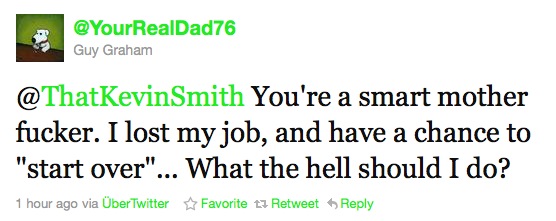
The whole Smith tweet rant began when a man in Texas sent him this simple tweet:

Smith’s response was a flurry of tweets which couldn’t be contained in a mere 140 characters. I took a moment to transcribe his tweets into a slightly easier to read narrative which you can see below. It’s great advice and well worth a few moments of your time:

Here’s the secret. Everyone always asks in regards to how I did it (whatever “it” is when asked).

It doesn’t even take TALENT to do what I did; I’m living proof of that. All you need to do is identify what you love to do and monetize that. If you like jerking off, sell your sperm or wank for porn.

If you like dogs, monetize your canine interest. Lazy motherfuckers like me will always pay someone to wash his dog(s). Some people will pay you to babysit ’em!

If it never feels like work, it’s NOT work. Life is mutable; the rigidity of working for someone else doesn’t allow for much flexibility.  So create your own ideal universe. That’s all I’ve been doing now for nearly 20 years.

I didn’t want to have to go to my relatives houses if I didn’t want to – as my parents would make me do when I lived with them. So I wanted to find a way to be able to say “I’m not going” for which I wouldn’t catch shit. Being a filmmaker seemed like an excellent excuse to not go to relatives houses if I didn’t want to.

So I got into filmmaking, and 1 day, I was able to say to my parents “I can’t go to Aunt Virginia’s this weekend; I’m making MALLRATS.”

So my parents couldn’t give me shit for not going to visit relatives with them, because I was balancing multimillion dollar budgets for movies about boys giving stink palms & seeing boobies out in Minnesota. Ta-da!

The secret to a successful life is hardly a secret; it requires you to be self-centered as all fuck, is all. So long as it’s not at the expense of others, make yourself the center of your universe. You only get to do this ONCE, so try to take as much stress out of the process as you can. Why stress out in some office wearing clothes you hate, when the REAL stress lies ahead, as we face an inescapable grave. Doubt I’m gonna go quietly into that good night, so I’ll save the stress for then.

Sadly, as far as I’ve learned, we can do NOTHING to alter death; it’s GONNA happen. But life? We can shape & change the fuck out of life!

Sometimes, the path isn’t direct. S’like folks who start movie websites: they just love movies. Not sure what their end-game’s gonna be, but writing about them & hosting trailers is a start, right?

For some, the end-game will be to make a film. For some, just having people read what they have to say about a subject they love is good enough. Regardless, the smart ones will always find a way to earn off it. Because once you’ve got a taste for working for yourself, doing what you love doing? You’ll work 10x as hard as any brick-layer or paralegal, but you’ll NEVER feel it, never recognize it. And let the cranks cat-call from the sidelines; they lack balls of any element, let alone brass.

Case in point: this isn’t a debate at all – this is just advice. It’s subjective, so it can’t be wrong. Yet I’ve seen a Tweet or two from cats who wanna debate the advice, criticize it, or mock me for it. They’re the equivalent of the pantomimed losers in the bar Baldwin told us about in GLENGARRY: “Oh yeah. I used to be a salesman. It’s a tough racket.” Tip your excuse-lubricant & scoff all you want, Slappy; must be working out for you.

Ignore the flock of Wah-Wahs, focus on what you love to do, and earn off it. And remember: once you get paid to do it, doesn’t matter whether someone thinks you’re good at it or not; opinions pay imaginary rents, kids. You get paid to do it, you’re a pro.

The work is long & will take you away from lots of other people & things. But you will never know/feel/realize it’s work – not until you look back. This Sundance marks 17 years since the CLERKS debut changed my life.

But from the moment we got our foot in the door, the workload intensified a thousand fold. And I never noticed – because I loved it so much. For 15 of those 17 years, I didn’t stop. Cranks will tell you I’ve been living off CLERKS forever, but that’s dismissive self-deception.

We got our foot in the door & I never stopped. And while the changes were imperceptible to some, each time out, we worked a little harder at developing the various muscles of storytelling. In that analogy, RedState is the most physically fit of all the stories I’ve told. It’s the sum total of nearly two decades of hard work (for which, most times, I was handsomely overcompensated, monetarily & otherwise).

And it never felt like work when we were crafting them. What made them feel like work was slugging it out with jackasses over opinion, or getting by the fear-driven gatekeepers who finance, market, or rate the stories I’ve tried to tell. Like hockey, film used to be a simple, fun game that grown-up kids loved to play. Then, someone figured out how to make a buck off it. Now it’s a business.

Rage against the darkness all you want: at the end of the day, it’s called the movie BIZ. Bitching about that fact’s akin to bitching about sharks in the ocean: if you’re stepping into the surf, you’re stepping into the food chain. Don’t be a dummy: make sure you’re in a boat.

Start with a small boat and one day, you realize you’re Cap’n Stubbing. Or in my case, Cap’n Crunch. Then you can put a dog in a sailor suit & cock-block French pirates.

It’s summed up on this dopey yoga wall hanging the wife has in the house that I only really understood this year: MAY YOU REALIZE YOUR DIVINITY IN THIS LIFETIME. That’s worth working for.

It took me 40 yrs, but I finally realized my divinity in this lifetime. Not talking “Clapton is God” or Lennon’s “We’re bigger than Jesus” when I say this: but we can each …hell, we SHOULD… each make of ourselves… a god, for lack of better expression. And I’m not talking the drag some kid into the woods and cut his heart out bullshit; I’m talking about finding for ourselves the same reverence the faithful reserve for the divine.

And what better to shoot for than mortal divinity? And not that angry god bullshit, either: if the X-Men taught me anything, God loves & man kills.


Now THAT’S well said. Smith, who you should absolutely follow on Twitter, is still tweeting out more wisdom and I’ll continue to update this post as long he does.

Are You Willing To Work As Hard As Kevin Durant?

The other day I came across an interesting blog post from an old high school basketball teammate of mine who has gone to become one of the top basketball strength and conditioning coaches in the country. His name’s Alan Stein, and he was a strength coach for NBA superstar Kevin Durant’s high school team when Durant was in high school.

A few weeks ago Stein went to Oklahoma City to visit Durant and spend a day with him to get a look at what a typical day in the life of one of the NBA’s best players is like. You can read his full description of the day here, but here’s an excerpt that caught my eye:

Kevin Durant chooses to arrive at the arena 3 hours before tip-off to begin his preparation.  His routine includes treatment from the athletic trainer, corrective exercises with the strength coach, and shooting a couple hundred shots.

KD was all business on the way to the game. He takes his mental preparation very seriously.

Once we arrived at the arena, KD spoke to every person he passed on the way to the locker room… security officers, maintenance workers, PR folks, etc.  He looked them in the eye, shook their hand, and called them by name.

We got to speak with Dwight Daub, the Thunder strength coach.  He does an outstanding job.  He gave us a quick run-down of what the players do in-season:

Players have to get in a minimum of 10 strength workouts per month.  They have the option to lift on game day. Most choose not to and prefer to lift before/after practice.

Players have to get in a minimum of 12 corrective exercise workouts per month.  These brief workouts consist of movements tailored specifically for individualized weaknesses and injury prone areas.

Players that average playing less than 15 minutes have to get in 15 minutes of intervals on the elliptical or treadmill on game days to maintain their conditioning level.  They do 15 sets of :30 on, :30 off at an appropriate intensity level.

Even though the team had a shoot around that morning at 9:00am, almost every player (from both teams) came in early to put in extra work.

Seeing NBA players work out on game day reminded me of one of my favorite quotes:

“There will be two buses leaving for tonight’s game. The 2:00pm bus will be for those who need some extra practice. The empty bus will leave at 5:00pm.”

Many young players make the mistake of thinking NBA players just play.  Nothing could be further from the truth. These guys are great players because they work on their game every day.

I’m sure at this point you’re wondering what any of this has to do with comedy.

Just like basketball, a comedy career is something that many outsiders (and some insiders) think is all about natural ability and has little to do with hard work. But the reality is that there’s lots of athletes out there with NBA-caliber talent who don’t make it in the NBA just like there’s lots of comedians out there with more talent than success in their career.

It’s easy to forget when you look at some of basketball’s most successful players or comedy’s breakout stars that most likely their own hard work played a key role in their success. It’s not just that they got the breaks. They probably made those breaks. Or at the very least, they were prepared to take advantage of those breaks.

Think about what you’re doing to achieve your career goals and compare it to what a guy like Kevin Durant does to achieve his.

Kevin Durant “takes mental preparation very seriously.” Do you?

Kevin Durant acknowledges and appreciates all the people in his organization around him. Do you?

Kevin Durant spends 12 days a month doing “corrective exercises” to improve on his individual weaknesses. Do you even know what your weaknesses are?

Do you think you work as hard as Kevin Durant at achieving your own goals? And if you don’t, why should you expect to succeed?

The 1,000 True Fans Theory

Way back in 2008,  Wired magazine co-founder (and really smart guy) Kevin Kelly laid out his 1,000 True Fans theory for artists. You can read about it in Kelly’s now legendary blog post, but the basic concept is that all an artist needs in order to make a living off their art is 1,000 true fans.

It’s likely that many of you may have heard of the 1,000 True Fan theory before, but I thought it would be worth posting because many of you probably haven’t. Here’s an excerpt from Kelly’s post:

A creator, such as an artist, musician, photographer, craftsperson, performer, animator, designer, videomaker, or author – in other words, anyone producing works of art – needs to acquire only 1,000 True Fans to make a living.

A True Fan is defined as someone who will purchase anything and everything you produce. They will drive 200 miles to see you sing. They will buy the super deluxe re-issued hi-res box set of your stuff even though they have the low-res version. They have a Google Alert set for your name. They bookmark the eBay page where your out-of-print editions show up. They come to your openings. They have you sign their copies. They buy the t-shirt, and the mug, and the hat. They can’t wait till you issue your next work. They are true fans.

Kelly later adds:

Assume conservatively that your True Fans will each spend one day’s wages per year in support of what you do. That “one-day-wage” is an average, because of course your truest fans will spend a lot more than that.  Let’s peg that per diem each True Fan spends at $100 per year. If you have 1,000 fans that sums up to $100,000 per year, which minus some modest expenses, is a living for most folks.

One thousand is a feasible number. You could count to 1,000. If you added one fan a day, it would take only three years. True Fanship is doable. Pleasing a True Fan is pleasurable, and invigorating. It rewards the artist to remain true, to focus on the unique aspects of their work, the qualities that True Fans appreciate.

The key challenge is that you have to maintain direct contact with your 1,000 True Fans. They are giving you their support directly. Maybe they come to your house concerts, or they are buying your DVDs from your website, or they order your prints from Pictopia. As much as possible you retain the full amount of their support. You also benefit from the direct feedback and love.

The technologies of connection and small-time manufacturing make this circle possible. Blogs and RSS feeds trickle out news, and upcoming appearances or new works. Web sites host galleries of your past work, archives of biographical information, and catalogs of paraphernalia. Diskmakers, Blurb, rapid prototyping shops, Myspace, Facebook, and the entire digital domain all conspire to make duplication and dissemination in small quantities fast, cheap and easy. You don’t need a million fans to justify producing something new. A mere one thousand is sufficient.

There’s a lot more great insight in Kelly’s full blog post, so I highly recommend you head over and give it a read.

Quick Clicks: How The Simpsons Got Written, LA’s Hottest Show, The Guy Behind College Humor, & More

Here’s a few things I’ve come across recently that are worth a click:

• Bill Oakley, a former writer on The Simpsons, breaks down how they used to write the show in this interesting behind-the-scenes look at the show and its writing staff.

• Yahoo has the fun story about how Erik Weiner made a viral video making fun of his one-line appearance in a Sopranos episode…and how that viral video wound up getting him a much bigger role on Boardwalk Empire.

• The LA Times profiles one of Los Angeles’ hottest comedy show, The Meltdown, and explains how it may be on its way to becoming the next Comedy Death Ray.

New York magazine has a very interesting profile of Ricky Van Veen, the guy behind College Humor. Besides being a good read, the article includes a lot of good advice for video creators including the observation that, “There’s a difference between merely funny and viral funny.”

What You Can Learn From Kanye West

Every once in a while I come across an article that’s so damn great I feel like I want to just rip it off and post the whole thing right here on this site. I won’t do that of course, but I will tell you that music industry guru Bob Lefsetz’s blog might be my new favorite thing to read online. I got hooked into reading about 50 of his daily ‘letters” last night and found them all to be really applicable to the comedy game even if they’re ostensibly about the music industry.

One in particular that I think is a must-read for comedians is this post about Kanye West. In it, Bob begins by asking, “How does an artist go from being the most hated man in America to #1?” and goes on to lay out 8 specific secrets to Kanye’s success. Here’s a taste:

4. If you’re not willing to give away something for free, you’re not willing to have a career.  If Kanye can give away free tracks, why can’t you?  It’s about your relationship with your fans.  The song doesn’t have to be on the album.  You’ve got to know where in the food chain to charge, and it’s not at every contact point.

5. Maintain contact.  You’re doing your own act.  Now, with the Internet, you don’t need permission to do it.  You can perform on YouTube, you can tweet, less is more is history.  Now you always give more, and the public decides how much it wants to graze in your neighborhood.  Fans come and go, but you can’t let it impact your art.  You’ve got to do what you want to do, not what you think the audience wants.

6. Have a personality.  If no one hates you, you’re not doing it right.

7. Don’t focus on the album release.  Your marketing’s got to go on for years.  The Doobie Brothers released a new album.  Straight to the dumper.  There was no Twitter presence, no fan engagement, just a record most fans don’t know exists and don’t want anyway.  And I only use the Doobies because they’re an ancient act, and all the ancient acts don’t know how to do it.  You don’t need a label and you don’t need an album.  You need fans, which you’ve got, and you need to know how to reach each and every one of them.  Pat Simmons should have played acoustic in someone’s house.  The band should have done live performances of classics on YouTube.  They should have gotten their fans involved.  If Paul McCartney wants to sell a new album, he’s gonna have to do it this way too.  Unless you want to be a recluse, if you want to survive in the new world, you’ve got to get yourself out there.  Don’t pooh-pooh it as marketing, it’s performing!  And isn’t that what you do!  And it can be as much about music as you want it to be.

God, I think I’m in love.

This Is What It Takes To Make $11,000 A Month From Your YouTube Videos

MyU2B Stats is a new website that’s put together a rather addictive little product for video creators and people interested in the monetization of online video. The site has developed a formula to estimate how much money various partner channels on YouTube are making through the ads YouTube sells against their content.

Now this is far from an exact science and their numbers should definitely be taken with a big grain of salt, but it is a very interesting look at what various video producers may be making from their YouTube videos and which of their individual videos are accounting for the bulk of that revenue. Here’s what MyU2B has to say about how they calculate their figures:

*The “Gross” is an estimated earning potential of a channel or video, based on the number of views, earning an average CPM of known YouTube partner channels.

Accuracy aside, here’s a look at what MyU2B estimates that comedian Jon Lajoie is currently making from the 55 videos he’s posted on his YouTube channel:

• Lajoie is earning an estimated $11,842 per month for his videos on YouTube.

• He’s doing this based on generating an average of 9.2 million views each month

• He’s attracting an estimated 37,200 new subscribers to his YouTube channel each month.

• His best moneymaking video at the moment is Show Me Your Genitals, which earns him about $1,953 per month thanks to about 1.5 million views of the video each month. That video was originally released way back in May 2008.

• Jon’s most profitable videos continue to be videos that he released years ago. Four of his five most profitable videos were released in 2009 or earlier but continue to bring in more dollars now – this is a great demonstration of the way a hit video can continue to bring in revenue on YouTube long after it goes “viral.”

The State Of The Comedy Union: December 2010

Once upon a time way back when I ran a blog called Whip It Out Comedy, I used to write the occasional State of the Web Comedy Union post. It was essentially a look at what was happening in web comedy at the time (here’s what was happening in April 2008), and I thought it might be a good idea to revive the column here on Connected Comedy.

So, here’s a look at where comedy’s been and where it’s headed at the moment:

THE BIG NEWS: People Are Paying For Comedy Content

The golden rule of the Internet used to be that nobody will pay for content. But that’s started to change – at least it’s started to change when it comes to podcasts. Quietly, a number of comedy podcasts have started to generate revenue through a combination of donations, subscription memberships, merchandise, live shows, and sponsorships.

While the exact economics of these shows are not public information, I know that podcasters Adam Carolla, Marc Maron, Kevin Smith, and Jimmy Pardo are among those who have managed to turn their podcast creations into money making businesses. And the best news is that it’s not just guys with pre-established followings who have found people willing to shell out a few bucks for them. Relative unknowns such as Red Bar Radio and Nobody Likes Onions seem to be cracking the code as well.

THE LITTLE NEWS: MySpace Comedy Relaunches

Did you know that MySpace Comedy relaunched its new comedy page the other day? Probably not. That’s because while everything MySpace does used to be big news, it’s now unfortunately become very little news. That said, despite the site’s plummeting traffic and what seems like an inevitable demise, I applaud them for at least trying to come up with something new and worth your time. I know they’ve got some writers doing original work over there and I’ll at least be interested to see how it develops.

TREND I LOVE: Comedy Clubs Embracing Social Media

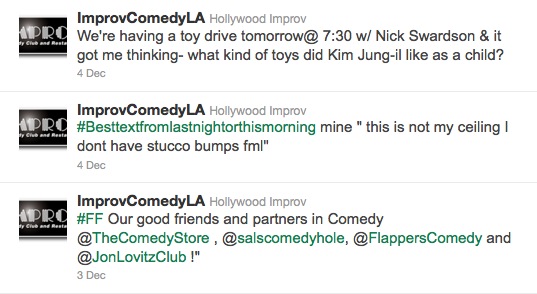
A couple weeks ago I posted an analysis of the way the Comedy Store and The Improv were using Twitter. But one thing I neglected to mention in it is how great I think it is that more comedy clubs seem to finally be embracing social media at all. For a long time they sat on the sidelines, but that seems to have changed in recent months. This is a great trend that will be good for the clubs, good for comics, and most importantly good for comedy fans and customers.

TREND I HATE: Hollywood Cockblocking Your TV

For a long time I’ve believed that it’s inevitable the the Internet and television will collide, providing unprecedented distribution possibilities and shaking up the entire Hollywood system. Well, that day still hasn’t come, but it’s knocking on the door thanks to companies like Netflix and devices like Google TV and Apple TV. The last thing standing in its way are the traditional Hollywood studios and distributors who are clearly doing everything in their power to prevent it from happening in a doomed attempt to protect their control of your TV set. The war’s coming whether they like it or not, and they’re going to lose.

DOING IT RIGHT: The Naughty Show and Ghetto Bird Social Club

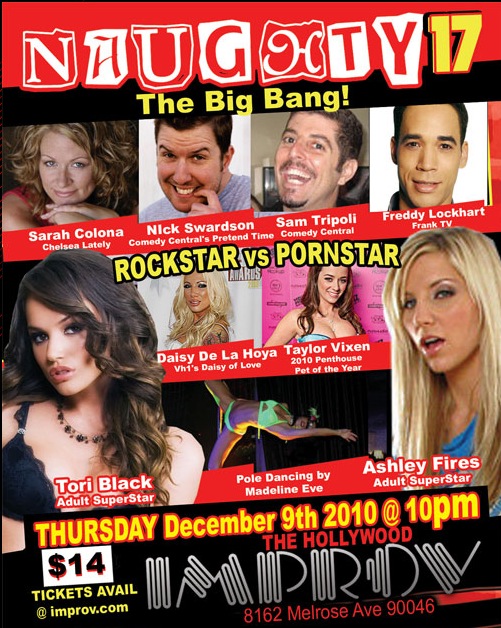
I went to two recent live comedy shows in LA that stuck out to me as examples of people that are doing things out of the ordinary and creating cool things in the process.  First, comedian Sam Tripoli has turned his monthly Naughty Comedy Show into a true “event,” featuring an absurd mix of characters, videos, stripper poles, porn stars, and stand up that’s hilarious and has built a great buzz around Hollywood. On the other end of the spectrum was the Ghetto Bird Social Club, a stand up comedy show put on in the apartment building parking lot of comedians Mike Bridenstine and Mike Holmes that featured great comics performing outside (under the sweet hum of police helicopters) in a really unique atmosphere.

DOING IT WRONG: The Laugh Factory

I love what the Laugh Factory has been doing in terms of shooting videos of the performers at its club and the idea for an 80-hour comedy marathon that’s being broadcast streaming live online right now is a great one. The only problem? Making people register and login to watch it. Sure, it only takes a second and it isn’t that big of a deal, but it just seems like an unnecessary deterrent to people that you ideally want to tune in and share your show with their friends. I’d suggest making it easier for people, not more difficult.

JUST WONDERING…

At what point are brands going to realize that traditional advertising (read: cramming bad commercials and banner ads down the throat of any audience that you can find) doesn’t work? And at what point are content creators going to realize that relying on advertising revenue to fund their projects is not a great business model? Either both sides know this and are just playing dumb because it’s easier than trying to create a new business model that provides actual value or both sides actually are just dumb. Which one do you think it is?

10 Tips To Get The Most Out Of Follow Friday On Twitter

Follow Friday has been one of the best “inventions” that the Twitter community has ever come up with. In case you don’t know, Follow Friday essentially means that users post tweets with recommendations of who they think their followers should follow and the end result is a great way for everybody to gain new followers and connect with interesting people.

But with a little help from some creative Twitter search queries, you can also use Follow Friday to identify lots of highly targeted people that you should follow and that may be interested in following you. It’s a great way to find your audience and connect with a community that you want to join.

Here’s 10 Things You Can Do To Get The Most Out Of Follow Friday:

Search: #FF Comedy

This search results in showing you a list of tweets where people are recommending comedy people that they think are worth following. If they’re doing that, the chances are that they’re either comedy fans or comedy creators.

Search: #FF Podcast

This is a great search for podcasters who may be looking for other similar podcast creators to connect with or as a way to find people who already listen to other podcasts.

Search: #FF YouTube Channel

If you’ve got a YouTube channel and want to find other people with YouTube channels to connect with, this search provides you with a great tip sheet.

Search: #FF Casting

There’s not a ton of results for this one, but the people who do show up in a Follow Friday casting search are definitely worth following if you’re looking to line up some auditions.

Search: #FF Comedian

If you’re looking to connect with other stand up comedians, then this is a good search for you because it’s much more specific than the generic comedy search.

Search: #FF Funny Blog

This will likely tip you off to a lot of people who run funny blogs and those are great people to have a relationship with for the next time you’ve got a piece of content you want to promote.

Search: “Who Should I Follow”

This one isn’t just Follow Friday specific, but it seems to be a little more active on Fridays. This is a great search because it gives you a list of people who are actively looking for recommendations about who they should follow on Twitter. It’s the perfect opening to introduce yourself to them.

Search: “Need A Laugh”

Similar to above, this one isn’t just Follow Friday specific and it provides a list of people who are asking for somebody to send them something funny. You might as well be that somebody.

Search For Somebody Else’s Audience

Do you think that Patton Oswalt’s fans would be likely to enjoy what you do? Then search for #FF PattonOswalt and you’ll be able to find a list of his fans that are showing their love for him. Is Dane Cook’s fanbase your target demo? Then a #FF DaneCook search should do the trick.

Don’t Forget About Word Variations

Not everybody uses #FF as their Follow Friday tag. Some people use #FollowFriday or just #Follow. With any of the above searches, don’t forget to also search the different variations of the words.

Did you like this post?  If so, why not give my Twitter a little #FF love?