Everywhere you look these days somebody’s asking you to follow them on social media. But very few of those people bother to explain why you should follow them and what you will get out of giving them your attention. That’s a mistake and one you shouldn’t make.
If you’re going to ask people to follow you, then you should be able to explain to those people what’s in it for them.
I know what’s in it for you if they follow you – more views, more traffic, more attention – but I think it’s worth you taking a moment to think about what’s in it for them.
If I follow you, what do I get out of it? Will I get valuable information? Will I get a laugh a day? Will I get something that I can’t get anywhere else?
Have you even given any thought to why somebody should follow you?
Once you’ve figured it out, you should probably share that with the people you ask to follow you because the clearer the value somebody gets from taking an action, the more likely they are to take that action.
(NOTE: I’d love to hear why you think people should follow you on Twitter or Facebook. Feel free to leave a comment with your reason.)
It seems like every comedian I speak to is unhappy with their website. Either, they don’t have an “official” site at all because they can’t afford to get one built, or their “web guy” has been working on building their site for a year, or their site is impossible for them to update on their own so it still features that big coffee house gig they had scheduled back in 2007.
But the reality is that even with little to no budget, you are able to have a decent looking and functional personal website. Here’s five easy ways you can do it:
Use An About.Me Page
About.me describes itself as a “custom splash page and personal analytics dashboard,” which is really just a fancy and intimidating way of saying it’s a free template that lets you create a one page site about yourself. It’s super easy to use – just upload a picture and fill in your relevant information – and you’ll have a professional looking site up in no time.
But what’s really great about About.me is that it incorporates icons for your Twitter, Facebook, YouTube, blog, and whatever other accounts you may have where you’re creating content. So with a click of a button, people can see in a pop-up window whatever you’re posting on those sites. Plus, About.me also provides you with statistics about how many people are visiting your site for those of you that care.
(NOTE: About.me is so new that it’s in private beta right now so you have to apply for an account, but you’ll likely get one within a couple weeks.)
Redirect Your Personal Website Domain To Facebook
Here’s a simple way to give yourself a better website – let Facebook build it for you. Assuming you’ve bought your own domain name, just redirect that domain to point to your Facebook page. For no cost, it allows you to use all of Facebook’s tools and lets people connect with you easily while still getting the benefits of being able to just tell people to go to YourName.com to find you. You could also do the same thing with your YouTube channel, Tumblr, WordPress, or Blogger blog depending on your needs.
Find A Designer On 99 Designs
If you’ve got a little bit of cash to spend, I highly recommend going to 99 Designs to find somebody to build you a custom website. 99 Designs describes itself as “crowdsourced creative design,” which basically means that they have a community of designers who regularly compete to get your business. On their web design page, they explain that for $499 you can get lots of different professional designers offering their services based on your specific requests. You simply view all the samples you get and then choose the person that you best suits your taste.
Don’t Have A Website, Have A Newsletter
Depending on what your goals are, you may not necessarily need a full website. You might be better served with a newsletter that allows you to capture people’s email addresses and update them whenever you have something you want to promote. There’s several ways to run a newsletter, but one extremely simple one I’ve come across recently is called Tiny Letter.
For zero cost, you can set up your own newsletter through Tiny Letter to get you started.
NOTE: This article was written in 2011. A lot has changed since then, but the underlying principles remain true.
When people ask me how they should “do” social media, I usually tell them to think about the people they follow on social media and why they follow them. It can be especially helpful to look at two people or companies with similar goals and see how each of them try to accomplish those goals using social media. Inevitably, you can learn as much from somebody who’s doing a great job with social media as you can learn from somebody that’s not.
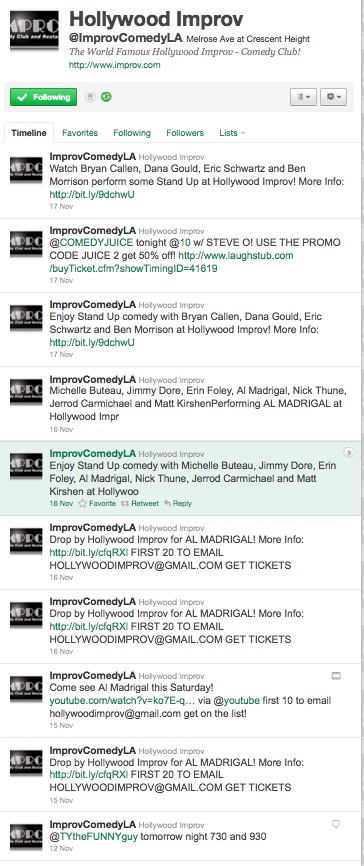
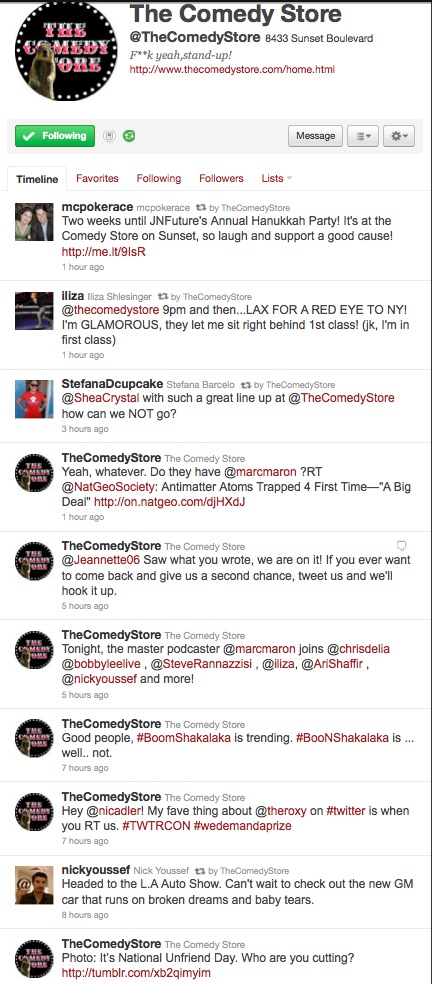
To illustrate my point, I thought I’d share with you a look at how two Los Angeles comedy clubs – The Comedy Store and The Hollywood Improv – are using Twitter at the moment. They both have the same basic goal of getting people to come to their clubs and see shows, but as you’ll see their approach to Twitter is completely different.
Here’s a look at the last 10 tweets from The Improv:
And here’s a look at the last 10 tweets from The Comedy Store:
Which one would you rather follow?
I’m guessing the choice is pretty clearly The Comedy Store (sorry, Improv – I still love you too). Here’s a few reasons why:
• The Comedy Store tweets about more than just itself. Five out of the 10 Comedy Store tweets are actually retweets of other people and comics’ tweets. Even if they’re about the Comedy Store, there’s a feeling of a community and that they’re not just talking at you, they’re talking with you. By comparison, none of the Improv’s tweets were from anybody but themselves.
• The Comedy Store gives me something, the Improv just asks me for something. Two of the Comedy Store’s tweets are links to things I may find interesting that have nothing to do with their shows. They’re giving me “content” that I might like and I’m getting something out of following them besides just show updates and requests for me to buy tickets. On the flipside, every single Improv tweet is about one of their shows and asking me to go to them.
• The Comedy Store keeps it fresh, The Improv says the same thing over and over again. If you look at the Improv’s tweets, you’ll notice that in their last 10 tweets four of them are the exact same. And three more of them are also the same. That means that basically 50% of their last 10 tweets are just repeats of things they’ve already told me. Not only is that boring, it’s probably pretty annoying.
So why should you care?
Even if you don’t run a comedy club, you can probably look at the differences between how these two clubs are using Twitter and think about what you’re doing with your own tweets. Do you tweet more like The Comedy Store or The Improv? And which would you rather be? Just something to think about next time you’re crafting your 140 character bits of hilarity…
Twitter’s trending topics are always a great snapshot of what people are obsessing over online at the moment, but if you look at them in a slightly different way you can see that they’re actually about much more than that. In fact, you’ll notice that there are some very specific things that trending topics on Twitter tend to have in common and those things are actually the very same things that can help any kind of content (even outside of the Twitter universe) go viral.
For the past couple weeks, I’ve been paying attention to what’s been trending on Twitter and noticed five specific traits that a lot of the trending topics during this time had in common. These traits are worth keeping in mind as you create any kind of content that you hope will have the potential to go viral. Here they are:
Holidays Are Viral
Around Halloween, there were multiple trending topics on Twitter related to the holiday including #HappyHalloween and #GhettoHalloweenTreats. It shouldn’t really come as a surprise that any holiday-related content around that specific holiday has a good chance of going viral and this is nothing new – back in the days when MySpace ruled the world I used to regularly get videos featured on the front page that were holiday-related. Editors of websites and blogs will inevitably be looking for holiday themed content on those days, so you might as well give them what they’re looking for and reap the rewards.
One other note: in general I think that the more you can put a clever/obscure twist on the holiday, the more success you’re likely to have. #GhettoHalloweenTreats seems a lot more fun than just the simple #HappyHalloween.
“I” Am Viral
This might be the most important thing to remember about viral content – people love the opportunity to express what they believe about something. The more something is about “me,” and the less it’s about “you,” the more likely it is to go viral. I would guess that more than 50% of the trending topics on Twitter start with “I” and this past couple weeks was no exception.
In the past couple weeks, trending topics included: #IShouldHaveKnown, #IFeelLike, #ImOneOfThosePeople, #ILive4, and #ICantLiveWithout among others. All of these went viral in part because they gave people the opportunity to talk about themselves and that’s something people LOVE to do.
Opinions Are Viral
The only thing people like sharing more than stuff about themselves is probably their opinions. Opinionated content is always more viral than non-opinionated content and sure enough the same is true when you look at Twitter trending topics. Some of the hottest topics on Twitter the past couple weeks were #ThingsThatPissMeOff, #ThingsThatGrindMyGears, and #WeCantBeFriends – all of which are about people expressing their opinions about things.
If your own content includes a strong opinion about something it’s way more likely to be shared by people who agree with your opinion and want to express that agreement by sharing your content with other people. Ironically, they’re also likely to share it if they strongly disagree with your opinion because sharing it gives them a chance to express their disagreement. Even if they share it and say “This guy’s an idiot and here’s why…,” they’re still sharing it and you’re still getting more exposure for your content.
Pop Culture Is Viral
It should come as no surprise that people love pop culture and celebrities so it also shouldn’t be surprising that content related to those things tends to be viral as well. For example, #MoviesInMyPants, #BandNamesInMovieTitles, and #CelebsWhoMightBeDead all were trending on Twitter recently because they gave pop culture lovers a chance to show off some of their knowledge about movies, bands, and celebs in a fun way.
Nostalgia Is Viral
One of the other lessons I’ve learned over the years that’s reflected in Twitter’s trending topics as well is that people love to share things that are nostalgic. Recent trending topics such as #TweetYour16YearOldSelf and #ThingsWomenDontDoAnyMore probably went viral in part because they allowed people to reminisce about the good old days.
People love nostalgia and they like to share videos and content that reminds them (and their friends) of things they used to do or love. For example, look at how many people are sharing stuff on Twitter right now and saying “Remember this?” about it.
I recently came across this video on the Writer’s Guild of America’s YouTube channel and even though it’s speaking primarily to screenwriters, I think the discussion is equally relevant to all content creators. The video features highlights from an all-day seminar hosted by the WGAW Publicity and Marketing Committee with the goal of providing writers with tools to help them get online, promote their careers, raise their industry profiles, build their brands and distribute and monetize their work.
Panelists included WGAW Board member Aaron Mendelsohn (Virtual Artists), screenwriter John August (Charlie and the Chocolate Factory), new media producer Doug Cheney (Big Fantastic), writer Jeff Zedlar, web site producer Michael Berman (TheBerminator.com), Google’s Sunil Daluvoy, Facebook’s Matt Jacobson, WGAW New Media Project Manager Tamara Krinsky, YouTube’s Danielle Uhlarik, writer Peter Hyoguchi (Strike.TV), The Bannen Way’s Bailey Williams and Mark Gantt, Blip.tv’s Rafi Mamalian and agent David Tochterman (Innovative Artists).
Today’s NewTeeVee Live conference in San Francisco brought together a lot of people on the front lines of the rapidly changing face of television and Internet content and I thought it would be worth sharing a couple highlights from the conference.
How To Turn Viewers Into Fans, And Fans Into Dollars
The CEO of Blip.tv, Mike Hudack, spoke about how his company helps web content creators build businesses for themselves and what he’s learned about what works and what doesn’t. Here’s an excerpt:
“We have people making half a million dollars or more a year with an independent web show,” said Hudack. “It’s much easier now to get out there and make a show yourself,” he noted, but you need distribution, marketing, ad sales and other services to make it profitable. His favorite tool that Blip.tv offers is what’s called “the engagement curve.” An average episode on Blip.tv is 16 minutes long, he said. Over the course of those 16 minutes, “We watch second by second where people drop off,” he said. “You can see what people didn’t like,” and what snippets they wanted to watch again. “Every episode, you have constant continual improvement,” which leads to more engagement and more fans, he said.
A sizable and loyal audience is of course essential for monetizing video shows, said Hudack. “To have a sustainable show these days, you certainly need hundreds of thousands of viewers,” he said, adding that the ones that are “really making a lot of money” typically have millions of viewers. One key for building an audience is branding, and on that front, web show producers should take a cue from Law & Order (dun-dun) — devising instantly recognizable intro that’s 5-6 seconds long saying “this is what you’re watching.”
And here’s video of the full presentation:
Behind The Live Stream Boom
Executives from the leading live streaming platforms including Ustream, Justin.tv, Livestream, and YouTube got together for a panel to discuss the booming growth in the space recently which has seen a 600% increase in the amount of video watched online compared to last year.
Here’s video of the panel discussion:
The Social Innovation of Glee!
Hardie Tankersley, FOX’s VP of Innovation, spoke about the various ways the network has used Twitter to promote its hit show Glee!.
Many of you have probably never heard of Keenan Cahill, but the chances are good that somebody has sent you one of his videos to watch at some point in the past couple years. That’s because Cahill, aka BeenerKeeKee19952 on YouTube, has gotten more than 66 million views of the videos he’s posted on his channel since October 2009.
Cahill is a 15-year-old YouTube star, whose videos primarily consist of him either lip-syncing or actually singing along to popular songs from the webcam in his bedroom in Chicago. He’s gotten so much traction and built such a following for himself that he recently was booked as a guest on Chelsea Lately where he debuted his newest video – a video that happens to include a cameo from none other than 50 Cent.
So how did this kid do it? Well, for starters he actually created something and put it out there – something that so many comedians who claim to be trying to build a career don’t ever seem to actually do. Sure, his videos are simple, but he’s unique and they struck a chord with an audience.
But that’s not the only secret to Cahill’s success. In a recent interview, Cahill explains some of what he’s learned over the course of the past couple years. Here’s an excerpt:
What’s the key to making a viral video?
I would say just be funny with it, something totally unexpected, something nobody else would ever think of. What I do is, I pick a funny song, something that’s popular, and it’s funny for a guy to do a really upbeat girl song.
Here’s another interview with Cahill from a Chicago radio show where he talks a little more about his story:
And finally, for a little more inspiration here’s Keenan performing “Live Your Life”:
In 5 Free Tips, I provide some advice specifically tailored to one person’s content. If you’d like me to give you 5 Free Tips, please send me an email and tell me a little about yourself.
Today’s free tips are for stand up comedian Arbel Kodesh, who sent me the following email:
Hi Josh,
My name is Arbel Kodesh. I’m a 21 year old stand up comedian currently living in Palo Alto California. I read your “5 Free Tips” and was wondering if you could help me out. I’ve been doing stand up for about a year and enjoy it a lot. I try to take advantage of every opportunity I get to perform but I still don’t feel like that’s enough. I really want to get a lot of people to see my material and what I’m about, and I don’t feel that performing once a week (normally in front of a lot of other comedians) is the way to get a following or get my name out.
I checked out Arbel’s work and came up with the following 5 Free Tips for him:
TIP #1: Pay Attention To Video Titles
If you’re looking to get more views of your videos, one simple thing you can do is title them in a way that will attract some views from people searching YouTube for similar stuff. For example, the videos on your channel are titled things like “Arbel on Celebrities,” and “Arbel on Coca Cola.” But it’s doubtful that anybody’s searching YouTube for “Arbel on…” anything because not many people know you yet.
I’d suggest instead titling the videos to include relevant words that people do search for. For example, your “Arbel on Celebrities” video includes a bit about the singer Pitbull who lots of people search for and those people will be most likely to “get” your joke. So titling your video something like “How Pitbull Records His Songs” might get you some extra views because it will show up as a related video when people are watching other Pitbull videos and the more interesting title might catch their eye and get you some easy clicks.
One more quick note about this. I would still include your name in the title, but you can put it after the headline. So the Pitbull video title would be, “How Pitbull Records His Songs – Arbel Kodesh.” I’d put your name after a hypen at the end of all of your videos because that will help them show up as related.
TIP #2: Start A Blog
You mentioned wanting to get your name out to more people and I’d highly recommend starting a blog of some sort. Whether you’re writing funny stuff on the blog, or even just sharing funny videos or links to interesting things you find, having a blog is a very easy way to give people a reason to start connecting with you. Making videos takes time and effort, but blogging can be much quicker and it starts to give people a reason to check out your site every day. They get in the habit of that, which comes in handy when you do have a new video or show you want to promote.
One more quick note about blogging: In general, I’d recommend posting stuff that will be of value to other people. Having a blog and just promoting your own stuff all the time is rarely compelling to readers so it’s much more effective if you’re sharing stuff that has real entertainment value to them. If you establish yourself as a source for funny or interesting content, people will definitely come back to see more.
TIP #3: Contribute To Other Sites
One of the most common traps I see comics fall into is that the content they create winds up only being seen by the same people that already follow them and as a result they’re never really adding new fans or growing their audience. One of the best ways to break out of this is to contribute to other sites or channels.
Don’t be afraid to do a guest post or video for somebody else and think of it as a way to introduce yourself to a new audience. And of course, the bigger the site, the more new fans you may be able to attract.
TIP #4: Post Things On Facebook That People Will Share
It’s great that you’ve got a Facebook fan page and it’s nice to see you’ve already got some good interaction on it. Just like with blogging, you can grow your Facbeook page by sharing valuable or entertaining content that people are going to want to share with their friends. All too often people think that the only stuff they should post on their Facebook page is their own creations and that’s just not true.
There’s nothing wrong with sharing a hilarious cat video that you’ve found online even if it has nothing specifically to do with you. As long as it’s entertaining, what will happen is your Facebook followers will share it with their friends and when they do those friends will see it as being shared “via Arbel Kodesh” which introduces you to a whole new audience.
Your goal on Facebook should be to post as much “shareable” content as possible, because the more people share what you post, the more people are introduced to your page, and the more people are likely to then follow you themselves.
TIP #5: Subscribe and Comment On Other YouTube Channels
YouTube is definitely a community and if you want to get more people subscribing and commenting on your videos, then you need to make yourself a part of that community. Right now, you’re not subscribed to any YouTube channels and I doubt that you comment on many videos. But think about this: Every time you comment on a video or subscribe to somebody’s channel, a link to your channel gets on their radar. It’s really free promotion for your channel.
In general, you’ll find that the more you become a part of the YouTube community, the more attention that community will pay to your own creations.
I hope this helps Arbel, and if anybody else would like to get 5 Free Tips, please let me know.
I had a conversation with a stand up comedian recently who was frustrated at his lack of bookings. He bemoaned the lack of paid gigs out there and how difficult it is to get bookers to pay attention and give him a chance.
When I asked what his ultimate career goal was he replied that he’d like to have a career like another comedian (whose name I won’t mention), who headlines clubs around the country and probably makes about $2,000 per weekend booking.
The comic I was speaking with didn’t see how he was ever going to get to that point without bookers giving him a shot first. But I see it differently.
If his goal is to make $2,000 a weekend performing stand up in front of a couple hundred people, then he’s focused on the wrong way to get there. He’s putting all of his time and effort into catching the attention of bookers and hoping they’ll give him permission to have the career he wants to have. But he doesn’t need their permission.
To make $2,000 a weekend performing stand up, all you need to do is figure out how you can convince 200 people to spend $10 to see you perform. That’s not easy, but it’s not impossible. And more importantly, it’s a goal that’s completely in his control as opposed to a goal that somebody else has to allow him to accomplish.
I told this comedian that instead of waiting around for some booker to magically decide he’s worthy of their comedy club, he should put his efforts into something he can control — figuring out how to sell 200 tickets to his own shows.
And the irony is that if he can actually do that, he won’t need the booker or the comedy club. They’ll need him.
Here’s a few things I’ve come across recently that are worth clicking:
• Techipedia examines 7 Traits of Highly Effective Viral Videos. Spoiler Alert: If your video is identifiable, spontaneous, genuine, funny, informational, creative, and inspiring then it’s going to get a hell of a lot of views.
• Here’s an interesting discussion about what metric should matter most on YouTube: Views or subscribers?
• Deadline Hollywood’s Nikki Finke declared that Saturday Night Live has sucked so far this season, setting off 150+ comments from her readers about the state of the show. It’s a fun look at what Hollywood insiders (or at least wannabe Hollywood insiders) think about the show.
• In the wake of Comedy Central’s Rally for Sanity, Fark’s Drew Curtis rips Comedy Central and Jon Stewart for not being appreciative enough of the Internet and specifically Reddit’s role in the event’s success.
• YouTube star Phil DeFranco talks about some of what he’s learned in the course of racking up 439 million views for his videos.